Author: Catholic Candle
Lesson #30 – Contemplation on the Attainment of Divine Love
Mary’s School of Sanctity
Lesson #30 The Spiritual Exercises of St. Ignatius –—FOURTH WEEK –CONTEMPLATION ON THE ATTAINMENT OF DIVINE LOVE
This meditation is the final one that St. Ignatius gives in his Spiritual Exercises. One could almost see this meditation as the grand finale. So much could be said about the concepts that he gave us for this meditation. We will give some considerations after sharing what St. Ignatius set forth.
Initially, St. Ignatius gives two points to be noted. The first point is that love ought to be manifested in deeds rather than in words.
The second point is that love consists in a mutual interchange by the two parties, that is to say, that the lover give to and share with the beloved all that he has or can attain, and that the beloved act toward the lover in like manner. Thus, if he has knowledge, he shares it with the one who does not have it. In like manner they share honors, riches, and all things.
The preparatory prayer is the same as usual, I ask God Our Lord the grace that all my intentions, actions, and works may be directed purely to the service and praise of the Divine Majesty.
The FIRST PRELUDE is the mental representation of the place. Here it is to see how I stand in the presence of God Our Lord and of the angels and saints, who intercede for me.
The SECOND PRELUDE is to ask for what I desire. Here it will be to ask for a deep knowledge of the many blessings I have received, that I may be filled with gratitude for them, and in all things love and serve the Divine Majesty.
The FIRST POINT is to call to mind the benefits that I have received from creation, redemption, and the particular gifts I have received. I will ponder with great affection how much God Our Lord has done for me, and how many of His graces He has given me. I will likewise consider how much the same Lord wishes to give Himself to me in so far as He can, according to His divine decrees. I will then reflect within myself, and consider that I, for my part, with great reason and justice, should offer and give to His Divine Majesty, all that I possess, and myself with it, as one who makes an offering with deep affection, saying:
Take, O Lord, and receive all my liberty, my memory, my understanding, and my entire will. All that I have and possess Thou hast given me. To Thee, O Lord, I return it. All is Thine; dispose of it according to Thy Will. Give me Thy love and Thy grace, for this is enough for me.
The SECOND POINT is to consider how God dwells in His creatures: in the elements, giving them being; in the plants, giving them life; in the animals, giving them sensation; in men giving them understanding. So, He dwells in me, giving me being, life, sensation, and intelligence, and making a temple of me, since He created me to the likeness and image of His Divine Majesty. Then I will reflect upon myself in the manner stated in the first point, or in any other way that may seem more beneficial.
The same procedure should be observed in each of the points that follow.
The THIRD POINT is to consider how God works and labors for me in all created things on the face of the earth, that is, He conducts Himself as one Who labors; in the heavens, the elements, plants, fruits, flocks, etc. He gives them being, preserves them, grants them growth, sensation, etc. Then I will reflect on myself.
The FOURTH POINT is to consider how all blessings and gifts descend from above. My limited power, for example, comes from the supreme and infinite power from above. In like manner justice, goodness, pity, mercy, etc. descend from above just as the rays from the sun, the waters from the spring, etc. Then I will reflect upon myself, as explained above, and conclude with a colloquy and the “Our Father.”
We now will share what Fr. Hurter gives to us about the above four points in what he calls four motives, or reasons for loving God, and then we’ll add a brief note for each one.
The First Motive for Loving God
God is our greatest benefactor. Love shows itself by benefactions. God simply overwhelmed us with benefits. Think but of the gifts of nature: body and soul, health and the use of the senses, food and clothing, beloved parents and benefactors, general and special benefits. All this we owe to God, and these benefits He has conferred on us daily and hourly for many years. We are but a composition of benefits. “What hast thou that thou hast not received?” (I Corinthians., 4:7)
We come now to the still more precious gifts of the supernatural order, the order of graces: our redemption by the sufferings and death of the Son of God, our creation into this world after the coming of Our Lord. Recall all the gifts of faith, of the true Church, of the sacraments; that the Lord, by sanctifying grace, has made us His adopted children, that He is so near to us by His Sacred Body in Holy Communion, the repeated remission of our sins, the many means of graces which accompanied us from the day of our birth to this day:[1] so that in gratitude we must acknowledge: “He hath not done in like manner to every nation, and His judgments He hath not made manifest to them.” (Ps. 147:20) To thousands and thousands he has not been as generous as He has been to us.
Let us cast a glance into the hereafter, on the blessings of heaven. What is the Lord in His goodness not willing to give? Himself in all His glory. “I am thy reward exceeding great.” (Gen. 15:5)
If giving presents is a proof of love, and the Lord has showered benefits down upon us poor human beings, how He must love us! “What shall I render to the Lord, for all the things that He hath rendered to me?” (Ps. 115: 12) If beggars for a few cents love their benefactors, how shall we requite God’s love for us? What love then do we owe to God? But love must show itself in deeds. What can we give to the Lord? All that we have belongs to Him. But the Lord is so good that He takes His own benefits as presents if we but offer them as a sacrifice. Therefore, we shall confirm our love for the Lord by an act of consecration. We must say with a grateful, willing and cheerful heart: “Take, O Lord, and receive my entire liberty, my memory, my understanding, and my whole will. All that I am and have Thou hast given me, and I give it back again to Thee, to be disposed of according to Thy good pleasure. Give me only Thy love and Thy grace; with these I am rich enough and ask no more.”[2]
Additional note about the First Motive
Yes, indeed, we need nothing more than God. He must be for us our all and everything. From the very first meditation in the Spiritual Exercises, we have been taught by St. Ignatius that God must be our number one priority and our highest love. In this first motive for loving God, we are really addressing the most important reasons that we owe God gratitude and love. What could be more important than the gift of the Catholic Faith and all that comes with the Faith? We cannot thank God enough for it. Seeing how precious the gift of Faith is, and how vulnerable we are in that we are incapable of keeping the Faith without God’s help, helps us to be more grateful to God. With gratitude comes humility and love.
Fr. Hurter continues:
The Second Motive for Loving God
God in His love for us wants to be near us always. Love shows itself in this: that it is fond of being with the person it loves. Lovers like to see each other. How does God answer this demand? He is everywhere near us, distributing favors in the whole of nature. In this eagerness to be still nearer to us, the son of God came down from heaven to visit us in our homes: “And the Word was made flesh and dwelt among us.” (John 1:14) To perpetuate this visit, He instituted the most holy Sacrament of the Altar, to be wherever even a few Christians assemble. There He is day and night in the midst of them; and He rather waits for us there, that we should have to wait for His coming and visit. If we cannot come to Him, He has Himself brought to us, even if our dwelling be ever so poor, a mere hut, a stable, a prison. The Holy Ghost makes us His temple, in which He desires to dwell. “Know you not,” writes St. Paul, “that you are the temple of God, and that the Spirit of God dwelleth in you?” (I Cor. 3:16) Furthermore, Our Divine Savior in His love for us wants us to be with Him forever. “Father, I will that where I am, they also whom Thou hast given Me may be with Me.” (John 17:14) To Him, therefore, the words apply: “My delights were to be with the children of men.” (Prov. 8:31)
Such love, such condescension, calls for a return, and since a lover is fond of being near the person he loves, we will show our love of God by being with Him in thought, as a child away from home often thinks of its dear parents, and by visits which we can easily make to the Blessed Sacrament.[3] We should be glad to converse with Him all the more because it is an honor that God deigns to associate with us poor creatures, and because these visits are always so rich in graces.[4]
Additional note about the Second Motive
Our Lord referred to Himself as the heavenly Bridegroom. This is the most intimate friendship He could give to humans. How loving of Him to want to be so close to us! St. Thomas Aquinas explains to us that Goodness is self-diffusive. We see this is so true especially when we consider the plan of God to dwell physically among us. He gives Himself to us in a beautiful divine friendship. Even when the Mystical Body has suffered persecutions in history, Our Lord always sustained His Flock. For He said, “I will not leave you orphans, I will come to you…In that day you shall know, that I am in My Father, and you in Me, and I in you.” (John 14:18 & 20) What a wonderful truth to know that the Trinity wills to dwell in us!
Fr. Hurter continues:
The Third Motive for Loving God
Love is strengthened not only by presents and visits but especially by deeds when it is active and generous in favor of the one beloved. Thus, a mother’s love for her child shows itself not so much when she gives it fine clothes as when she works and stints herself for it, spends many a sleepless night at its bedside to nurse it in its sickness, and denies herself in many ways that she may take care of her child; when from early morning to late at night she suffers and makes sacrifices for its welfare. So, too, does God show His love for us by being active for, in and about us. He is everywhere active in nature for our benefit. He gives growth and ripening to plants for our sustenance. He lights the sun to give us light and heat. He preserves, governs, and directs the universe, that it may be at our service. Yes, the Son of God went still further for our sake. He worked for us, bore painful sacrifices for us, even suffered to save us.
St. Bernard writes:
My reparation after the fall was not as my creation. He spoke and the universe was created. (Ps. 148:5) But He Who by a single word created me, has said much, done wonderful things, suffered severely, not only severely, but even what humiliated Him, to bring about my reparation. ‘What shall I render to the Lord for all the things that He hath rendered to me?’ (Ps. 115:12) In creation He made a present of me to myself, in redemption He gave Himself up for me, and thereby gave me back to myself. Hence by creation and redemption I owe myself for myself. What then shall I give to God for Himself? Were I to make a sacrifice of myself a thousand times, what am I compared with God?
I must therefore show and confirm my love by working, making sacrifices, and suffering for God. “Therefore, whether you eat or drink, or whatsoever you do, do all to the glory of God.” (I Cor. 10:31)[5]
Additional note about the Third Motive
What more could Our Lord have done for us than He did? He suffered and died for us. Even more importantly, He showed us by the cruel suffering and insults He endured how much He loved His heavenly Father. At the same time, He showed how malicious sin is and how we should rather die than to offend God. In very fact, He showed us how to love the Father. We ought to imitate Him for He is always Our Model of perfect love.
Fr. Hurter continues:
The Fourth Motive for Loving God
The amiability of God. That this glorious and exalted motive may enkindle in us a fervent love, let us consider how often a mere shadow of beauty, a drop of perfection found in creatures, draws our heart, charms and enraptures us. What love, then, will the infinite beauty of God, the fountain of all perfection, enkindle in us? If, therefore, creatures approach you with their beauty and loveableness to draw you to themselves, to fetter and imprison you, cry out to them: “I would be a fool were I to run after a drop and give myself to a shadow, when I can have the sum-total of all beauty and glory. No, I will give my heart to the Infinite Being, Who alone can make me perfectly happy.”
Creatures with their beauty shall be to me as a guide directing me and telling me to “Love God!” To Him my whole heart shall belong. And therefore, creatures are so beautiful that they may remind me “how much the Lord to them is more beautiful than they, for the first author of beauty made all those things.” (Wis. 13:3)
Rightly does St. Augustine say: “Heaven and earth and all that is in the universe cry out to me from all directions that I, O God, must love Thee. And they do not cease to cry out to all, so that they have no excuse.”
And if I furthermore consider that this infinitely beautiful, exalted, and perfect Being is mindful of me, and watches over me, and loves me, although He has no need of me whatever; that He wants my love and longs for it, and rejoices when I love Him—how we must consider ourselves pressed to comply with His wish, and dazzled with His beauty and loveableness, be entirely consumed in His love, love Him with our whole heart, and with our whole soul, and with our whole mind, and with our whole strength, as He commanded us to do. (Mark 12:30)
Let us ask Our Lord by His precious Blood for such a love; and let it be the most beautiful fruit of these spiritual exercises. Let us willingly repeat the beautiful petition of St. Augustine: “That I may know myself and know Thee, that I may love Thee and despise myself.”[6]
Additional note about the Fourth Motive
There is nothing higher than God. We learn in our Catechism that He is the Supreme Being. He has all perfections. If we ponder His attributes, which we humans can only do one at a time, we soon grow in admiration of Him. We are overawed by His immense qualities. We were naturally made to love God. If we follow our nature as we ought, our hearts desire God and are attracted to Him. As St. Augustine said, “Our hearts were made for Thee O Lord and are restless until they rest in Thee.” Since He is our final end, we can never be truly satisfied until we possess God completely. Our natural inclination is to soar up to God. These thoughts lead us to our colloquy.
Colloquy: O Infinite and Divine Majesty, how can I, a poor creature, ever thank Thee enough for all the many blessings Thou hast showered upon me? Thou hast created me rational and with an immortal soul. Would that I could even appreciate these two aspects alone! But in addition to these priceless gifts, Thou hast given me Thy Divine Son to be my soul’s Spouse and intimate Friend. This is the utmost treasure that any human could want! But alas, I am such a poor wretch who has not been grateful as I ought. I beg Thee, Dear Trinity, to help me study Thee and all Thy truths so I can learn to appreciate Thee and grow in an ever-deeper love of Thee. Help me to remain ever faithful to Thee so my soul can be Thy bride in time and in eternity. (I will end my colloquy with an Our Father.)
In our next lesson we will address St. Ignatius’s method for making a choice and his recommendations on penance.
[1] In this time of the great apostasy when the majority of uncompromising Catholics have no priests and sacraments, we must not think that God is not still taking care of our spiritual needs. He has made our prayers more efficacious including our spiritual communions and rosaries, precisely because we are refraining from participating in compromise Masses and Sacraments.
We should also keep in mind that even if we do not have the sacramental confession available without compromise that we must practice perfect acts of contrition. Furthermore, by using indulgenced prayers and sacramentals such as our rosary beads, and Signs of the Cross, we can remit our venial sins. Our Lord indeed does not leave us orphans, especially when we are sacrificing and avoiding compromise out of love for Him!
[2] Considerations from Sketches for the Exercises of An Eight Days’ Retreat, by Hugo Hurter, S.J., Ph.D., D.D., Professor Emeritus of Theology in the Catholic University of Innsbruck, copyright 1918; third edition, 1926, St. Louis, MO and London, Page 269-271.
[3] Again, because the majority of uncompromising Catholics living in these times of the great apostasy do not have access to the Tridentine Mass and sacraments and the Blessed Sacrament, we should endeavor to make many spiritual communions and meditate on the Trinity dwelling in our souls, especially through His Divine grace. We should speak to God in our souls and pour out our hearts to Him with love and gratitude.
[4] Considerations from Sketches for the Exercises of An Eight Days’ Retreat, by Hugo Hurter, S.J., Ph.D., D.D., Professor Emeritus of Theology in the Catholic University of Innsbruck, copyright 1918; third edition, 1926, St. Louis, MO and London, Page 269-271.
[5] Considerations from Sketches for the Exercises of An Eight Days’ Retreat, by Hugo Hurter, S.J., Ph.D., D.D., Professor Emeritus of Theology in the Catholic University of Innsbruck, copyright 1918; third edition, 1926, St. Louis, MO and London, Page 272-273.
[6] Considerations from Sketches for the Exercises of An Eight Days’ Retreat, by Hugo Hurter, S.J., Ph.D., D.D., Professor Emeritus of Theology in the Catholic University of Innsbruck, copyright 1918; third edition, 1926, St. Louis, MO and London, Page 274-275.
Glacier-Melting Alarmism
Let us consider what is sometimes called the “deep state”. The federal government has a small number of political appointees at the top of the various departments of the federal government. These “bosses” are usually replaced when a new president takes office.
But underneath those bosses are a myriad of “career employees” who are supposedly non-political and who cannot be fired when the political administrations are changed. Most of those career employees are liberals/leftists (of one sort or another) and they cannot be replaced even when a more conservative governor or president takes office.
In about the 1960s, leftist leaders declared publicly that they would fill the federal bureaucracies with leftists who could not be fired because they were not political appointees although these workers, in their viewpoints, were/are highly political leftists. The phrasing for this, which the leftists used at the time, was that they were undertaking “a long march through the institutions”. That this march was a “long march” indicated that the leftists knew this was not the work of a couple of years, but rather, of decades. This leftist campaign not only targeted the federal government bureaucracies but also the universities and other institutions.
For purposes of this article, let us take one example. Most of the U.S. National Park Service career employees are fully onboard with the leftist agenda. Among other ways this is true is that they strongly promote climate alarmism, such as featuring brochures, signs, and films which boldly proclaimed (before 2020) that all glaciers at Glacier National Park (in Montana) are melting away rapidly and would soon be entirely gone (viz., by 2020).[1]
Here is a photo of one of these signs[2], which was installed sometime before 2010[3]:

Notice that these climate-alarmist “scientists” assert that they “know” that the glaciers started forming 7000 years ago. By our Catholic Faith, we understand that the world is only about that old. But do these “scientists” really know when (and in particular 7000 years ago!) the present glaciers started forming (as these “scientists” assert that they know)? That is very doubtful!
Further, these “scientists” speculate and say that they “know” that during the entirety of the last 7000 years, the glaciers never were larger than they were in the middle of the 1800s. A thinking person would certainly consider that assertion very doubtful because that assertion would require the “experts” to know the relative sizes of the glaciers during the entire preceding 7000 years. That is very doubtful!
Leaving aside the shaky basis of these dubious claims, a thinking person would be able to discern the implicit admission contained in the sign above:
These “experts” say that, at the end of the particularly severe cold cycle (“The Little Ice Age”), the glaciers were at maximum size. A thinking person would say, “of course the glaciers were at the maximum (or at least larger than they are now) at the end of the cold climate cycle called the “Little Ice Age”! That is the whole point of a “Little Ice Age” – viz., that there is greater cold and hence, larger glaciers.
Further, the sign implicitly admits that the glaciers are shrinking (“rapidly” according to them!) because we are in a warming cycle (compared to the prior cold cycle). So, the climate alarmists are solemnly warning that the glaciers which had grown in response to the prior cold cycle are now shrinking in response to the subsequent warming cycle. So, what these “scientists” are really telling us is that the climate goes in cycles and we are in a warming cycle in which the glaciers are shrinking. What “geniuses” they are!
But they are leftists (or the dupes of the leftists), so they cannot attribute this normal glacier shrinkage to these natural climate cycles. No! They must declare that man caused this glacier shrinkage in order that they can alarm people that these very ancient – 7000-year-old – glaciers are being lost and so (according to these “scientists”) we must fight anthropogenic (man-caused) global warming.
Notice in the sign above, the National Park Service leftists claim that there will be no more glaciers in 2020. None. Zip. Nada.
But those glaciers are all still there![4] All 29 of them!
The Park Service, however, is removing the signs warning that the glaciers will disappear any year now, because those signs now show the ridiculousness of this alarmist claim.[5] Do the National Park Service leftists admit they were wrong? Of course not. They merely move on to a different alarmist claim predicting utter destruction and desolation a little further into the future.
In this (“glaciers disappearing”) alarmism, the U.S. Park Service and U.S. Geological Survey like to display glacier photos from decades ago and compare them to more recent photos of the same location. The problem is that those photos are dated showing the year but not the month of the year. This is important because, every year, the glaciers grow in the winter and shrink in the summer. So, to someone who understands how a glacier fluctuates every year, the photos do not prove anything unless we know in what month of the year the photo was snapped.
One exception to the rule (viz., that the month is not given for the glacier photos), is the photo of one of the best-known glaciers, Grinnell Glacier, taken by USGS scientist Daniel Fagre on August 26, 2010. Knowing the month of this photo allows us to compare the photo to the same glacier at nearly the same time of the year, twelve years later, in 2022. The 2022 photo was taken two weeks later on September 10, 2022, roughly at the time when the glaciers experience their first average freeze (which occurs on September 14). Thus, the 2010 photo was taken before this glacier experienced its final two weeks of shrinking/thawing.
This means that the Grinnell Glacier presumably experienced two more weeks of melting and so was smaller on the same calendar date (September 10) than it was when Fagre snapped the picture in 2010. Here are the two photos (below).[6] As you see, there is no apparent decrease in the size of that glacier over twelve years.

Incidentally, a team of glacier scientists from Lysander Spooner University visits Glacier National Park each September and has noted that the most famous glaciers such as the Grinnell Glacier and the Jackson Glacier appear to have been growing – not shrinking – since about 2010. The Jackson Glacier, which is easily seen from the Going-To-The-Sun Highway may have grown as much as 25% or more over the past decade.[7] But do the leftists admit they are scaremongers? No. Do they admit they are wrong? No. They insist that there is an emergency and ignore their past ridiculous claims.
Let these considerations help us to put things in perspective and help us to distrust the leftists’ lies and alarmist claims which are aimed at aiding the globalist power grab.
[1] https://wattsupwiththat.com/2019/06/06/glacier-national-park-quietly-removes-its-gone-by-2020-signs-2/
[2] https://nypost.com/2020/01/09/glacier-national-park-removes-signs-predicting-glaciers-will-be-gone-by-2020/
[6] The photos are available here: https://wattsupwiththat.com/2022/10/29/what-is-going-on-with-the-glaciers-at-glacier-national-park/
Words to Live by – from Catholic Tradition
When thou seest any enemy of God wealthy, with armed attendants and many flatterers, be not cast down, but lament, weep, call upon God, that He may enroll that enemy to become numbered amongst His friends: and the more he prospers being God’s enemy, so much the more do thou mourn for him. For sinners we ought always to bewail, but especially when they enjoy wealth and abundance of good days; even as one should the sick, when they eat and drink to excess.
Words of St. John Chrysostom, Sermon 39 on 1 COR. 15:27-8.
The Connection Between Virtue and Happiness – Part 2
Catholic Candle note: Recently, we published Part 1 of an article on the connection between virtue and happiness. That article can be found here: https://catholiccandle.org/2023/11/26/the-connection-between-virtue-and-happiness-part-1/
Summary of What We Covered in Part One
In Part 1, we saw that happiness is the one thing everyone wants for its own
sake and that everything else (e.g., money, power, pleasure, and fame)
is only desired for the sake of happiness.
We saw that happiness requires virtue. We saw that friendship is the crown of the virtuous life and is impossible without that virtuous life. Most people do not have genuine, significant friendships because such friendship requires genuine, significant virtue and most people do not have such virtue. For a friendship that is not only genuine and significant but which is even very great, there is required as a condition, virtue which is also very great.
We saw that most people are unhappy and that they try to distract themselves from their unhappiness (with things such as pleasures, travel, rock music, videos, video games, money, fast cars, fame, hallucinogenic drugs, abusing alcohol, etc.).
We saw that those who are somewhat more conservative and have some tendency toward being more virtuous, are happier or less unhappy than those persons who are more liberal and are more immersed in sin and vice.
Part 2
The Connection Between Virtue and Happiness
Concerning
The Happiness of Virtuous Persons;
The “Somewhat Happiness” of the “Somewhat Virtuous”;
And the Unhappiness of the Rest of Mankind
A Look at Depression – the “Flip-side” of Happiness
Let us now look
at the flip-side of this “happiness gap” between conservatives and liberals.
That is, which group tends to be more depressed? Predictably, the answer is
the mirror image of the happiness studies. Whereas conservatives are happier,
so liberals are more depressed, especially liberal women, as shown in the graph
below: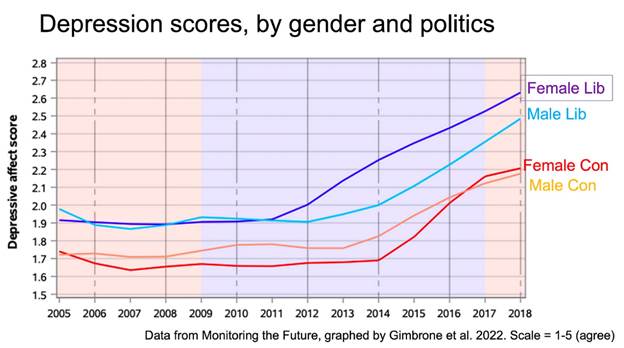
This graph is taken from Gimbrone’s 2022 study, available here: https://www.thefp.com/p/why-the-mental-health-of-liberal
Pew Research Center gives additional data which shows the greater unhappiness of liberals (compared to conservatives): Pew researchers asked their respondents whether they had ever been diagnosed with a mental illness. Similar to the depression question above (and constituting a mirror image of the results of the happiness survey), liberals, especially liberal women, are much more likely to have been diagnosed with a mental illness. Most of all, this is true about young liberal women. See the graph below, where more than 50% of young liberal women responded that they were diagnosed with a mental illness.
Figure 1. Data from Pew Research, American Trends Panel Wave 64. The survey was fielded March 19–24, 2020. Graphed by Jon Haidt. This graph is available here: https://www.thefp.com/p/why-the-mental-health-of-liberal
Keeping in mind the happiness research we reviewed earlier in this article, it is no surprise that liberals would be more depressed and be more likely to have “mental” problems because “mental” problems and depression are roughly the opposite of happiness, just like liberal doctrine is roughly the opposite of conservative doctrine. But why are these problems worse in liberal women as compared to liberal men?
One answer appears to be that young women are more liberal than
young men. So, it makes sense that just as liberalism correlates with
unhappiness, and young women tend to be more liberal than young men, that young
women would be more unhappy and depressed than young men. See the Gallup poll
data below.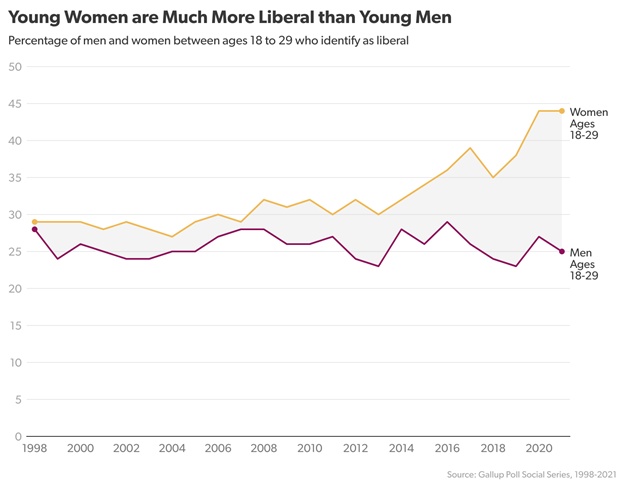 This
Gallup poll data is from the Gallup Poll Social Series and it available
here: https://www.americansurveycenter.org/featured_data/the-growing-political-divide-between-young-men-and-women/
This
Gallup poll data is from the Gallup Poll Social Series and it available
here: https://www.americansurveycenter.org/featured_data/the-growing-political-divide-between-young-men-and-women/
Also, just as it is consistent with young women tending to be more liberal, they also tend as a group to be more godless and irreligious. So, whereas conservatives make a larger place in their lives for God and are happier, so young liberal women, especially, are less likely to make room for God in their lives and are more depressed and more likely to have been diagnosed with a mental illness.[1] See the graph of Gallup poll data below.
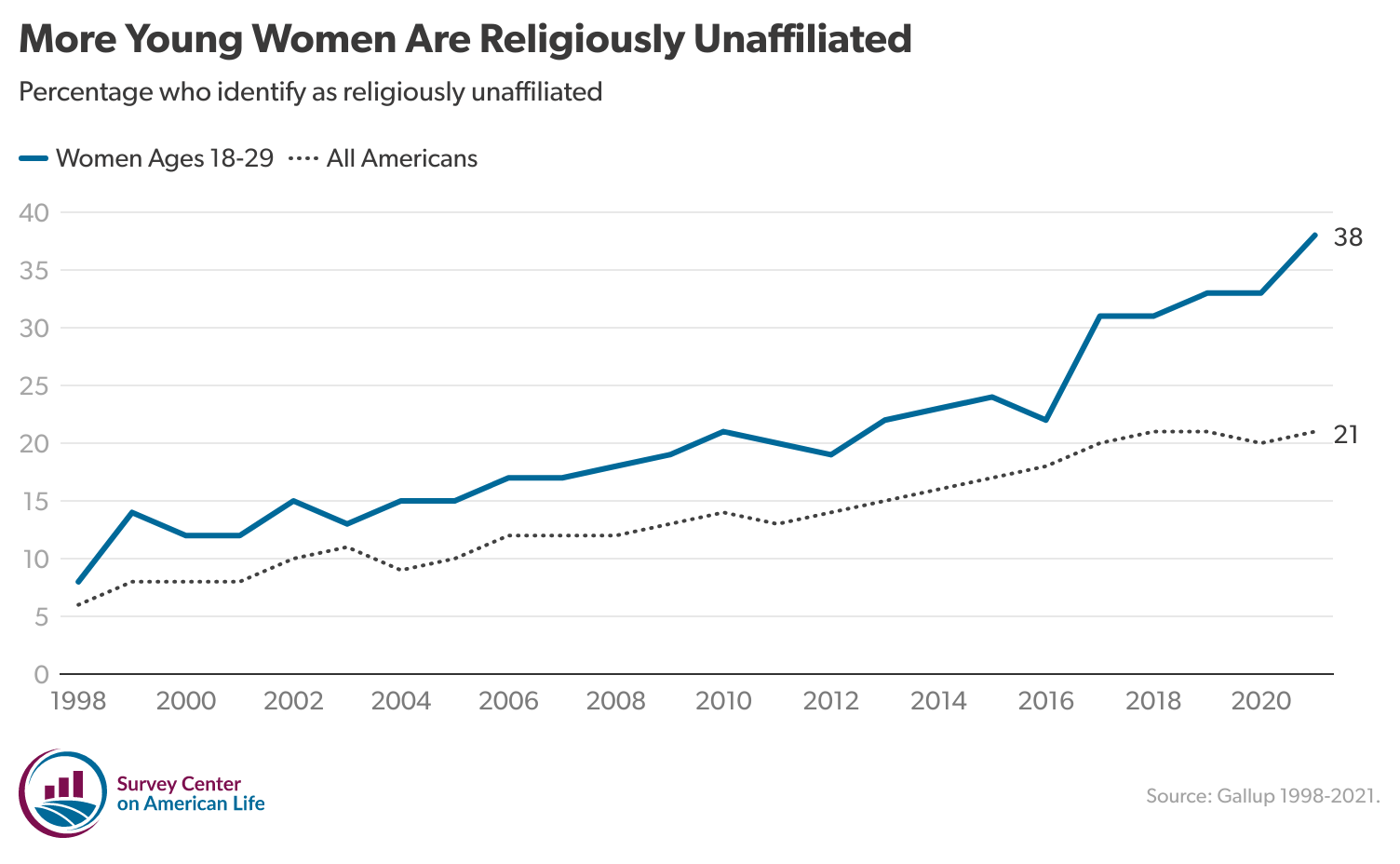
The data from this Gallup poll is available at this link: https://storylines.substack.com/p/the-political-gender-gap-is-exploding?s=w
What we have seen in the article above not only fits with what Aristotle proves in the Nicomachean Ethics, Bk.10, ch.6, but also fits with the rest of what we know. For example, there is the old French proverb: “A sad saint is a sad saint indeed”, (which is a pun equivocating on the meaning of “sad”) meaning that a saint who is unhappy is a poor excuse for a real saint.
Comparing the Happiness of Young Liberal Women to the Happiness of Young Conservative
Women
How good God is, that the more we do His Will on earth, the more He prepares us for the perfect happiness of heaven while making us happy on earth! Of course, the happiness God gives on earth is genuine but does not necessarily mean greater pleasure or riches.
Having just seen that young liberal women (as a group) are more depressed and more likely to be diagnosed with a mental illness than any other group, even more likely than young, liberal men, now let us compare young liberal women – who are the most unhappy group – with their opposites: young conservative women. How do they compare?
Before looking at the survey research, let us first of all reason about this question and see if we already know the answer that the survey will show us.
Young Liberal Women are – as a Group – Farthest from the Life that God and
Nature Intended for Them.
We know that happiness requires that we live in conformity with our nature and our highest faculty (reason). And we know that the happy life is the virtuous life. Aristotle, Nicomachean Ethics, Bk.10, ch.6.
What does this mean more particularly? One thing is that we must live the role in life that God created us to live. So, the great work of a woman’s life – for which God made her – is usually to be (and to dedicate her life to being) a wife and mother[2] although God also can call her to be a spiritual wife (Bride of Christ) and mother in the religious life. To take merely one of the proofs by which we infallibly know this truth, St. Paul teaches us:
She [viz., a woman] shall be saved through childbearing; if she continues in faith, and love, and sanctification, with sobriety.”
1 Timothy, 2:15.
The anti-feminist author, Mrs. Donna Steichen,[3] describes a man’s vocation and role in the family in the following words:
A father’s role is of great importance … [b]ut normally he must be engaged elsewhere much of the time, dealing with the world, providing for his family’s material needs.[4]
So, a liberal, young woman is farther from the natural role in life for which God created her, than is the young liberal man. This is because God made her to be creating a happy home for her husband and children and to spend her days caring for her children and her home.[5] Instead, a liberal, young woman is out in the workplace, competing with men, earning a paycheck, trying to advance in the career world. She cannot entirely escape realizing the emptiness of her life which she lives in opposition to the way she was created to live. Often, she even murders her (unborn) babies rather than cherishing and nurturing them, as God intended and as He put into the very “fabric” of her being.
By contrast, even though most young, liberal men are not getting married (and so are rejecting the calls of their vocations) their lives are still largely spent “dealing with the world” outside the home as married men also do. Thus, they are not as far from the life for which God created them as are those liberal women. Of course, the work those men do is devoid of the greater significance which that work would have had, if they had been married and were doing that work for the sake of devotedly providing for their families’ material needs.
Here is how Mrs. Steichen states this reality of the importance of a husband’s work being primarily in its final cause (goal) of supporting his family as a necessary part of fulfilling the vocation of his life:
Only a fortunate minority of men find work significant in itself. For most, the knowledge that they are supporting their families is all that gives their labor meaning.[6]
Therefore, the young liberal man’s work has a large element of emptiness in it, because it lacks its familial purpose which “gives their labor meaning” (as Mrs. Steichen observes). There is much greater satisfaction and meaning in the work of a man who is providing for the material needs of those whom he loves, compared to merely providing for himself. We might say that providing for himself alone is much more a situation of focusing on himself and partaking more of a me-first and me-centered selfishness. That never makes a person happy.
So, we see that the life and circumstances of young, liberal women are even more a cause of unhappiness than those of the liberal young man. Like his work, her work is empty because it lacks God’s intended goal of that work and it is me-centric. But in addition to that, her work is not centered on the type of activities that God gave her to do with her life, which constitute the happy life of a woman. Thus, it makes sense that with a greater “distance” between her and the life she was created to live, there is also a greater “distance” between her and happiness (as compared to even a liberal young man).
By
contrast, look how there is virtually no difference between the depression
scores of conservative men and women: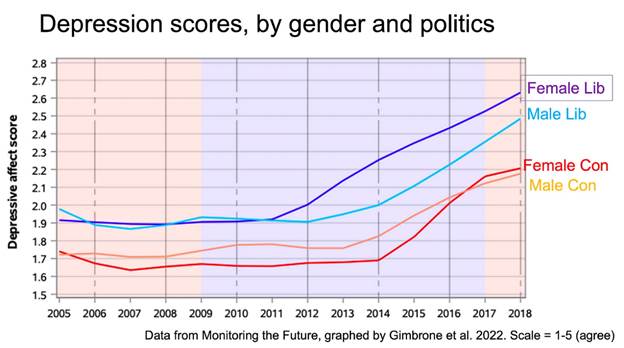
This graph is taken from Gimbrone’s 2022 study, available here: https://www.thefp.com/p/why-the-mental-health-of-liberal
That makes sense because conservative men and women are both living more the lives God created them to live. Conservatives are more likely to be married. The husband/father is more likely to be supporting his family, with his wife more likely to be a homemaker raising children and living the life of the heart of the home. Thus, although conservatives are not nearly as conservative and as virtuous as they should be, nonetheless, compared to liberals, they are happier and are living more the life God created them to live. Since young conservative men and women are both living more the life that God, Nature, and reason direct them to live, they are both (roughly) equally happy – and happier than liberals.
Reasoning about Why a Woman Might Choose the Feminist Life
As we consider how young, liberal women – who are shown to be the most unhappy group – compare with their philosophical opposites: young, conservative women, let us pause before looking at the polling data to do some “Aristotelean” reasoning. Let us consider this:
These unhappy liberal young women were not told that the feminist life they chose would make them unhappy. (People don’t choose a course of conduct because they believe it will make them unhappy.) So, what were these women told that the feminist lifestyle would accomplish for them?
Isn’t the answer that they were told (at least implicitly) that feminism would make them happier, rather than unhappy and depressed? They were told (really, lied to) that having a career would make them more “fulfilled”, right? Isn’t this another way of being told they would be more satisfied and happier?
But Aristotle and St. Thomas prove that happiness is caused by living according to our rational nature. Further, the rational life is the life of virtue, as Aristotle and St. Thomas Aquinas prove because virtue is acting (and living) according to reason (our highest faculty). For example, temperance is eating the amount of food that reason – not our passions – tell us is the correct amount.
Does the Feminist Life make a Woman Happier Because It Makes Her Richer?
So, when women are lied to that the feminist life will make them feel more “fulfilled”, what does that really mean? One possibility is that these young women suppose that being “fulfilled” means making more money. As we saw above, money does not cause happiness. Having a larger “number” in your bank account does not cause a person to live better the life of reason and virtue. Thus, being richer does not cause happiness.
Further, focusing on acquiring money is an empty life, not a meaningful life. Consider the man in the Gospel who gloried in his riches and exalted himself with having so much grain that he had to tear down his barns to build bigger ones. This is what Our Lord declared to him:
Thou fool, this night do they require thy soul of thee: and whose shall those things be which thou hast provided? So is he that layeth up treasure for himself, and is not rich towards God.
St. Luke’s Gospel, 12:20-21.
If money were to buy happiness, then rich people, (e.g., the lottery winners quoted earlier in this article), would be happier than other people – but they’re not. In fact, the opposite is true: lottery jackpot winners are more unhappy than most people.
If money were to buy happiness, then having lots of money would help us to live more the life of reason, but it does not. So, if being a career woman would make a woman richer, then this would not cause greater happiness because those riches would not be the cause of greater virtue and living a more rational life.
Of course, by our Catholic Faith we know that money is not of great importance but the real problem is the desire for money (i.e., the lack of poverty of spirit). So, the young liberal women would be led to unhappiness to the extent that they choose the life they do for the purpose of acquiring lots of money.
Incidentally, it actually happens that single career women are usually not richer than women who live more the traditional life that God created them to live. For example, in a Newsweek article, citing U.S. Census data, it states:
Married mothers ages 18-55 have a mean household income of $133,000, compared to $79,000 for childless, single women 18-55 ….[7]
In any event, if young liberal women live the feminist life in order to pursue money, that would explain their greater depression and unhappiness: money cannot buy happiness, and their feminist choices apparently do not lead to more money anyway.
But let’s look at other possible motives for why young women live the feminist life.
Does the Feminist Life Make a Woman Happier by Giving Her a Life of Greater Pleasure?
Perhaps young liberal women gullibly believe that feminism would make them happier by increasing the amount of bodily pleasure in which they can indulge.[8] But that cannot lead to happiness because living the life of pleasure makes it harder to live the life of reason because it increases passion and this passion obscures reason and promotes a life of slavery to one’s passions. Thus, living the life which is focused on pleasure tends to decrease virtue and, therefore, also decrease happiness.
Further, the life of pleasure is the life shared in common with the brute (irrational) beasts. If (contrary to fact) the life of bodily pleasure were the cause of the happy life, then those who indulged most extremely in bodily pleasures would be the most extremely happy. There are countless greatly-indulgent people who show this theory is false by their misery amidst their continual pleasures. Those people tend to use pleasure as a distraction to help them forget their unhappiness.
Also, reflecting on our own experience and those of others, people who have lost a loved one know by experience that the hurt of that loss is not cured by pleasures and that those people in the midst of their loss don’t “feel like” indulging in pleasures because they know it won’t help their sorrow.
Moreover, if pleasure were the cause of happiness, why is it true throughout history, that there have been many poor people who did not have much bodily pleasure, yet were very happy and lacked nothing of happiness despite the austerity of their lives? Consider the saints and holy religious.
Lastly, focusing life on pleasure-seeking is recognized as low and empty. People pity other people who have a pleasure-focused life. People who live for pleasure try to hide this fact because this life is one of addiction (or something similar to an addiction).
In any event, if young liberal women live the feminist life in order to focus on pleasure, that would explain their greater depression and unhappiness.
Let’s look at other possible motives for why young women live the feminist life.
Does the feminist life make a woman happier by making her feel “empowered”
and “honored”?
Suppose a young liberal woman pursues the feminist lifestyle because she seeks and loves power, desires to be the boss, feels important because she receives business honors, or because she is the "first woman to reach such-and-such a height", etc.
Living dedicated to such goals, is to live according to the Pride of Life, one of the three causes of sin mentioned in St. John the Evangelist’s first epistle, 2: 16. See also, Summa, Ia IIae, Q.77, a.5. This life is caused by pride, which is the “inordinate desire of one’s own excellence”. Summa, IIa IIae, Q.162, a.2, respondeo.
This is a life lived in a way which is the opposite of the way Our Lord commands us to live:
Learn of Me, because I am meek, and humble of heart.
St. Matthew’s Gospel, 11:29.
Because this life fosters the root of all evil, which is pride, this life does not foster virtue and so it cannot bring happiness. Instead, this life to promotes unhappiness both in those who achieve the pinnacles of worldly human respect and in those who are disappointed and fail in their goal.
In any event, if young liberal women live the feminist life in order to focus on the accolades of the world, this would explain their greater depression and unhappiness.
Does the Feminist Life Make a Woman Happier by Giving Her a Life Where She can Focus
More on Herself?
God made woman to be generous and giving. He made her to serve Him in her womanly vocation. Here is one way St. Paul makes that connection:
She [viz., a woman] shall be saved through childbearing; if she continues in faith, and love, and sanctification, with sobriety.
1 Timothy, 2:15.
When a woman has spent her life that way, she can look back at her life with true contentment. This is because this life is devoted to the Good and to the love of this Good.
The current fad and modern jargon emphasize the importance of “self-care”. In practice, such “self-care” is a “justification” for persons to eschew the responsibilities of selfless dedication to vocational responsibilities in order to have more time to focus on themselves. In other words, this is an excuse for a more selfish, me-centered life. One secular feminist leader used the following words to declare her own refusal of her vocational responsibilities so that she could free her time for whatever she would prefer to do instead:
I don’t particularly like babies. They are loud and smelly and, above all other things, demanding . . . time-sucking monsters with their constant neediness …. Nothing will make me want a baby ….[9]
But let us ask ourselves:
Does this type of a more self-absorbed life result in greater happiness?
We can rhetorically answer that question by asking another question:
When a person lives a more self-centered life, does that foster a life of reason and virtue, and therefore also greater happiness ?
When a young liberal woman focuses on herself, this increases vice (e.g., pride and self-love), decreases her use of reason and weakens or destroys virtue. Thus, if young liberal women live the feminist life in order to focus more on “self-care” and to have more time for themselves, that would explain their greater depression and unhappiness, as shown in the happiness polls earlier in this article (including part 1).
Further, if self-centeredness were the cause of happiness, then the most self-centered people would be the happiest. But we see they are not. In fact, we observe the opposite: viz., the people who are the most self-centered are among the unhappiest people.
It is obvious to everyone that being more self-centered is connected to the vice of pride (and other vices), not to a life of reason and virtue. Even the worldlings see self-centeredness as bad (at least in other people, even if they themselves are also self-centered). Whenever someone is told “you are becoming more focused on yourself”, he never says “Oh, thank you! That is so kind of you!” Because everyone knows being me-focused is bad and shameful, people who are like that try to hide this fact.
But let’s now look at another possible motive for why young women might choose to live the feminist life.
Does such a Young Woman Suppose that the Feminist Life will Make Her Happier
by Giving Her More Time in Which to Focus on Her Social Life?
Perhaps such a young woman naïvely believes that feminism would make her happier by increasing her opportunity to focus on her social life. For example, she might think that instead of making dinner for her family, she can have dinner in a restaurant with her “friends” from her workplace.
But as Aristotle proves in his Nicomachean Ethics, a person cannot have a true friendship without true virtue.[10] So whatever feminists suppose they will obtain, the truth is that they will fail to achieve real friendship without real virtue.
Let us ask ourselves:
Does this greater amount of social life result in greater happiness?
We can rhetorically answer that question by asking another question:
When a person
lives a more social life, does that foster a life of reason and
virtue?
The answer, of course, is that if a more social life does not foster a life of reason and virtue, then it does not foster happiness.
By contrast, those traditional family responsibilities (which a feminist rejects) are great opportunities for acquiring (and increasing) virtue. These maternal responsibilities are the fertile seedbed in which virtue and friendship can grow. In her traditional role – for which her womanly nature has prepared her – this young woman could be spending her days and the focus of her thoughts upon doing as much good as possible to those she loves the most (her husband and children), as well as aging parents, etc.. Such a young woman lives in a partnership aimed at this very important work. She teams up in this enterprise with her best friend and partner: her husband.
Of course, this family life is not a guaranty of virtue, friendship, or happiness. Nor does family life mean that those great Goods always come, or come without effort. Rather, this family life is a pathway which disposes the members of the family to attain these great Goods. This is like a school disposing its students to knowledge but some students learn very little (i.e., get very little good out of the school) because they are unwilling and rebellious.
Further, just as a student can commit the further wrong by separating himself from his school (i.e., being a truant), so likewise a spouse can not only do a bad job fulfilling his family responsibilities, but even abandon those responsibilities entirely, through abandoning his family. However, such bad conduct does not change the fact that a school and a family can be places of great Good, although that Good is not realized by ill-disposed persons.
It is neither the “fault” of matrimony nor a school that some people are ill-disposed. Nor does it mean that there is a better way to achieve those Goods than the way provided by those institutions.
So even though the feminists seek happiness like everyone else, they do not take the path which God and Nature intend for them – that is, the path which leads to happiness. So, the feminists do not have true and deep friendships. Often, they foolishly seek happiness by having more time to spend in shallow social interactions and transitory liaisons. Perhaps the feminist young woman watches movies with her “friends” or has “health club buddies” with whom she spends time and money dining at restaurants, etc. Any such “friendships” of pleasure are shallow and do not really satisfy the heart because those acquaintances lack the real virtue which is essential for real friendship. The unsatisfying shallowness of these “friendships” is a crucial reason why young liberal women have a greater incidence of unhappiness and depression.
As reported in an article in Newsweek on the subject, “single, childless women are about 60 percent more likely to report feelings of loneliness compared to married mothers.”[11] The reason is obvious: it is not a greater amount of social time or a larger number of supposed “friends” – but only the excellence of true friendships – which satisfies the heart and contributes to happiness and a satisfying life. A person who lacks deep friendships and instead substitutes shallow (so-called) “friendships” is sometimes described as a person “being alone even in a crowd”.
So, the feminists find themselves with more social time but with an inability to be a real friend and to possess (and enjoy) real, true friendships. Thus, the feminists spend their greater social time on emptier and more meaningless activities. They often spend lots of time on “social media”. They might have a great number of Facebook “friends” and foolishly follow their peers’ example of supposing that, the larger the number of Facebook “friends” they have, the happier and more popular they will be. The truth is that this number of such “friends” is virtually irrelevant, even detrimental.
On Facebook, the use of the term “friend” is misleading. The term “contact” would be more accurate. The Facebook software prods each “friend” to “react” to the new pictures posted since the previous day by various “friends” and so, the more such “friends” a person has, the more time he needs to “keep up” with all of the “friends” and so it is a burden and time-drain to “have to” go through all of the usually-banal photos to tell each “friend” how “awesome” or “amazing” the photo is and try to find some witty words or insightful comment by which he can receive the attention of the rest of the ”friends” of that mutual “friend”.
The concept of Facebook “friends” turns true friendship on its head and exalts numbers (quantity) over quality, in direct contradiction to the truth. Thus, a person might be thrilled by receiving approving responses from a thousand of his Facebook “friends”, but overlook the fact that, if he had one genuine, deep friend in his entire lifetime, that would be worth far more than twenty thousand of those so-called “friends”.
The emptiness of this “social” life is obvious to any sensible person. This empty, feminist life with a greater amount of social time simply results in a greater incidence of unhappiness (and depression).
If more time for a social life were the cause of happiness, then those persons who had the greatest time for socializing would be the happiest. But they are not. And those people who had the least amount of social time would be the least happy. But they are not.
The fact that feminists are not the only ones who have rejected the life of virtue and reason (a life which causes happiness) does not change the fact that feminists do reject this life. In any event, if young liberal women live the feminist life in order to focus on having more time for their social life, that would explain their greater incidence of depression and unhappiness.
Feminism Involves Hatred of the Feminine “Nature”
Feminism is an attack on the feminine nature of women and girls by Our Lord’s enemies. Ultimately, this is the program of Satan, and his tools, the Marxists. Feminism is the “gospel” that preaches that women are worthless (or worth less) unless they are like men. This feminist “gospel” pushes women to live like men, dress like men, and try to be like men. It is the “gospel” pushing women to be aggressive, manly, “business savvy”, powerful, un-maternal, un-nurturing, not homemakers – in short: un-womanly.
Instead of being glad for the feminine nature God gave to them, feminism tells young women that they should strive to be just like a man (although they do not phrase it that way). Young women come to understand that, if they hope to be approved and to have their lives approved, they must try to be like a man.
Some of these young women try even harder than the others to be approved, by choosing the more extreme version of feminism, which is “transitioning” to “become” a “man”. You can see why “transgenderism” is feminism taken to a more extreme level since it is a more extreme way for a young woman to follow the feminist “gospel” to be like a man.
“Transgenderism” is feminism which includes surgical mutilation and permanent chemically-induced ruining of their bodies, in order to try even harder to be like a man. But this delusion merely causes more extreme unhappiness and even more depression because it is a more extreme rejection of God’s Will and of their feminine nature.
Although it is true that the leftists attack the whole population by promoting this gender dysphoria (“transgenderism”), the leftists especially prey upon young women. According to one Wall Street Journal article, this “transgender” delusion “overwhelmingly afflicts girls”.[12]
As compared to other groups, young women are most likely to declare themselves “transgender” – that is, to declare that they are really men. These pitiable young women have been betrayed by their fathers who have neglected their paternal duties to guide and defend their daughters. These young women have been tricked by society more broadly, e.g., by the media, academia, the entertainment industry, etc. These young women are also betrayed by others such as their mothers. But most of all, the corruption of society (including the “transgender” absurdity) is the fault of the men who did not do their duty to those under their care in their households.
So, feminism causes young women to be unhappy and have a higher incidence of depression. For those who are deceived into declaring themselves to be men, this unhappiness and depression increases all the more.
Polling Data Comparing the Happiness of Liberal Women and Conservative Women
So, now let us look a little more at the polling data about the happiness of conservative young women, as compared to liberal young women.
❖ Conservative women are more likely to be married than liberal women. Thirty-three percent of married mothers ages 18-55 say they are "completely satisfied" with their lives, compared to 15 percent of childless women in the same age range.[13]
❖
Liberal women are more likely to be
single and childless. These women are about 60 percent more likely to report
feelings of loneliness compared to married mothers.[14]
❖ Conservative women have a fifteen percentage-point advantage over liberal women in being “completely satisfied” with their lives. Specifically, thirty-one percent of conservative women (18-55) are completely satisfied with their lives, versus sixteen percent of liberal women. And this advantage can largely be explained by the fact that conservative women are 26 percentage points more likely to be married and 24 percentage points more likely to be happy with their family life.[15]
In the case of women, God’s purpose is inherently that women be wives and mothers (or spiritual wives – viz., religious sisters who are Brides of Christ; and spiritual mothers, such as teaching sisters, etc.)
In other words, the happiest women in America today are those least likely to be following the profoundly self-centered and anti-family lifestyle promoted by the leftist establishment.
Conclusion
God made us to know, love, and serve Him in this life so that we can be happy with Him in the next. That is our purpose. We find our deepest satisfaction when living according to our purpose. By contrast, we cannot find true satisfaction or happiness in rejecting God’s Plan for us.
The more we strive for virtue and holiness, the more we will be happy. If we are saintly, we will be extraordinarily happy.
Because the more we live the way God intended, the happier we will be, a woman’s happiness requires that she live the womanly life that God created for her to live.
Friendship is the crown of the virtuous life, and is incompatible with a life of sin and vice. So, in this life virtue causes happiness and friendship which disposes us to the life of complete happiness and Divine friendship in heaven for all Eternity.
[1] Concerning “Psychological” Problems and Counseling: In St. Thomas Aquinas’ Commentary on Aristotle’s Treatise on the Soul (“De Anima”), St. Thomas shows the truth that, aside from medical problems in the brain as a bodily organ which are caused by disease or physical trauma, what people need, who have “psychological” problems, is wise advice, sometimes over a prolonged period, about how to change their thinking about life and what moral choices they should make.
Thus, what is needed by people who have “psychological” problems is not someone with a particular academic degree or license but rather an advisor who has the virtue of Prudence, the Gift of the Holy Ghost which is called “Counsel”, and the other virtues and Gifts of the Holy Ghost.
[2] Read this article: https://catholiccandle.org/2019/12/02/the-role-and-work-that-god-gave-to-woman/
[4] Ungodly Rage, The Hidden Face of Catholic Feminism, Mrs. Donna Steichen, page 227, Ignatius Press, San Francisco ©1991.
[6] Ungodly Rage, The Hidden Face of Catholic Feminism, Mrs. Donna Steichen, page 227, Ignatius Press, San Francisco ©1991.
[7] https://www.newsweek.com/why-conservative-women-report-being-happiest-how-you-can-too-opinion-1748894
[8] This is the false position of Gorgias, who was ably refuted in that eponymous Platonic dialogue by common sense and by Socrates.
[9] Words of secular feminist leader, Amanda Marcotte, March 2014, found here: https://theothermccain.com/2016/11/15/feminists-hate-donald-trump-the-joys-of-happy-fun-victory-week-maga/
[10] See, Aristotle’s Nicomachean Ethics, Books 8-9 and St. Thomas Aquinas’s commentary on those books.
[11] https://www.newsweek.com/why-conservative-women-report-being-happiest-how-you-can-too-opinion-1748894
[12] When your Daughter Defies Biology, By Abigail Shrier, Wall Street Journal, January 6, 2019.
[13] https://www.newsweek.com/why-conservative-women-report-being-happiest-how-you-can-too-opinion-1748894
December 2023 PDF Issue
The Awe-inspiring Providence of How God Teaches Humility to His Friends.
Catholic Candle note: The following is a letter from a Catholic Candle reader. We invite our readers to send their own letters and articles.
Dear fellow Catholic Candle readers,
While reciting the Joyful Mysteries I found myself pondering the reason why God allowed the angels to fall. Would it not have been better to have all the created angels to be in heaven adoring God? For that matter, would it not have been better if Adam had not sinned and to have all humans obtain heaven and be with God?
Then I could almost hear what I have heard people say so many times before, “If there is a God and He is so good, then how can there be suffering, sickness, and death in the world?” I am sure, you, dear fellow-readers, have heard similar things.
How would I refute such questions?
Then, I remembered that the Candle had an article about how men are not created equal and how the fall of the angels and men showed God’s glory more than if these events had not occurred. The bitter questions of those who do not understand how Providence works make it sound like God is somehow unfair or unjust in His ways.
Then my thoughts went a bit deeper to ponder how God is so provident and He works on all levels from top to bottom, as it were. How marvelous it truly is that God chose to become Man in the form of a little Baby! In a cave used as a stable! For all those people who think that God is unfair, have they ever thought about how He chose such humiliations for Himself? How is it unfair that He gives us something to suffer and we are sinners and deserve suffering, when He, Who is perfect, showed us such loving examples of how to offer things up out of love for the Heavenly Father? He didn’t stop there; He suffered so many attacks, humiliations, and such an ignominious death on the Cross!
I couldn’t help contrasting the Blessed Virgin Mary to whom He gave so much, with so many souls to whom God chose to give little. It is almost overwhelming to contrast the most ignorant and weak savage pagan, to the immaculately conceived Mother of God. What a remarkable difference between two human creatures of God! Our Lady is God’s masterpiece. She had the use of reason from her conception and always served God perfectly.
God chose to do this and He is not unfair or unjust. He planned from all eternity to create man and He planned the means He would use to redeem man. He planned to create a perfect virgin to be the Mother of Wisdom Incarnate. He also planned that He would give her to us to be our Mother to help us miserable sinners work out our salvation. He planned that she would be more powerful than all hell put together.
The most astounding thought of all my contrasting back and forth was that God did all of what He did as a means to foster humility in us. Whether we think of all of the blessings He has given us from the Faith on down, or whether we see how low we are compared to Mary, the highest of all the saints, we are humbled by these thoughts. This all made me think how He wants our humility and how He allows all things to help us discover humility, see its beauty, and desire to have this most necessary virtue. Our Lord told us we cannot enter the kingdom of heaven without humility. I could not help but be struck how He works out all things in His creation and in particular, in the human race, in order to teach men this foundation of all virtue – humility. Mary and Blessed Christ Mass, fellow Catholic Candle readers!
To Make Murder Acceptable, Give It a Different Name
Webster defines murder as killing a human being unlawfully and with premeditated malice. That’s it! That’s ABORTION.
It was understood early on that the great majority of people would find so totally abhorrent the thought of going into an (operating) room and intentionally killing a baby. So, the answer for the Left was to muddy the linguistic waters by calling it “health care”, not murder, hoping it sounded merely like an innocent medical procedure. (That is not the case today, however, as nearly everyone realizes that it’s the life of an innocent child that hangs in the balance.)
Yet this ploy helped to destroy the consciences of people so that not only did they begin to think of abortion as no longer relevant to moral law, but as a solution to a “problem”, or an issue to be debated, or a convenient possibility, or finally, something to be promoted.
Now, this matter of the conscience of people is of particular importance because everyone must practice and live up to his Catholic Faith based on his informed and tender conscience in preparation for his particular Judgement. Jesus Christ is the Judge at the Particular Judgment, and we have to give an account of our whole life – every thought, word, act, and omission. Only then will we know the exactitude with which God sees and measures these acts, words, and even intentions in our deepest thoughts.
To help us prepare for the Particular Judgment, God created us with a conscience, sometimes called the “voice of God” because it bids us to do right and avoid wrong.
Relatively few have sufficiently studied the Catholic Faith to inform their conscience or have worked hard to keep it tender (which is the delicate opposite of a hardened conscience). As you might expect, a hardened conscience will accept what is wrong without concern.
Thus, a person with a hardened conscience will have no problem thinking of the growing fetus (i.e., a baby) as merely a “lump of tissue.” However, The Catholic Encyclopedia confutes this heretical nonsense:
Now it is at the very time of conception that the embryo begins to live a distinct, individual life. For life does not result from an organism when it has been built up, but the vital principle builds up the organism of its own body. In virtue of the one eternal act of the Will of the Creator, Who is, of course, ever-present in every portion of His creation, the soul of every new human being begins to exist when the cell which generation has provided is ready to receive it as its principle of life. In the normal course of nature, the living embryo carries on its work of self-evolution within the maternal womb, deriving its nourishment from the placenta through the vital cord, till, on reaching maturity, it is by the uterus issued to lead its separate life. Abortion is a fatal termination of this process.[1]
Intentional abortions are distinguished by medical writers into two classes. When they are brought about for social reasons, physicians [in past decades] style[d] them criminal; and they rightly condemn[ed] them under any circumstances whatsoever. They express[ed] utter contempt for the doctors and midwives concerned in them. They usually strive[d] to prevent such crimes by all means in their power. “Often, very often,” says Dr. Hodge, of the University of Pennsylvania, “must all the eloquence and all the authority of the practitioner be employed; often he must, as it were, grasp the conscience of his weak and erring patient, and let her know, in language not to be misunderstood, that she is responsible to the Creator for the life of the being within her.”[2]
Ethics, then, and the Church agree in teaching that no action is lawful which directly destroys fetal life. It is also clear that extracting the living fetus, before it is viable [i.e., able to survive on its own] is destroying its life as directly as it would be killing a grown man directly by plunging him into a medium in which he cannot live [e.g., underwater] and holding him there till he expires.[3]
The Catholic Church has not relaxed her strict prohibition of all abortion; but she has made it more definite. [Note: Catholic clergy and the hierarchy were outspokenly against abortion until the latter part of the 20th century. Since then, the conciliar church has been quiet and lukewarm at best in opposing abortion.] As to penalties she inflicts upon the guilty parties, her present legislation was fixed by the Bull of Pius IX, “Apostolicae Sedis,” (1869). It decrees excommunication – that is, deprivation of the Sacraments and of the prayers of the Church in the case of any of her members.[4]
Thus, it is clear to see that abortion is a mortal sin. (A person doesn’t get excommunicated for forgetting to genuflect in church.) It is murder and it is against the Ten Commandments and against the Natural Law. The Natural Law is the rule of conduct which is prescribed to us by our Creator and which we know by reason without special Divine Revelation. St. Thomas explains that Natural Law is nothing other than the rational creature’s participation in the Eternal Law, which is the Truth of Divine Wisdom Itself.
God has imprinted the substance of the Ten Commandments on the human heart and mind, and they have therefore binding force. Even if they had never been given to us through Divine Revelation, we would still be obliged to keep them, for they are dictated by reason, and taught by Natural Law. The revealed law on this merely repeats and amplifies the Natural Law.[5]
The fifth commandment is Thou Shalt Not Kill. Since we have seen that murder is the voluntary and unjust killing of a human being, it is easy to see why abortion is one of the four sins that “cry to heaven” for God’s punishment.
Though killing babies in the womb seems to have been unknown prior to the decadent morality of ancient Greece, at a later period this abominable practice proliferated but was met with severe punishments. And it is notable that the great prevalence of abortion ceased wherever Christianity became established.[6]
Thus, it is fair to say that in centuries past, Christians – and more specifically, the Catholic Church – were the primary defenders of innocent life against abortion and its practitioners.
Where is the Catholic Church today? It is MIA – i.e., Missing in Action. Who is to lead the fight against abortion, if not the Church? I believe an uncompromised Church could have subdued abortion if the billion Catholic faithful would have strongly objected at the ballot box when electing civil representatives, and this worthy goal could have been accomplished if the human leaders of the Church – the pope, bishops and clergy – had informed, reminded, and directed their flocks to actively oppose the evil of abortion.
“In former times, men were animated by the spirit of faith, and regarded a large family as a gift of God and a blessing from heaven, and considered God more than themselves as the Father of their children. But now that faith has weakened and people live isolated from God ….”[7]
They no longer universally consider babies as children sent by God, made in His image and likeness. They ignore the fact that abortion is a mortal sin, and that the killer of a baby deserves to spend eternity in the fires of hell.
Let us abhor this murder, which denies a baby any chance to see the Face of God and be happy with Him forever in heaven! Let us pray and fight to end abortion!
[1] The Catholic Encyclopedia, The Gilmary Society, New York, 1907, Vol. 1, p.47.
[2] The Catholic Encyclopedia, The Gilmary Society, New York, 1907, Vol. 1, p.47.
[3] The Catholic Encyclopedia, The Gilmary Society, New York, 1907, Vol. 1, p.48.
[4] The Catholic Encyclopedia, The Gilmary Society, New York, 1907, Vol. 1, p.49.
[5] My Catholic Faith, Bishop Morrow, My Mission House, Kenosha, WI, ©1949, Ch. 91, p. 185.
[6] The Catholic Encyclopedia, The Gilmary Society, New York, 1907, Vol. 1, p.48.
[7] Trustful Surrender to Divine Providence, Fr. Jean Baptiste, S.J., and St. Claude de la Colombiere, S.J., TAN Books, 1983, Ch. 3, p.52.
Lesson #29 – Apparition to the Two Disciples At Emmaus
Catholic Candle note: Below is the 29th part of this guide to the Spiritual Exercises of St. Ignatius of Loyola.
Mary’s School of Sanctity
Lesson #29 The Spiritual Exercises of St. Ignatius – Apparition to the Two Disciples At Emmaus
In our last lesson, we considered the suitability of Our Lord appearing to His Mother first to console her who is the Mother of Sorrows. Since she was so closely united to her Son all during His life on earth and especially while He hung on the Cross, she should be the first to join with Him in the triumph of His Resurrection.
We turn our thoughts to the other apparitions of Our Lord after His Resurrection. In our last lesson we listed several of these apparitions and we encourage the exercitant to meditate on as many of these apparitions as his time permits. In our current lesson, we wish to give an example of how one of these apparitions can be put into the framework that St. Ignatius gave us for Our Lord’s apparition to Our Lady. The other apparitions can be done in a similar manner. The apparition we are now considering is Our Lord’s apparition to the two disciples on their way to Emmaus.
The preparatory prayer is the same as usual: I ask God Our Lord for the grace that all my intentions, actions, and works may be directed purely to the service and praise of the Divine Majesty.
The FIRST PRELUDE: the history. Recall to mind Our Lord upon His Resurrection appeared in Body and Soul to His Blessed Mother. Subsequently He appeared to various others.
The SECOND PRELUDE: the mental representation of the place. Here it will be to see the two disciples travelling to Emmaus, discussing the events, and Our Lord meeting up with them and continuing the journey with them.
The THIRD PRELUDE: to ask for what I desire. Here it will be to request the grace that I may feel intense joy and gladness for the great glory and joy of Christ Our Lord.
The first, second, and third points are the same that we have had in the contemplation on the Last Supper of Christ Our Lord.
The FIRST POINT is to visualize the persons at the supper, {here Our Lord with the two disciples} and reflecting within myself, to strive to gain some profit from them.
The SECOND POINT is to listen to what they say, and likewise to draw some profit from it.
The THIRD POINT is to observe what they are doing and to draw some fruit from it.
The FOURTH POINT is to consider that the Divinity which seemed to hide Itself during the Passion, now appears and manifests Itself so miraculously in the most holy Resurrection by its true and most holy effects.
The FIFTH POINT is to consider the office of consoler that Christ Our Lord exercises, comparing it with the way that friends are wont to console one another.
The COLLOQUY: Conclude with one or more colloquies according to the subject matter and then with “Our Father.”
Before giving the considerations for this meditation we give the Scriptural account: [The following are verses from St. Luke 24:13-46]
And behold, two of them went, the same day, to a town which was sixty furlongs[1] from Jerusalem, named Emmaus. And they talked together of all these things which had happened. And it came to pass that while they talked and reasoned with themselves, Jesus Himself also, drawing near, went with them. But their eyes were held, that they should not know Him. And He said to them: What are these discourses that you hold one with another as you walk and are sad? And the one of them, whose name was Cleophas, answering, said to Him: Art thou only a stranger in Jerusalem, and hast not known the things that have been done there in these days? To whom He said: What things? And they said: Concerning Jesus of Nazareth, who was a prophet, mighty in work and word before God and all the people. And how our chief priests and princes delivered Him to be condemned to death and crucified him. But we hoped that it was He that should have redeemed Israel. And now besides all this, to-day is the third day since these things were done. Yea and certain women also of our company affrighted us who, before it was light, were at the sepulcher. And not finding his body, came, saying that they had all seen a vision of angels, who say that he is alive. And some of our people went to the sepulcher and found it so as the women had said: but Him they found not.
Then He said to them: O foolish and slow of heart to believe in all things, which the prophets have spoken. Ought not Christ to have suffered these things and so, to enter into his glory?
And beginning at Moses and all the prophets, he expounded to them in all the scriptures the things that were concerning him. And they drew nigh to the town whither they were going: and He made as though He would go farther. But they constrained Him, saying: Stay with us, because it is towards evening and the day is now far spent. And He went in with them.
And it came to pass, whilst He was at table with them, He took bread and blessed and brake and gave to them. And their eyes were opened: and they knew Him. And He vanished out of their sight.
And they said one to the other: Was not our heart burning within us, whilst He spoke in the way and opened to us the scriptures?
And rising up, the same hour, they went back to Jerusalem: and they found the eleven gathered together, and those that were with them, saying: The Lord is risen indeed and hath appeared to Simon. And they told what things were done in the way: and how they knew Him in the breaking of bread.
Now, whilst they were speaking these things, Jesus stood in the midst of them and saith to them: Peace be to you. It is I: Fear not. But they being troubled and frightened, supposed that they saw a spirit. And he said to them: Why are you troubled, and why do thoughts arise in your hearts? See my hands and feet, that it is I Myself. Handle, and see: for a spirit hath not flesh and bones, as you see Me to have.
And when He had said this, He shewed them His hands and feet. But while they yet believed not and wondered for joy, He said: Have you here anything to eat? And they offered Him a piece of a broiled fish and a honeycomb.
And when He had eaten before them, taking the remains, He gave to them.
And He said to them: These are the words which I spoke to you while I was yet with you, that all things must needs be fulfilled which are written in the law of Moses and in the prophets and in the psalms, concerning Me.
Then He opened their understanding, that they might understand the scriptures.
And He said to them: Thus, it is written, and thus, it behoved Christ to suffer and to rise again from the dead, the third day.
Painting the Scene and Giving Considerations for the Points Above.
Imagine the scene. Consider the frame of mind of the two disciples. They were still recovering from the grief of Our Lord’s death, when they heard seemingly bizarre tales. They had never really expected that Our Lord was truly God. To them everything seemed hopeless on Good Friday and to be told on Sunday that Jesus of Nazareth was not in His tomb and was alive, was not believable.
Our Lord comes along almost out of nowhere and joins them in their journey. He surprises them with His question about the Christ.
Then Our Lord gave them instruction of all the Scriptures which were fulfilled in Him. He showed them how the Redeemer would have to die to make satisfaction to the Father. They began to see how God’s providence ties all things together beautifully.
Finally, when they reached their destination they longed to have Him stay with them because they respected His wisdom. They were eager to hear more instructions from Him. When He blessed the bread at their meal and broke it, they recognized what He had done at the multiplication of the loaves. He allowed their eyes to be opened and then He disappeared.
They were so excited that they went all the way back to the Cenacle in Jerusalem. They related to the Apostles what had occurred. Then Our Lord surprises them a second time by appearing to them all. Again, all present could not believe their eyes and thought they saw a ghost. Our Lord ate some fish in front of them to prove that He was indeed not a ghost. He had compassion on them and instructed them how the Scriptures were fulfilled perfectly.
Father Hurter tells us that Our Lord hearing the disciples in their discourses on their journey to Emmaus, shows us that when we are feeling most bewildered, Our Lord is always nigh. He desires to help us unravel whatever problem or difficulty we may have. Our Lord has compassion on us. He instructs and encourages us. He doesn’t want us to be in the dark.[2] This also teaches us that we have to be careful to keep our conversations edifying.[3]
Another aspect that Fr. Hurter points out is that despondency and excessive sadness dimmed the vision of the disciples, “their eyes were held that they should not know Him.” In addition to this, their despondency and dejection caused them to forget the many consoling promises of God.[4]
Our Lord rebuked them for being “foolish and slow of heart to believe.” He lovingly consoles them by opening their eyes to the way the Holy Scriptures have been fulfilled in Him. He was patient with them and set us a good example of being patient with the weak of mind or body.[5]
The two disciples are eager to listen to what Our Lord explained to them. This is an edifying example for us. Furthermore, in this apparition, when Our Lord suddenly disappears shows us that when consolations come, they are not long lasting. Thus, we must prepare for a coming storm when we are in consolation. In the same vein, we must not fret when we are in desolation, because this too will pass and we must humble ourselves and wait for the next consolation. In short, we must be humble and submit to whatever Our Lord sends our way.[6]
The disciples hurrying back to Jerusalem showed their eagerness to spread the good news to others. They wanted to share their joy of having seen the Risen Lord.
When the disciples saw Our Lord again that night, after their return to Jerusalem, they were among the others who thought that they saw a ghost. Our Lord showed that He is very patient with us indeed and that He is willing to satisfy our intellects; thus, He proved to them that what they saw was really He.
COLLOQUY: [7]
To Our Lord: I, too, O Lord am slow of heart, and need to be rebuked by Thee. I thank Thee for Thy patience with me and Thy loving mercy that you have always shown me. I beg Thee to continue to be merciful with me, a wretched sinner. Make my heart desire to have Thee near always. Help me to serve Thee with a generous heart.
Please teach me O Lord, for I am eager to learn Thy ways and Thy Truth.
To God the Father: I thank Thee, O heavenly Father for the Resurrection of Thy Son. May my heart ever yearn to learn more about Thee and Thy Son and Thy wondrous ways. Please help me spread the truths of the Holy Catholic Church.
In our next lesson we will study St. Ignatius’s Contemplation to Attain Divine Love.
[1] Sixty furlongs = 7.5 miles.
[2] Considerations from Sketches for the Exercises of An Eight Days’ Retreat by Hugo Hurter, S.J. PH.D. D.D., Professor Emeritus of Theology in the Catholic University of Innsbruck, copyright 1918; third edition, 1926, St. Louis, MO and London, page 240.
[3] Considerations from Sketches for the Exercises of An Eight Days’ Retreat by Hugo Hurter, S.J. PH.D. D.D., Professor Emeritus of Theology in the Catholic University of Innsbruck, copyright 1918; third edition, 1926, St. Louis, MO and London, page 239-240.
[4] Considerations from Sketches for the Exercises of An Eight Days’ Retreat by Hugo Hurter, S.J. PH.D. D.D., Professor Emeritus of Theology in the Catholic University of Innsbruck, copyright 1918; third edition, 1926, St. Louis, MO and London, page 240.
[5] Considerations from Sketches for the Exercises of An Eight Days’ Retreat by Hugo Hurter, S.J. PH.D. D.D., Professor Emeritus of Theology in the Catholic University of Innsbruck, copyright 1918; third edition, 1926, St. Louis, MO and London, page 240.
[6] Considerations from Sketches for the Exercises of An Eight Days’ Retreat by Hugo Hurter, S.J. PH.D. D.D., Professor Emeritus of Theology in the Catholic University of Innsbruck, copyright 1918; third edition, 1926, St. Louis, MO and London, page 238.
[7] Of course, this is only a suggestion of a possible colloquy. The exercitant can compose his own colloquy.
Words to Live by – from Catholic Tradition
Peace and Happiness Comes from Mortifying our Lower Nature
“True peace of heart, then, is found in resisting passions, not in satisfying them.”
Imitation of Christ, Thomas à Kempis; Book I, Ch. 6.
The Connection Between Virtue and Happiness – Part 1
Catholic Candle note: The article below is part one of an examination of the connection of virtue and happiness.
Concerning
The Happiness of Virtuous Persons;
The “Somewhat Happiness” of the “Somewhat Virtuous”;
And the Unhappiness of the Rest of Mankind
We would like to point out some interesting, attention-grabbing research about happiness. It is something we already know (or should know), if we think about it – but perhaps we have not thought about it for a long time.
As we know, our society is segmented and polarized. So, this research examines different parts of society and seeks to discover in which part of society the people are happier, by their own description.
Usually, if someone says he is unhappy, he would not say this unless it were true, since people find it embarrassing to admit they are unhappy. On the other hand, if a person says that he is happy, it is possible that he is lying in order to look better and more successful or to impress the people he knows.
We see people put on a show of being happy, e.g., people who post photos of themselves in fancy or exotic surroundings, trying to convince themselves and their “Facebook friends” that they are happy and enviable. There is a great deal of research showing this but that is not the subject we consider now.
So, although a person’s description of his state (happiness or unhappiness) can possibly be false, this research was interesting nonetheless and is consistent with the strong proofs that Aristotle and St. Thomas Aquinas give, showing that virtue causes happiness.
Happiness is the One Thing We Seek for Itself. Other Things We Seek for the
Sake of Happiness.
In Aristotle’s Nicomachean Ethics, happiness is shown to be the Final End of all of our actions and is the reason for which all men desire everything else. In other words, although we value other things such as pleasure, health, and honor, we only value them to the extent we suppose they will increase our happiness.
If a hermit lives in poverty (with poor food, wearing a rough and uncomfortable habit, and living in an unheated cell), yet, if he is extremely happy, then he lacks nothing. Soft clothes or pampering food (or whatever similar goods) are irrelevant if those things do not add to his happiness. Similarly, if a poor peasant family lives in deep mutual love and is exceedingly happy, what indeed do they lack or need?
Along the same line of thought, of what good are soft clothes or pampering food if a person is unhappy? A good example of this is a person who has lost his best friend (e.g., to death). A person who has lost such a best friend, or otherwise has great sorrow, cares nothing about pleasures and honors.
Here is how St. Augustine, Doctor of the Church, before his own conversion, describes his loss of a friend:
My heart was black with grief. Whatever I looked upon had the air of death. My native place was a prison-house and my home a strange unhappiness. The things we had done together became sheer torment without him. My eyes were restless looking for him, but he was not there. I hated all places because he was not in them. They could not say “He will come soon,” as they would in his life when he was absent. I became a great enigma to myself and I was forever asking my soul why it was sad and why it disquieted me so sorely.
Confessions of St. Augustine, Book 4, chapter 4.
So, again, happiness is what all men want. All other goods they could possess (pleasure, health, honor, etc.) don’t matter unless they add in some way to happiness. For example, a pleasurable dinner is a good thing when one is happily sharing it with his true friend.
Happiness Requires Virtue.
As Aristotle shows in the Nicomachean Ethics, friendship is the crown of the virtuous life and is impossible without that virtuous life.[1] Most people do not have genuine, significant friendships because such friendship requires genuine, significant virtue and most people do not have such virtue. For a friendship that is not only genuine and significant but which is even very great, there is required as a condition, virtue which is also very great.
In his sermon in praise of the man who is living a virtuous life, St. John Chrysostom, Doctor of the Church, teaches that the virtuous life is the happy life. Here are his words: the virtuous man is “the most blessed of men, even in this life as well as in that to come”. Sermon #12 on Philippians, 3:17.
When people are unhappy, they try to distract themselves from their unhappiness (with things such as pleasures, travel, rock music, videos, video games, money, fast cars, fame, hallucinogenic drugs, abusing alcohol, etc.).
Money does not necessarily add to a person’s happiness and, on the “flip side”, if he is happy, he does not covet money. As one investigation into lottery winners stated: “You would be blown away to see how many winners wish they’d never won ….”[2] A news article quotes one lottery winner as follows: “Before committing suicide, he said, ‘Winning the lottery is the worst thing that ever happened to me.’ ”[3]
Why did those unhappy people wish they never won the money? Because it made them unhappy (or more unhappy). Money is undesirable if/when it makes a person unhappy (or more unhappy) – because happiness is what we all seek.
The most senior member of the Catholic Candle Team unwaveringly told his children (when he was raising them) that if someone would offer him a million dollars, he would refuse it. He wisely knew that money is not happiness and does not cause happiness.
Further, many people know very little about what happiness is (just as they know so little about what friendship is). So, they suppose pleasure or money brings happiness (just like they suppose that “friendship of pleasure” or “friendship of utility” is real friendship).[4]
A Person’s Tendency Toward Being a Conservative is in Some Way a Tendency
Toward the Person Being Happy.
Having recalled these truths to our minds, we begin now to examine how those truths connect the happiness (or unhappiness) of a person to his political affiliation. Is there any reason that we would expect that political conservatives would be happier than political liberals?
We know that the saints are the happiest people and that, as Aristotle and St. Thomas Aquinas prove, the virtuous life is the happy life. This is also the teaching of St. John Chrysostom, as quoted above.
So, to the extent that conservatives have any general tendency – even a slight one – to be more virtuous than liberals, then we would expect that there would be some tendency – at least a slight one – that conservatives would be happier than liberals.
Certainly, those who are labeled as political conservatives are usually not truly very conservative. For example, President Ronald Reagan – who was perhaps the most conservative U.S. president in modern times – was divorced from his wife (Jane Wyman) and was “re-married” to First Lady Nancy Reagan. True conservatives preserve the true traditional Catholic teaching on all subjects, including her teaching on morals and in the Church’s “social” encyclicals such as Pope Pius XI’s Quas Primas.
But although conservatives are usually not really very conservative or greatly virtuous, it does seem that they are relatively more conservative and comparatively more virtuous than liberals. Thus, we would expect that most conservatives are not greatly happy because they are not greatly virtuous. But we would expect that they are comparatively happier than liberals because they are relatively more virtuous.
Conservatives are More Likely to give some Role (or a Greater Role) to God
in their Lives.
Most political conservatives are confused on matters of religion. Most of them do not belong to the true Catholic religion. Further, among even those conservatives (Republicans) who are Catholics, none (or almost none) of them practice the full traditions of the Catholic Church. However, as compared to political liberals, it is more likely that God has some role in the lives of conservatives. Granted, this is a low threshold for conservatives (viz., that they pay more attention to God than the liberals do). But to the extent this is true, we would expect that this would result in a tendency toward greater happiness (or less unhappiness) than is true of liberals.
Conservatives are More Likely to Consider Themselves Bound by Fixed Moral Principles.
Similarly, political conservatives are more likely (as compared to liberals) to hold that there are fixed moral principles (rules of conduct) to which they must conform, even when they don’t feel like conforming to those principles. Some of those conservatives’ moral principles are false – viz., where they diverge from Catholic moral principles. However, conservatives are more likely to at least have some true moral principles and to consider themselves bound by them. Thus, we would expect that this would result in at least some tendency that conservatives would be happier (or less unhappy) than is true of liberals.
Conservatives are (at least Somewhat More) likely to Follow Reason in Matters
of Conduct.
Further, political conservatives are more likely than liberals to follow their reason on matters of their conduct. For example, liberals are more likely to accept the absurd and rationally-incoherent position that a man becomes a woman if he decides he is one. Conservatives are more likely to reject this claim.
Another example is liberals deciding it is fine to murder their babies if they don’t want those babies, and to call them “pieces of tissue” and merely a part of the woman’s body if those babies are unwanted. (One pro-abortion U.S. Representative whom we know, explicitly compares an unborn baby to a gallbladder which needs to be removed.)
But if liberals want to have a baby they speak differently and call him a preborn baby. We see this in pro-abortion actresses when they want the baby that they are carrying, when (we are told) they post on social media that their baby will be due in six months (or whatever).
Reason is the highest power of the human soul. Living in accordance with our highest faculty is the path of happiness (as Aristotle and St. Thomas prove). So, although most conservatives are very far from living according to reason in every way, nonetheless, since political conservatives follow reason at least a little more than liberals do, we would expect that conservatives would generally be at least a little happier (or a little less unhappy) than liberals are.
Liberals are More Likely to Follow Some Version of Marxism.
The leftists are inexorably pushing Marxism, which is, essentially, a “gospel” of envy and hate, i.e., setting one group in society against another.[5]
Envy is one of the seven deadly sins. The Marxists focus on issues such as income inequality – as if it is somehow wrong or unfair for someone else to have more money or possessions than we do.
Happiness both requires virtue as well as requires us to rid ourselves of vices (such as envy), which are the opposites of virtues. Thus, the leftists/Marxists are essentially preaching a “gospel” which promotes vice and thus, we would expect that this would make liberals less happy (or more unhappy) than conservatives.
Liberals are More Likely to Follow some Version of Socialism.
The liberals are more likely to promote or accept socialism, which is promotion of the government redistributing wealth from those who earned it to those who did not.
Socialism strongly opposes justice, the Natural Law, and the teaching of the Catholic Church. As St. Paul said:
If any man will not work, neither let him eat.
2 Thessalonians, 3:10.
While it is certainly not unjust (in fact, it is laudable) for a person to give alms to the needy from his own property, that is not socialism. Rather, socialism is the system of voting or deciding that your neighbor (i.e., other people) must be compelled to give “alms” by confiscating his property through unjust taxes to give to those who the government decides are more deserving of the confiscated property.
So, although most conservatives are not truly and fully conservative, they at least see more clearly than liberals the evil of socialism. In this way, such conservatives are at least comparatively more virtuous than liberals in these matters of justice.
Liberals are More Likely to Consider Themselves to be Victims.
Seeing that Marxism is, fundamentally, the “gospel of envy”, the Democratic constituency are told that the unhappiness of their lives is due to being victims of other people, e.g., the rich. This is effective for the Marxist leaders because unhappy people are more easily formed into protesters. By contrast, happy people are disinclined to be agitated into protest and rioting.
But persons who consider themselves to be victims of other people’s greed and selfishness are more likely to feel discontented and unhappy. This results in liberals considering themselves less happy (or more unhappy) because of their (so-called) “victimhood”. This is obvious: if a man sees someone wearing a very nice coat, he is much more likely to feel discontented and unhappy about this if he thinks the coat should belong to him instead of the man who is wearing it.
Conservatives are More Likely to get Married and Remain Married – this Makes
Them Happier.
Conservatives are more likely to marry and remain married. Thus, their lives are happier and more stable. This is because they are answering the calls of their vocations[6] which they have from God and by their human nature and the Natural Law.[7] Marriage also allows for the lifetime best-friendship that God blesses spouses with.
Here is how the Catholic Church traditionally expresses this truth in the marriage ceremony:
O God, by Whom Woman is joined to Man, and the partnership, ordained from the beginning, is endowed with such blessing that it alone was not withdrawn either by the punishment of original sin, nor by the sentence of the flood, graciously look upon this, Thy handmaid, who, about to be joined in wedlock, seeks Thy defense and protection.
Quoted from the nuptial blessing of the Rite of Holy Matrimony.
Research (Polling Data) about Happiness
Now let’s look at the polling data. Every year in a poll, the Pew Research Center has asked the very same questions about happiness. This started in 1972 and every year the results are substantially the same. (As many Catholic Candle readers know, Pew is in no way a conservative organization. Far from it!)
In one copy of the annual poll (2006), roughly one third of people said that they are “very happy”.[8] (The question is worded: “Generally, how would you say things are these days in your life – would you say that you are very happy, pretty happy or not too happy?”)
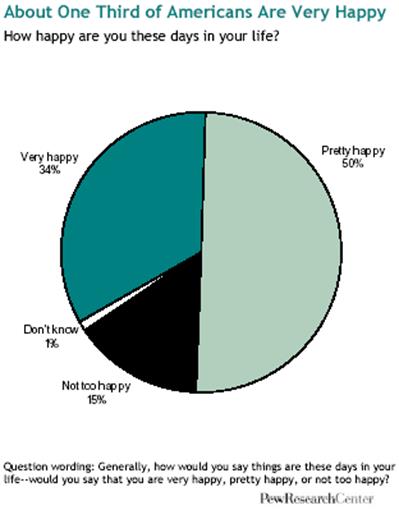
As noted earlier in this article, most conservatives are not really
very virtuous compared to the saints and so are not really very capable of much
happiness. However, this Pew polling data and this present Catholic
Candle article focus on the relative happiness of one group
of people in society, compared to a contrasting group. Of this group (viz.,
the one-third of people who respond that they are “very happy”), what traits do
they tend to have in common?
Comparing the Traits of Conservatives to the Traits of Those Persons Who
Reported Being “Very Happy”
As discussed above, conservatives are more likely to give some role (or a greater role) to God in their lives. Consistent with that, the Pew polling data shows that, one trait of those persons who report being “very happy”, is that they give God a greater role in their lives (as compared to those that answer that they are “not too happy”). Although it is true that most people are confused in matters of religion nowadays, nonetheless it is relatively better for a person to give God a place in his life, even if practicing a false religion, as compared to giving God no place. It is especially true that it is “the fool that said in his heart ‘there is no God.’” Psalm, 52.
In our age of confusion and for the purpose of the polling questions, Pew attempts to make tangible the idea of people giving God a greater role in life by asking people how often they go to church. This is not a perfect proxy but it does shed some light on this issue.
Religiosity
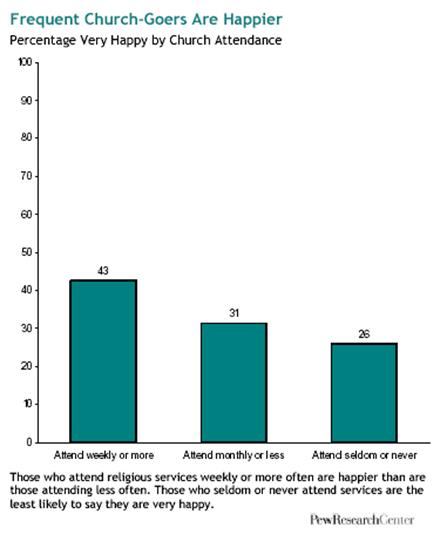
It turns out that those who describe themselves as “very happy” are also persons that attend church more frequently than those who say that they are “not too happy”. Such “church-goers” are in a relatively less-bad situation (compared to those who hold that there is no God or, if there is, they own Him nothing) because regular “church-goers” appears to recognize at least their own Natural Law duty toward God.
So, in a very rough sort of way, this poll shows what we know infallibly by our Holy Catholic Faith, viz., “Happy is that people whose God is the Lord.” Psalm, 143.
Married people, on
Average, are Happier than Other Adults.
The polling data shows that, besides giving God a larger role in their lives, another trait that happier adults have in common is that they are married. We see in the Pew Research poll (below) that 43% of married people say that they are “very happy” whereas only 24% of unmarried people say they are “very happy”. Pew Research says that “this has been a consistent finding for many years and many surveys”. 2006 Study, p.7.

This greater happiness (enjoyed by married people) is the same in both men and women, as you see below. 2006 Study page 21.

Further, this greater happiness is not only among newly-weds. Rather, it persists throughout the entire marriage. Pew Research 2006 Study page 22.

Conservatives have
a “Happiness Advantage” Because They are more Likely to get Married and Remain Married
– this Tends to Make Them Happier.
Whereas the polling data shows that, typically, people who are more likely to marry and remain married, are happier, this characteristic describes those who are more conservative (as discussed above).
This is another reason why conservatives tend to be happier than liberals. Of course, the happiness of the married (and conservatives) would be far greater if they were far more virtuous, as Aristotle proves in Nichomachean Ethics, Bk.10, ch.6.
The adjective “Republican” largely means that a person is somewhat conservative, even though not as conservative as a Traditional Catholic would know he needs to be. Likewise, “Democrat” tends to mean that a person is more liberal, as compared to a Republican. This label tends to reflect the happiness gap that we have already seen on the charts concerning religion and marriage. See the chart below.
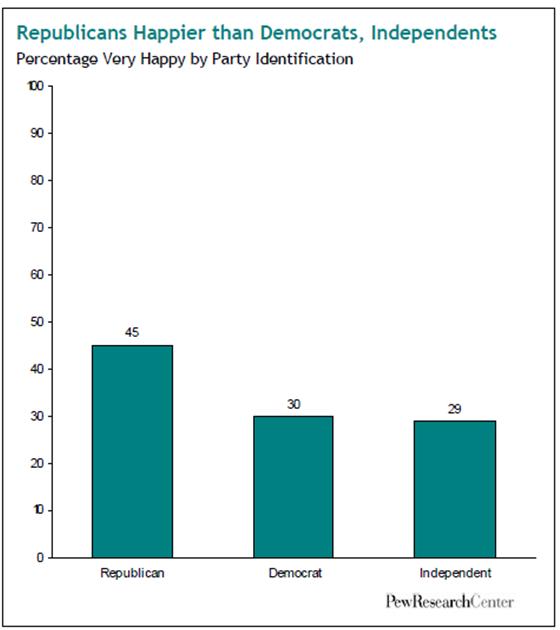
The graph immediately above is taken from: Are We Happy Yet?, page 5, Pew Research Center, results can be found here: https://www.pewresearch.org/social-trends/2006/02/13/are-we-happy-yet/
This is not surprising, since those party affiliations tend to serve as proxies for those habits of character regarding greater or lesser morality and use of reason.
As Pew Research Center explains:
Some 45% of all Republicans report being very happy, compared with just 30% of Democrats and 29% of independents. This finding has also been around a long time; Republicans have been happier than Democrats every year since the General Social Survey began taking its measurements in 1972.[9] See the graph below.
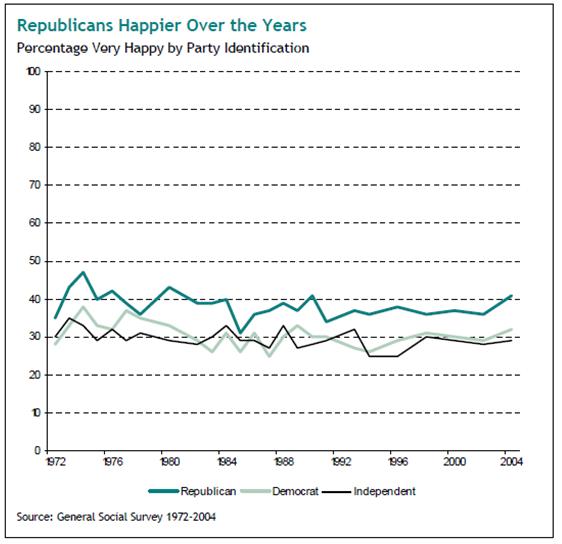
One would be mistaken to think that the greater happiness of conservatives is because conservatives tend to have more money, although it is true that they do tend to have more money. Common sense would tell us that conservatives would tend to have more money because greater wealth is a fruit of habits that are associated with conservative principles, e.g., hard work, delayed gratification, stable families, following the rules (i.e., having a “law and order” outlook), etc.
But money is not why conservatives are happier than liberals. If we compare conservatives and liberals even in the same income brackets, the conservatives in every income bracket are more likely to say they are very happy, compared to liberals, by roughly the same proportions. See the graph below.
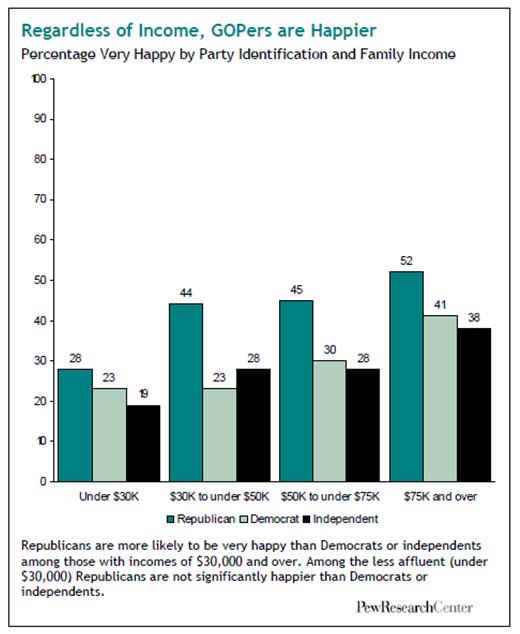
The graph immediately above is taken from: Are We Happy Yet?, page 14, Pew Research Center, results can be found here: https://www.pewresearch.org/social-trends/2006/02/13/are-we-happy-yet/
In our godless,
feminist, Marxist times, a person could (wrongly) suppose that perhaps the gender
of the poll respondent played a role in the result that conservatives are
happier than liberals. But this is false. Those respondents who are “very
happy” were about the same in each gender. 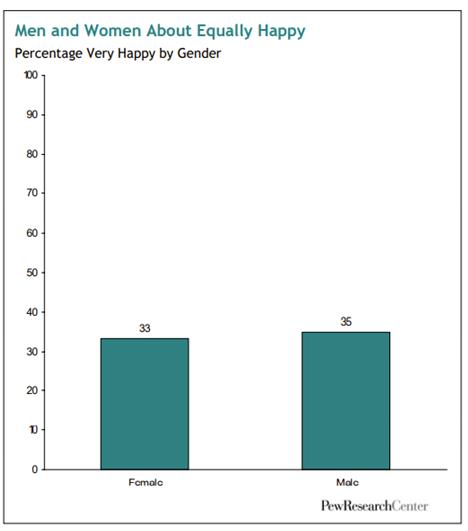
The graph immediately above is taken from: Are We Happy Yet?, page 27, Pew Research Center, results can be found here: https://www.pewresearch.org/social-trends/2006/02/13/are-we-happy-yet/
This makes sense because the happiness of the conservative life and principles is the life of relatively more virtue and use of reason and that is what makes people happier – both men and women, as Aristotle shows in the Nicomachean Ethics, Bk.10, ch.6.
This poll showing that Republicans are happier than Democrats is merely coming to the same fact as does Aristotle’s Ethics, but from a different direction. Republicans, although very far from perfect, holy, and virtuous, are relatively more likely to emphasize the importance of God, virtue, and marriage, as compared to Democrats.
(To be continued)
[1] See, Aristotle’s Nicomachean Ethics, Books 8-9 and St. Thomas Aquinas’s commentary on those chapters.
[4] Such people have so-called “friendships” which are merely convenient, comfortable, transitory liaisons, and are counterfeit “friendships” that Aristotle and St. Thomas Aquinas call “friendships of pleasure” and “friendships of utility”. See, Aristotle’s Nicomachean Ethics, Book 8, especially chapters 3-5, and St. Thomas’s commentary on Book 8 of this work.
These “friendships” are not real friendships because real friendships are based on love of the friend and a focus on the good for the friend. By contrast, “friendships of pleasure” and “friendships of utility” are based on (and focus on) the good for me, not for the friend.
Examples of so-called “friendships of pleasure” are those based on a mutual enjoyment of video games and competing against each other in racket ball, or enjoying someone’s company as a “shopping buddy”, a “travel buddy” or a “movie buddy” (so that the person does not have to engage in such activities alone).
“Friendships of utility” are not real friendships either, but are based on a good I can get out of association with that other person, e.g., when other people are impressed with me because they see that I know important people such as the particular “friend” (e.g., they see that I am a friend of the pope, the president, or the celebrity); or the “friend” sends business to the company that I operate resulting in profit; or he gives me gifts. The so-called “friendship of utility” is reflected in the ironic remark which is sometimes made concerning a rich person, who is described as having “all of the friends that money can buy.”
So, the point made immediately above this footnote, is that some people think that enjoying pleasure is the same thing as true happiness just like they think that friendships of pleasure are true friendship. Similarly, such people sometimes think that possessing money is true happiness, just as they think that their associations with others which bring them money are true friendships.
[5] See, e.g., this article regarding the similarity between the program of the Marxists and Satan. https://catholiccandle.org/2022/03/20/the-feminist-program-is-the-same-as-that-of-satan-and-marx-part-ii/
[6] This article is about the nature of happiness in the natural order, comparing conservatives and liberals. It is beyond the article’s scope to consider the happiness of those with the supernatural vocation to the religious life. However, the vocation to the religious life is a great calling and brings great happiness when this call is answered generously.
[7] Summa Theologica of St. Thomas Aquinas, Suppl., Q.67, a.1.
[8] Are We Happy Yet?, Pew Research Center, results can be found here: https://www.pewresearch.org/social-trends/2006/02/13/are-we-happy-yet/
November 2023 PDF Issue
Lesson #28 – The Resurrection of Our Lord
Mary’s School of Sanctity
Lesson #28 The Spiritual Exercises of St. Ignatius –—EXPLANATION OF THE FOURTH WEEK OF THE EXERCISES – THE RESURRECTION AND APPARITIONS OF OUR LORD
St. Ignatius devotes his fourth week of the Spiritual Exercises to the joy of the Resurrection and apparitions of Our Lord.
In this lesson we will concentrate on the first apparition of Our Lord after His Resurrection. Tradition tells us that Our Lord appeared first to His Mother.
St. Ignatius gives us the following for this first contemplation of the fourth week.
The preparatory prayer is the same as usual, I ask God Our Lord the grace that all my intentions, actions, and works may be directed purely to the service and praise of the Divine Majesty.
The FIRST PRELUDE is the history. Here, it is how after Christ expired on the cross, and His Body remained separated from the soul, yet always united with the Divinity. His soul, likewise united with the Divinity, descended into hell. There He released the souls of the just, then returning to the sepulcher, and rising again, He appeared in Body and Soul to His Blessed Mother.
The SECOND PRELUDE is the mental representation of the place. Here, it will be to see the arrangement of the Holy Sepulcher and the place or house of Our Lady, noting its different rooms: her room, her oratory, etc.
The THIRD PRELUDE is to ask for what I desire. Here, it will be to request the grace that I may feel intense joy and gladness for the great glory and joy of Christ Our Lord.
The first, second, and third points are the same that we have had in the contemplation on the Last Supper of Christ Our Lord.
The FIRST POINT is to visualize the persons at the supper, (here, Our Lord with His Mother) and reflecting within myself, to strive to gain some profit from them.
The SECOND POINT is to listen to what they say, and likewise to draw some profit from it.
The THIRD POINT is to observe what they are doing and to draw some fruit from it.
The FOURTH POINT is to consider that the Divinity which seemed to hide Itself during the Passion, now appears and manifests Itself so miraculously in the most holy Resurrection by its true and most holy effects.
The FIFTH POINT is to consider the office of consoler that Christ Our Lord exercises, comparing it with the way that friends are wont to console one another.
The COLLOQUY: Conclude with one or more colloquies according to the subject matter and then end with an “Our Father.”
Painting the Scene and Giving Considerations for the Points Above.
Our Lord was buried before the first three stars appeared in the sky on Good Friday. Our Lady came away from the Holy Sepulchre with St. John. She knew by Faith that Our Lord would rise again. Yet, her Sorrowful Heart was torn asunder with grief and she pondered deeply all that had occurred. She knew what fallen human nature was and she understood better than all other humans what the price of redemption was. She spent the next thirty-six hours in prayer and reflection.
Yes, the thirty-six hours that Our Lord’s Body lay in the tomb mark a crucial pivot point in the course of all human history because of His Resurrection which followed. He proved what He prophesied about Himself – that He would rise after three days. Our Lord died and was buried on Friday; was in the tomb all of Saturday; and for also part of Sunday, the first day of the week.
From the moment of His conception, Our Lord had all of the powers of a glorified body. Previously, He hid these powers. But now, having risen from the dead, He uses those powers. For example, this means that His Body could pass through material substances. Thus, it was that He passed through the Holy Winding Sheet and passed through the large stone that was blocking the entrance of the Sepulchre. Also, He had agility which means that He could move quickly to wherever He wanted to go. He certainly could go past the guards without them noticing Him.
What happened on Easter morning? Holy Scripture tells us that there was an earthquake and that an angel came and rolled back the stone and sat upon it. The angel’s countenance was as lightning, and his raiment was as snow. “And for fear of him, the guards were struck with terror, and became as dead men.” (Matt. 28:4)
Now let us go to the chamber of Our Lady. She suffered greatly at the foot of the Cross. Her sweet soul had been pierced by the sword of sorrows as Simeon predicted. The Church refers to this as her transfixion. No one could guess what anguish was hers as she watched her Divine Son die on the Cross.
We can imagine that she has spent her time in prayer and reflection. She meditated upon the entire life of Our Lord. She considered the Old Testament and saw how all things written about her Son were fulfilled most perfectly. She thanked God the Father for the Incarnation and the Redemption. Her heart was full of gratitude and love for the Holy Trinity. She relived the Passion and Death of her Son while she offered her sufferings in reparation for the sins of mankind. She was the only one who did not lose the Faith. Even though she longed to see the triumph of the Resurrection, she knew there was no purpose to go to the sepulcher. She could anticipate that her Dear Son would come to see her.
How fitting it was that Our Lord should go and console His Mother on Easter morning!
He showed her His triumph. He greeted His Mother and embraced her—she who by her Fiat became the cause of our joy. The visit was a long one. St. Teresa of Avila related in her autobiography that Our Lord revealed to her that Our Lady was so overwhelmed with grief that she would soon have died; and so He remained a long time with her in order to console her. Because of her great grief, it was not until several moments after He came that she was able to realize, to her immense joy, that He had come.[1]
Can we imagine what beautiful things they said to each other? Or do we simply imagine that because Mary is the masterpiece of God and her heart already had a mystical union with her Son that they simply spent their time together without any spoken words? We are free to ponder the scene in different ways and we want to be receptive to the inspirations of the Holy Ghost.
Certainly, Mary’s heart was full of joy and gladness! Her soul was enriched more than ever before.
Maybe Our Lord told her about her future mission among the apostles and the faithful. Her role as the Mother of the flock is an extremely crucial one. She would be the one to dispense the graces that He had won through His Passion and Death. Of course, she would be delighted to serve Him in such a beautiful motherly task. She would be so happy to nourish her spiritual children and help them as much as possible.
COLLOQUY:[2]
To Our Lady: Oh, my Mother Mary, you were the first to see Our Lord at His Nativity so it is fitting that you should be the first to see Him in His glorified Body. I rejoice with you O Mary!
You were the one who suffered with Him more than anyone, and died a veritable death along with your Son, and you were the only one who kept the Faith, so it is fitting that the greatest joy should be yours. You suffered so much at the horrifying death of thy Son and now your heart is filled with tremendous joy. Please help me be ever grateful to thy Son for His Passion, Death, and Resurrection. Keep me always united to thy Divine Son.
To Our Lord: Oh Dearest Lord, how can I thank Thee enough for Thine Incarnation, Passion, Death, and Resurrection! Thou hast made our Faith so rich with all of these truths. Thou art so good to us poor creatures! I thank Thee for giving Thy holy Mother Mary to be our dear Mother who always watches over us. Please help me be a faithful child of Mary.
To God the Father: I thank Thee, Dearest Heavenly Father, for the Incarnation, Passion, Death and Resurrection of Thy Divine Son. I beg Thee to help me always be grateful for my Faith and Thy mercies. I thank Thee for giving me Mary as my Mother. Thou knowest how much we need her.
Other apparitions of Our Lord that the exercitant can meditate on are:
· The apparition to Mary Magdalene
· The apparition to the two disciples on the way to Emmaus
· The apparition to Simon Peter
· The apparition to the apostles in the cenacle without Thomas (Didymus)
· The apparition to the apostles including Thomas (Didymus)
· The apparition to the apostles who were fishing
In our next Lesson we will meditate on Our Lord’s apparition to the two disciples on their way to Emmaus.
[1] This is paraphrased from the Liturgical Year by Dom Gueranger vol. VII Paschal Time Book I citing the Life of St. Teresa; in the Additions see p. 402 in the translation by David Lewis, 1870.
[2] Of course, this is only a suggestion of a possible colloquy. The exercitant can compose his own colloquy.
Is Communism Dead?
Catholic Candle note: The article below concerns the consecration of Russia which Heaven commanded to be performed by the pope and all of the bishops of the world. This command pertains to the bishops in their capacity as wielding jurisdictional power to govern the Church throughout the world. As such, the consecration can be performed by those Ordinaries who govern the Church, despite the doubtfulness that their conciliar consecrations give them the sacramental power of a bishop. For an explanation of this, please read chapters 10 and 11 of this book: https://catholiccandle.org/wp-content/uploads/2020/08/sedevacantism-material-or-formal-schism.pdf
Catholic Candle holds that a bishop should be presumed to have a valid Episcopal consecration when he is consecrated under normal conditions, by the Church in normal times. In other words, the fact that he was consecrated under the Church’s normal conditions, in normal times, causes an appropriate presumption that he is a valid bishop.
However, this presumption (of the validity of such a bishop’s consecration) could be rebutted even in normal times, by a positive doubt – even a small positive doubt – concerning the validity of his particular consecration. Read more about this principle here: https://catholiccandle.neocities.org/faith/new-ordination-doubtful.html
We hold that the consecrations performed outside these normal conditions and not during normal times, do not deserve such presumption of validity because the Church does not vouch for those consecrations. Those consecrations should not be taken as valid unless they are proven valid.
For further information about the doubtfulness of the conciliar “consecration” rite, read this analysis: https://drive.google.com/file/d/0B49oPuI54eEGZVF5cmFvMGdZM0U/view
For more about the principle that it is our duty to treat doubtful consecrations and ordinations as invalid, read this article here: https://catholiccandle.neocities.org/faith/new-ordination-doubtful.html
Is Communism Dead?
The short answer is No.
Webster’s Dictionary states that Communism is a theory advocating the elimination of private property. That is one of the main goals of Communism and Socialism. Another pillar is the eradication of our freedom to work and plan for a life on earth and salvation thereafter.
Perhaps because these Communist goals are so horrific to contemplate, most people today choose to simply ignore what this actually means and how the increasing rise of Communism is radically changing their lives and jeopardizing their salvation. It is easier for them to believe that Marxism/Socialism/Communism were discredited decades ago and that the Blessed Mother’s command in 1917 no longer applies, viz., that the pope and all the bishops of the world must consecrate Russia to her Immaculate Heart.
Wrong! The dangers of Communism are now greater than ever and Our Lady’s command is more important than ever. Our Blessed Mother gave us explicit instructions on what must be done to avoid wars and persecution of the Church.
If people will do what I will tell them, many souls will be saved, and there will be peace. The war is going to end. But if they do not stop offending God, another and worse war will break out in the reign of Pius XI. (1922-1939) [This refers to World War II.]
When you see a night illumined by an unknown light, know that it is the great sign that God gives you, that He is going to punish the world for its crimes by means of war, hunger, persecution of the Church and of the Holy Father.”[1]
To forestall this great tragedy, she asked for the consecration of Russia to her Immaculate Heart and for Communions of Reparation on the First Saturdays.
If they heed my request, Russia will be converted, and there will be peace. If not, she shall spread her errors throughout the world, promoting wars and persecutions of the Church; the good will be martyred, the Holy Father will have much to suffer, various nations will be annihilated…”[2]
Well, what do you think? Has the world taken her warning to heart? Have people become more religious, more devout? Or even more law-abiding?
On the contrary. Because Rome did not heed Our Lady’s admonition, many of these things have come to pass. The civilized world is suffering because Russia continues to spread her errors, causing widespread chaos. We have a bad pope who also is head of the anti-Catholic conciliar church; (thus, we don’t expect him to consecrate Russia,[3] despite the occasional attempts at consecration that various (so-called) bishops have tried. (Note: Our Lady specified that the consecration must be done universally, by the pope and all the bishops at the same time.)
Worldwide, there are currently two major wars and many smaller conflicts. The number of vocations and people attending church are greatly decreased. Although in most or all places in the world, faithful and informed Catholics have nowhere to attend Mass because they have no access to an uncompromising priest, this is not the reason for greatly decreased church attendance throughout the Western World. Instead, church attendance is way down because people ignore God, not because they shun compromising priests.
Public immorality is rampant. Satan worship is on the rise. Abortion is considered a “right” (by some tortured use of the word). Birth control is a matter of convenience. Hundreds of thousands (some say, millions) of vulnerable children have been brainwashed into believing they are not who they thought they were and are in need of ongoing surgeries and unending “treatments.” (The implication is that “God made a mistake.”)
We are edging toward complete lawlessness, as demonstrated by the following:
ü Moves to defund the police;
ü No cash bail for criminals (i.e., so they are free to commit more crimes until their trials come up – if they’re still around);
ü Smash and grabs thefts from stores are increasingly common, and in many cities (e.g., San Francisco) the police ignore the thefts unless the value of the goods stolen is over $1,000;
ü Arson and rioting are accepted and tolerated; and
ü Blatant corruption is in the highest levels of government.
The goal of this Marxist push is to make citizens feel so unsafe that they will demand that the government should implement a police state, as happened in the Communist takeover of Russia during the Bolshevik (Communist) Revolution of 1917.
The governments throughout the Western World will continue with their insane upside-down policies and attack anyone pushing back against them. One example of the increasing U.S. police state is the leftists weaponizing the FBI – as happened in Virginia recently when the FBI placed “spies” in more conservative “Latin Mass” churches, until a whistleblower disclosed this fact publicly, after which this spying was supposedly stopped and the FBI policy memo was quietly withdrawn.
Unfortunately, most people have a very obscured understanding of the difference between right and wrong, between the true and the false, and between good and evil. Such people (and their parents and their children) have been “educated” in an educational system which, for the past 70 years, has been predominantly left-wing.
The planned convulsions in society, the riots, the attacks on the family, and the full-tilt assaults on every aspect of our culture are all direct results of failure to follow Our Lady’s command at Fatima.
Not a rosy picture, is it? Were it not for realizing that God knows what is going on here in the world He created, it would be panic-time. As it is, He expects us to keep up the good fight and trust in His love for us. Thus, our job is to live the Catholic life and hold the Catholic Faith without any compromise. Let us do this without fear!
[1] Mother of Christ Crusade, Fr. John de Marchi, I.M.C., (Published by the Mother of Christ Crusade, 1947,) Chapter V.
[2] Mother of Christ Crusade, Fr. John de Marchi, I.M.C., (Published by the Mother of Christ Crusade, 1947,) Chapter V.
[3] For an analysis of why the pope’s 2022 “consecration” did not fulfill Our Lady’s command, read this article: https://catholiccandle.org/2022/04/20/did-the-popes-consecration-fulfill-heavens-command-no/