Lesson #22 – The Trials of the Holy Family

                    Mary’s School of Sanctity                   

Lesson #22 – The Spiritual Exercises of St. Ignatius – SECOND WEEK – THE 3rd, 4th, and 5th CONTEMPLATIONS – THE TRIALS OF THE HOLY FAMILY

St. Ignatius has the exercitant study Our Lord’s life in detail.  

St. Ignatius tells us to repeat the first and second contemplation and use these as our third and fourth contemplation.  However, in his fifth contemplation/meditation, he wants the exercitant to put as much of his five senses into the imagining of the circumstances and scenes as possible.  St. Ignatius tells us that just as we use our imagination to see and hear the subjects of our contemplation, we should now try to use our sense of smell, taste and touch as well.  How do we do this in our imagination?  He tells us to smell the infinite fragrance and taste the sweetness of the Divinity, and the virtues of the persons of whom we are contemplating.  Also, he suggests to us to use our sense of touch by ‘walking’ in the places of the persons we are contemplating about and likewise to embrace and kiss the venerable places we are visiting in our imagination during these contemplations.   In this way, St. Ignatius wants us to draw more and more fruit out of each meditation.  He wants us to make many considerations from pondering Our Lord’s Life so we can come to conclusions and thereby imitate Our Lord better.

For our purposes here, we will endeavor to set up the contemplations in the similar manner that we used in the first two contemplations of the Incarnation and the Nativity.  We encourage the reader to include his other senses by applying his imagination as St. Ignatius suggests above.  Then the Spiritual Exercises become our personal pilgrimage into the Life of Our Lord as we follow in His Footsteps and make our study of His Virtues in His Hidden Life and then later on in these Exercises for His Public Life.

We must keep in mind that St. Ignatius has set out the Spiritual Exercises to be done over a period of a month with the different meditations to be done in various times during the day and some of them to be actually done during the night.  However, for our treatment of the Exercises here, we intend to give the substance of the various meditations and the reader, being the exercitant, can plan his schedule to do the Exercises when he sees fit.

So, in the second week of the Spiritual Exercises we can see how St. Ignatius has us go through several scenes of Our Lord’s Life.  We can take topics from the Gospel of Our Lord’s Life before He began His Public Life.  For this particular lesson we will set out the contemplation/meditation of the Trials of the Holy Family.  Of course, a separate meditation could be done on each of the Trials.  We will consider the Flight into Egypt, the Return from Egypt and the Finding of the Child Jesus in the Temple.  First, we will set out the topics in the same manner St. Ignatius gave us for the Incarnation and Nativity.  Then we will give the actual Scriptural accounts of these three trials and lastly, we will give some possible considerations one could use when meditating on these trials.  Thus, this lesson will be basically the substance of three separate meditations given one after another.


The Flight into Egypt

The preparatory prayer is the same as usual, I ask God Our Lord the grace that all my intentions, actions, and works may be directed purely to the service and praise of the Divine Majesty.

The FIRST PRELUDE: I will to recall to mind the history of the subject I am about to contemplate.  Here it will be how the Holy Family had to flee to Egypt in order to save the Life of Our Lord who was threatened at the hands of Herod.  

The SECOND PRELUDE: I will ask for the grace that I desire.  Here I will ask for an intimate knowledge of Our Lord, Who wants me to imitate Him, that I may love and follow Him better.  I also will ask for the grace that I may follow the holy examples of Our Infant Lord, Our Blessed Mother, and St. Joseph, the foster father of Our Lord.

The FIRST POINT: First, I will SEE the three kings making inquiries about the birth of Our Lord, the King of the Jews.  I will likewise SEE Herod’s reaction and the events surrounding the visit of the three kings to the King of kings.  Then I will SEE how, after being warned in sleep, the kings took a different route back to their native lands.  I will SEE the angel warning St. Joseph in his sleep to flee.  Immediately following this, I will SEE St. Joseph awaking Mary and the Holy Family fleeing immediately.  I will SEE how Herod is incensed with anger when he perceived that he was fooled by the holy kings.  Further I will SEE the results of Herod’s rage.  I will SEE the Holy Family all during their exile in Egypt, their journey there being sorrowful while they know many innocent little ones will be murdered as substitutes for the Infant King, etc.

The SECOND POINT: I will HEAR the excited and troubled crowds witnessing the coming of the foreign kings.  I will HEAR the hurried confusion of the people as the soldiers hunt down the infant boys two years old and younger.  Especially I will LISTEN to the wailing and lamenting as Herod’s soldiers butcher all of the Holy Innocents.   

The THIRD POINT: I will CONSIDER the actions of St. Joseph and Our Lady.  I will consider the angel telling St. Joseph in his sleep what God’s will is for him and the Holy Family.  

The COLLOQUY: I will now think of what I should say to the Infant Jesus, St. Joseph, and Our Lady.   I will ask help according to the need that I feel within myself, so that I may more closely follow and imitate Our Lord Who as an Infant is already suffering the malice of His creatures and has just fled into Egypt as an exile from His homeland.  I will close with the “Our Father” 

Let us begin by reviewing the Scriptural Text regarding this event.  [These verses are from St. Matthew 2:1-18]

When Jesus therefore was born in Bethlehem of Judah, in the days of king Herod, behold, there came wise men from the East to Jerusalem, saying: Where is he that is born king of the Jews? For we have seen his star in the East, and are come to adore him.

And king Herod hearing this, was troubled, and all Jerusalem with him. And assembling together all the chief priests and the scribes of the people, he inquired of them where Christ should be born.  But they said to him: In Bethlehem of Judah. For so it is written by the prophet:  And thou Bethlehem the land of Judah art not the least among the princes of Judah: for out of thee shall come forth the captain that shall rule my people Israel.

Then Herod, privately calling the wise men learned diligently of them the time of the star which appeared to them; And sending them into Bethlehem, said: Go and diligently inquire after the child, and when you have found him, bring me word again, that I also may come and adore him.

Who having heard the king, went their way; and behold the star which they had seen in the East, went before them, until it came and stood over where the child was.  And seeing the star they rejoiced with exceeding great joy.  And entering into the house, they found the child with Mary his mother, and falling down they adored him: and opening their treasures, they offered him gifts; gold, frankincense, and myrrh.

And having received an answer in sleep that they should not return to Herod, they went back another way into their country.  And after they were departed, behold an angel of the Lord appeared in sleep to Joseph, saying: Arise, and take the child and his mother, and fly into Egypt: and be there until I shall tell thee. For it will come to pass that Herod will seek the child to destroy him.

Who arose, and took the child and his mother by night, and retired into Egypt: and he was there until the death of Herod:  That it might be fulfilled which the Lord spoke by the prophet, saying: Out of Egypt have I called my son.

Then Herod perceiving that he was deluded by the wise men, was exceeding angry: and sending, killed all the men children that were in Bethlehem, and in all the borders thereof, from two years old and under, according to the time which he had diligently inquired of the wise men.

Then was fulfilled that which was spoken by Jeremias the prophet, saying:  A voice in Rama was heard, lamentation and great mourning; Rachel bewailing her children, and would not be comforted, because they are not.

Considerations for the FIRST POINT: to use the sense of sight:

·          SEE all of Jerusalem being disturbed because of the entourage of the three kings.  They do not know what to do about these kings.

·         SEE how upset Herod is.  He cannot rest until he has removed all perceived ‘threats’ to his throne.

Let us set out some background facts and briefly see the events.  Then we will add more details as we describe what we would hear and the actions we should consider.

We must keep in mind that Herod is not a Jew and he was the first foreigner to be appointed king of the Jewish nation.[1]  With fallen human nature it is easy to see why Herod was anxious not to lose his position which was given him by the Romans. 

Also, it is sad to consider that the people were not enthused to have their Savior born.  Scripture says that all Jerusalem was troubled along with Herod.  We must not forget that these poor people were not informed properly by their leaders and were not given good examples of piously awaiting the Messiah.

The three kings came with their train of servants and camels.  They had been studying the heavens and had been following a very unusual star.  Providence had the circumstances be such that the kings who had been following this star for such a long distance, now lost the star and therefore believed that they needed to make inquiries of the local king.  Providence knew that Herod would get upset by their news of what they had seen and were now seeking.  Indeed, God wanted Herod to know this information because God knew that Herod would become enraged in his jealousy and ruthlessly seek to kill the first Martyrs in the New Testament – the Holy Innocents.

The star then appeared again and pointed the kings to the house where the Infant King was.  Of course, the three kings did not hesitate to pay homage to the Messiah of mankind.

We can imagine the kings adoring Our Infant Lord and giving His parents gold, frankincense, and myrrh.  The Blessed Mother and St. Joseph know the significance of three precious gifts: Gold to honor the Divine Royalty of Our Lord; frankincense to adore Him as their God made Man; and myrrh to prepare Him for His redemptive Sacrifice.  

Upon leaving to return to their respective native countries the three kings were warned in a dream not to return to give Herod any information regarding this Holy Infant.  Also, St. Joseph was awakened by an angel and told to flee at once in order to rescue Jesus from the hands of a jealous earthly king, namely, Herod.

We watch in our imagination as St. Joseph meekly awakens Mary to tell her they must depart at once.  We can observe them gathering what few possessions they have and leaving quickly.

Imagine the scene as the Holy Innocents are butchered.  See the bloody swords of Herod’s henchmen, his soldiers, carrying out his attempted Deicide.

Considerations for the SECOND POINT: HEAR the people conversing in excitement about the kings being in town.  They are disturbed about the rumor that these kings are seeking the King of the Jews who has now been born.  These people are not interested in the King of kings.  Hear also what the angel is telling St. Joseph.  Then try to imagine what St. Joseph is telling Mary.

Imagine the hubbub and noise in the small town where gossip spreads quickly.  The crowds were naturally curious about the foreign kings that arrived.  When they heard the three kings were seeking a new king of the Jews, they were bewildered as to what this could mean.

Contrast in your imagination this confusion with the sweet and respectful visit the three kings made to Our Infant King.  Perhaps there was not much conversation but surely devout reverence was paid to Our Dear Lord, for Scripture tells us that they fell down and adored Him.    

Imagine the angel giving St. Joseph the urgent warning about the threat to the life of the Divine Infant.  

Imagine St. Joseph gently waking Mary and telling her of the warning of the angel.  They do not speak much but make all haste to get away.

As the Scripture tells us, after the three kings were informed by the angel to not revisit Herod, they decided to return to their native lands by a different way.  Herod, because he was a vicious man, began to suspect that the three kings deceived him.  He was in a fury!

Imagine his angry outburst to his court and soldiers as he ordered that all the male children two years old and younger should be killed in Bethlehem and in all the surrounding areas.  He wanted to take precautions because he wanted absolutely no rivals for his throne.

We can also imagine the great lamentations that occurred in all those homes where this massacre of the Holy Innocents occurred.  The soldiers grabbed the little ones out of the arms of their wailing mothers.  What must it have been like for all those women when they heard what was happening all over town and the countryside and then knowing and anticipating what awaited their own infant sons?  Imagine all those grieving mothers and fathers witnessing the horrifying death of their little ones.  Imagine their grief was made so much worse because they didn’t understand why Herod had commanded this dastardly thing to be done.

Considerations for the THIRD POINT: Consider of the Holy Family’s flight into a foreign land full of pagans.   Consider the Holy Family imagining the fury of Herod and murdering so many male infants in his blood-thirsty attempt to kill the Babe he perceived to be the rival to his throne.

Now we must put our scene together and consider all the actions of all of those involved.  Since we have painted the sights and sounds about Herod and the townsfolk so graphically above, we leave it to the exercitant to fill in the details in his imagination.  We now turn our thoughts more particularly to the Holy Family.

First, let us think about the terrifying escape in the night.  Then we will reflect upon some other aspects of the sufferings of the Holy Family.

While he was sleeping, St. Joseph received the command to leave.  He arose at once and was prompt in his obedience to the angel.  As Fr. Hurter puts it, “Yet in that very night St. Joseph rises at once and with a heavy heart wakes Mary who needed sleep.  God calls; that was enough for him to obey at once.”[2]

Fr. Hurter points out four basic, poignant aspects. 

But what consoled them, what comforted them?

a. The thought—it is the will of God; and that will they esteemed above everything.

b. The thought—our heavenly Father watches over us, guides and directs us.

c. The thought—it is done for Jesus to save His life; and for doing that no sacrifice was too great for them, no effort too much, no suffering too severe.

d. The thought – Jesus is with us.  The consciousness of this sweetened everything for them.  One look at the dear little infant Jesus and fatigue vanished and hardships were forgotten.  With this fourfold thought we also should try to console ourselves in our sufferings and little crosses.[3]

Yes, the danger was real and great.  If they tarry the Infant would be destroyed by Herod’s command.

This hasty departure into exile leads us to ponder another aspect in the fact that God wanted the Holy Family to suffer privations.  We can consider why Our Lord wanted to suffer still more and to practice poverty more strictly—to have to go to a foreign land and suffer still greater wants.  Oh, how Our Lord loves poverty! 

We must remember that St. Joseph left his carpentry work in Nazareth in order to obey the decree to go back to the city of David.  Hence, Our Lord was forced to be born in dire poverty in a stable.  And now the command comes for the Holy Family to leave their homeland and go into exile.  What an additional bitter cross!

Yet, Our Lord chose this cross for Himself and His parents so they could be an example for us of being completely detached from things of this world.  Plus, the Holy Family’s suffering is meant to teach us to trust in God’s loving Paternal care of us.  We must not complain but accept God’s Will no matter what comes.  We must work and do what we can but must also know that God will provide for us when we do His Will.

Therefore, St. Joseph did not murmur but accepted this cross which was a heavier one due to the fact that the future was unknown.  How should he get to Egypt?  He had never been there before.  It was the dark of night and very dangerous to be travelling to an unknown place and over dark, potentially thief-infested, roads.

Also, St. Joseph was a prudent planner for the future needs of his family.  He must have pondered what kind of carpentry prospects he would have in Egypt, as they hastily left Bethlehem to go there. 

We must bear in mind, too, that Egypt is a pagan country.  No doubt Our Lady and St. Joseph were considering the spiritual heartache that awaited them where Satan was worshipped in the form of idols.  This land of Egypt was full of foolish superstition and massive confusion.  Indeed, it is a land and people hostile to the descendants of the Israelites. 

Although St. Joseph and Mary must have wondered what they will do in such a pagan land, they humbly submit to God’s Will.  What heroic obedience!  What humble trust in God!

One additional heartache both Mary and St. Joseph must have suffered was the thought that Herod, being such a wicked man, would stop at nothing to get what he desired.  The angel did say, “For it will come to pass that Herod will seek the child to destroy him.”  In fact, Herod was truly capable of any sort of malice.  Most likely they knew Scripture predicted that there would be a mass murder of children in Rama.  Hence, Mary and St. Joseph would feel such compassion on all those families who would be afflicted by Herod’s malice.  They knew that those children were killed in the place of Christ.  They prayed for those families.

Concluding thoughts:

So, carrying their precious Bundle, Our Infant Savior, they flee as quickly as they can on the dark obscure road which leads to the foreign pagan land.  They are ready to accept whatever God has in store for them.  They cling to Jesus, knowing that they are rescuing Him, but also that He, as God, is holding them safely in His Hands.

The COLLOQUY:  Dearest Infant being swept away from Herod’s danger by Thy dear Parents, I thank Thee for such marvelous examples of charity, humility, and long-suffering.  Please assist me to imitate Thy virtues for I am so weak.

Dear St. Joseph, I thank thee for thine example of calmly doing thy duties.  Thou art such a model of leadership.  I want to follow thy example of complete resignation to the will of God.  Please intercede for me and guide me.

Oh, tender Mother Mary, I thank thee for thine example of complete submission to God through thy humble submission to St. Joseph.  I admire your patience in all the hardships that thou hast endured.  Please teach me patience in suffering.

Oh, Holy Family, help me work out my salvation.  Guide and protect me.

Oh, dear sweet innocent victims of Herod’s jealousy, you have spilled your blood as victims in substitution for Him Who in thirty-three years will shed His innocent blood for your Redemption.  How precious it is to me to ponder all of you waiting in the Limbo of the Fathers until the day when Our Savior brings you into heaven with Him.  Your precious martyrdoms are a hope for me.  Pray for me, oh Holy Innocents, for I am still a sojourner in this confusing world.


The Return from Egypt

The preparatory prayer is the same as usual, I ask God Our Lord the grace that all my intentions, actions, and works may be directed purely to the service and praise of the Divine Majesty.

The FIRST PRELUDE: I will recall to mind the history of the subject I am about to contemplate.  Here it will be how the Holy Family finding out that Herod was dead and St. Joseph being informed in a dream to settle in Nazareth.

The SECOND PRELUDE: I will ask for the grace that I desire.  Here I will ask for an intimate knowledge of Our Lord, Who wants me to imitate Him, that I may love and follow Him better.  I also will ask for the grace that I may follow the holy examples of Our Blessed Mother and St. Joseph, the foster father of Our Lord.

The FIRST POINT: First, I will SEE the Holy Family returning to their native country after having been in exile for some considerable length of time.

The SECOND POINT: I will HEAR what St. Joseph and Our Lady may be saying to one another.

The THIRD POINT: I will CONSIDER all of the hardships of this move back to Israel and settling anew in their native country. 

The COLLOQUY: I will now think of what I should say to the Child Jesus, St. Joseph, and Our Lady.   I will ask help according to the need that I feel within myself, so that I may more closely follow and imitate Our Lord Who has just returned from the sad exile in Egypt. I will close with the “Our Father”

Let us review the Scriptural Text for this next trial of the Holy Family.  [These verses are from St. Matthew 2:19-23]

But when Herod was dead, behold an angel of the Lord appeared in sleep to Joseph in Egypt, saying: Arise, and take the child and his mother, and go into the land of Israel. For they are dead that sought the life of the child.  Who arose, and took the child and his mother, and came into the land of Israel. 

But hearing that Archelaus reigned in Judea in the room of Herod his father, he was afraid to go thither: and being warned in sleep retired into the quarters of Galilee.  And coming he dwelt in a city called Nazareth: that it might be fulfilled which was said by the prophets: That he shall be called a Nazarene.

Considerations for the FIRST POINT: to use the sense of sight

SEE St. Joseph being informed in a dream again to return back to his homeland.

Fr. Hurter informs us that, “Despite all precaution, death soon put an end to the reign of Herod. He promised himself decades of years, but the vengeance of God soon overtook him.”[4]

The Church historian Bishop Eusebius tells us how Herod was struck by a sickness which consumed him.  He had a mild fever which corrupted his innards and gave him an overpowering desire for food, ulcers in his intestines and gangrene to his male organs which produced worms.  He eventually stabbed himself and, as he lay dying, he ordered the death of his third son, Antipater.  Upon giving this dreadful command he died instantly in agonizing pains.[5]  Truly a fitting end for such a vicious man!

St. Joseph was then informed again by the angel to make a journey – this time, back to Israel.  Imagine St. Joseph once again obeying the command of God, without murmuring and with promptitude.  He and Mary and the young Child Jesus gathered their few belongings and began their track back.  This meant that once more, despite any home they were able to make or carpentry business that Joseph had established, they leave all of that behind and start back to Israel.

They trusted in God when they left Israel, trusted Him the whole time they were in exile, and now they do not hesitate to trust in Him as they return.

St. Joseph being always cautious and prudent deliberated about where he should take his family to live.  He had heard that Archelaus, the son of Herod, was now ruling.  This made him wonder if living in Bethlehem would be safe.  The angel now instructed St. Joseph to settle in Galilee.

Now that we have painted the rough sketch of events, let us try to reflect on what was said.

Considerations for the SECOND POINT: HEAR what St. Joseph and Mary might say during their journey back with the young Child Jesus.

 St. Joseph tells Mary what he has learned from the angel of God.  She does not doubt St. Joseph and docilely prepares for their departure back to Israel.  They no-doubt would say prayers of thanksgiving that the danger from Herod is past.  So, they make their journey back in much quiet prayer and reflection.

Fr. Hurter gives us these words to reflect upon:

Mary and Joseph waited with patience and resignation in a strange land, until the angel came with the glad tidings: “Arise and take the child and his mother, and go into the land of Israel.”

Let us persevere in patience and resignation under the crosses which the Lord sends us, because he wills it, as long as He will it, and as he wills it. May the dear little infant Jesus breathe His spirit into us that after His example we must submit to trials, practice patience, and persevere for as long as He wishes.[6]

Considerations for the THIRD POINT: CONSIDER THE ACTIONS of the Holy Family as they fulfill God’s Will in returning to Israel, namely, settling in Nazareth in order to fulfill Scripture.

Let us now penetrate deeper into the hardship of having to move again.  St. Joseph, as the head of a family, knew how difficult it would be to basically have to start his business afresh.  It has been a long period of time since he and Mary departed Nazareth to travel to the town of David.  What would the people back in Nazareth think of the Holy Family?  Would they wonder why this couple never returned after the census?  This couple abandoned their tiny house and no one has heard anything about them.  The carpentry shop was abandoned too.  This was indeed very strange.

Then, suddenly, this couple returns with a young Child.  What would the townspeople think of this event?

And yet, St. Joseph and Mary accept all of the perhaps cruel gossip that had been told about them. They do not try to explain what has happened.  They would quietly set about picking up their former life in Nazareth.


Concluding thoughts:

What great admiration do we not owe to the Holy Family, for their fortitude and patience in all that God had sent to them!  We frail humans are so far from such resignation and virtue!  Instead, we wretched humans complain, so often, at least internally when inconveniences come our way.   So many lessons we can learn from the dear Holy Family!  They were extremely blest and also extremely tried.  God wanted them to grow in virtue and be a model for all of us.  How truly edifying they are!

They lived in want and poverty and strict obedience to the commandments of God.  It is as if we cannot have enough esteem for them!

COLLOQUY: With what an overflowing heart do I now address Thee, O Holy Child!  I see with what Providence Thy Heavenly Father has cared for Thee!  Help me O Divine Child to trust in God always.

Dear Holy Parents, teach me how to imitate thy trust in God and thy fortitude. When my life is full of trials, I will reflect how mine are nothing in comparison with yours. Guide me and teach me in all things.


The Finding of the Child Jesus in the Temple

The preparatory prayer is the same as usual, I ask God Our Lord the grace that all my intentions, actions, and works may be directed purely to the service and praise of the Divine Majesty.

The FIRST PRELUDE: I will recall to mind the history of the subject I am about to contemplate.  Here it will be how Our Lord’s Parents found Him in the Temple when He was twelve years old.

The SECOND PRELUDE:  I will ask for the grace that I desire.  Here I will ask for an intimate knowledge of Our Lord, Who wants me to imitate Him, that I may love and follow Him better.  I also will ask for the grace that I may follow the holy examples of Our Blessed Mother and St. Joseph, the foster father of Our Lord.

The FIRST POINT: First, I will SEE St. Joseph and the Blessed Mother bewildered when they discover that the Boy Jesus had stayed behind in Jerusalem.  I will accompany them as they return in their anguish to look for Him.

The SECOND POINT: I will HEAR what they may be saying and what the doctors in the Temple are possibly discussing with the Boy Jesus in the Temple.

The THIRD POINT: I will OBSERVE and CONSIDER what the Holy Parents are doing, suffering and their joy in finding their Divine Son in the midst of the Doctors. 

The COLLOQUY: I will now think of what I should say to each to the members of the Holy Family, starting with Our Lord, the boy Jesus, St. Joseph, the head of the Holy Family, and Our Dear Blessed Mother, the refuge of sorrowing parents who seek the salvation of their children.  I will ask help according to the need that I feel within myself, so that I may more closely follow and imitate Our Lord.  I will close with the “Our Father”

Let us review the Scriptural Text for this third trial of the Holy Family that we are studying in this lesson.  [These verses are from St. Luke 2:41-52]

St. Luke ch.2: 41-52

And the child grew and waxed strong, full of wisdom: and the grace of God was in him.  And his parents went every year to Jerusalem, at the solemn day of the Pasch. And when he was twelve years old, they going up into Jerusalem, according to the custom of the feast, and having fulfilled the days, when they returned, the child Jesus remained in Jerusalem. And his parents knew it not.

And thinking that he was in the company, they came a day’s journey and sought him among their kinsfolks and acquaintance. And not finding him, they returned into Jerusalem, seeking him.

And it came to pass, that, after three days, they found him in the temple, sitting in the midst of the doctors, hearing them and asking them questions. And all that heard him were astonished at his wisdom and his answers.

And seeing him, they wondered. And his mother said to him: Son, why hast thou done so to us? Behold thy father and I have sought thee sorrowing. And he said to them: How is it that you sought me? Did you not know that I must be about my father’s business?

And they understood not the word that he spoke unto them. And he went down with them and came to Nazareth and was subject to them. And his mother kept all these words in her heart. And Jesus advanced in wisdom and age and grace with God and men.

 Considerations for the FIRST POINT: I will SEE St. Joseph and Blessed Mary on their journey home and discovering that the Child Jesus is not among their kinfolk.  Also SEE them returning back to Jerusalem in haste to look for the Child Jesus.  SEE them entering the Temple and witnessing their dear Son discoursing with the wise ancients. SEE Our Lord meekly returning home with His parents. 

Before delving into the details of this trial of the Holy Family, there is some important background information to understand. We will allow Fr. Hurter to help us paint the scene.  Fr. Hurter tells us, “The hidden life of Our Lord was simple and uniform.  He passed His time in prayer and work.”[7]

The only change to their routine was the yearly visit to Jerusalem for the great holy days.  In fact, this yearly journey was a big sacrifice for the Holy Family.  We must be mindful that St. Joseph was faithful in keeping the law.  It should make a deep impression on us to remember how Our Lord did not exempt Himself from the law. Furthermore, we see how Mary also was zealous for the honor of God.  

Fr. Hurter has the following moving description of the Holy Family:

[This was] a real pilgrimage of prayer, silence and many privations.  Observe with what reverence they enter the temple, with what fervor they pray, with what heartfelt devotion they make the prescribed offerings.  Consider the sentiments which filled our Divine Savior, Mary and Joseph at their appearance before the Most High, and how long they persevered there in prayer until finally the time came for them to return.  Let us dwell on this touching sight for our edification.[8] 

An interesting comment that Fr. Hurter makes is that when the feast days were over, Blessed Mary and St. Joseph returned home with heavy hearts because they did not have the temple in Nazareth, and they loved this holy place so much.  This was how intensely they loved the service to God!

And so this heartache was with them yet another time.  However, this time they depart from Jerusalem, and without knowing it, they leave the source of all their love, the Child Jesus Himself, behind.

We see them travel “a day’s journey” (as Sacred Scripture says) and only then do they come to realize that the Child Jesus is not in the travelling group.  Of course, they hurry back to Jerusalem.

Then three days of anguish are their portion as they hunt for Him everywhere.  It is only after these days pass that they find Him in the Temple amidst the doctors. Imagine their delight at seeing Him and their amazement in hearing Him discoursing with these wise men.

His Mother speaks with Him briefly.  Then we see the Holy Family quietly withdraw and leave Jerusalem to head for home.  The Holy Son is subservient to His Mother and Foster Father.  We see Him ever meek and humble of heart.

Considerations for the SECOND POINT: HEAR what St. Joseph and Blessed Mary might say as they inquire everywhere concerning their dear Son.  HEAR the fascinating questions and answers that the ancients are discussing with the Divine Child.

Having set the scenes of this great trial of St. Joseph and Our Lady, let us spend some moments pondering the words spoken. What did the holy parents say to each other when at the end of the first day’s journey they met and realized that the Holy Child was neither of them?  They did not rebuke each other or blame each other for this mishap.  They soberly resolved to go back to Jerusalem.

They spend three days looking longingly for Our Lord.  We can well imagine them asking many people if they had seen a boy of Our Lord’s description.  Their sorrow grew with each answer in the negative.

Finally, they search one last time at the Temple, and this time they hear a Voice that they recognize—it is the Lord!  Imagine their surprise when they heard the doctors of the Law asking questions of Someone and the response of their young Son is heard in the room.  They look in the direction of the Voice and see the Child Jesus speaking in succinct answers explaining the Law and Scriptures to the group of learned men.  Imagine their delight at finding Our Lord safe.  They knew the Scriptures that the Son of Man must be put to death and yet they did not know when this would happen.  Recalling the horrific malice of Herod, perhaps they thought while they searched, that now might be the time that someone would try to kill the Child Jesus.  How very relieved they are that they found Him!

Listen to Our Blessed Mother as she asks, “Son, why hast Thou done so to us? Behold thy father and I have sought Thee sorrowing?”

This is not to be thought of as a complaint, but merely the anguish of her Immaculate Heart.  The words of Simeon have been echoing in her heart these three days, “And thy own soul a sword shall pierce, that, out of many hearts, thoughts may be revealed.”[9] Yes, God wanted her to feel this intense sorrow of having lost her Son so that parents who lament the loss of a wayward child would be all the more willing to fly to Holy Mary’s heart, begging the assistance of one who knew well this exquisite spiritual suffering. 

Then His reply to her question was not meant as a disrespectful rebuke to His Mother, but a statement of a fact about Providence. “How is it that you sought Me; did you not know I must be about My Father’s business?”

This mysterious answer shows that God’s Providence is often hidden from us but the faithful Mother will keep and treasure His Words in her heart, pondering them again and again.  She is not angry.  He is Divine and she is not.  His Father’s business must have been urgent and she humbly submits to the Divine Will.

Considerations for the THIRD POINT: CONSIDER THE ACTIONS of the Holy Family as they fulfill God’s Will in returning to Jerusalem to do their part to look for the Child Jesus.  Consider the surprise of St. Joseph and Blessed Mary when they find Our Lord in the Temple.  Consider their relief to find Him alive and unharmed. Consider the humility in which they heard the solemn words of the Child Jesus stating that He was doing His Father’s business.

At this point we will strive to appreciate the depths of Providence’s mysterious Plans.  By reviewing the events of this momentous trial, we can get a better view of this most distinguished couple of all human history.  Let us look at their actions and the actions of Our Lord to get a better understanding of the virtues possessed and which were augmented in this trial.  Not only did Providence send this suffering to St. Joseph and Blessed Mary, but He wanted us to study them and learn how to suffer the most grievous crosses humbly and virtuously.

Now is a fitting time to share some piquant points from Fr. Hurter.

In investigating why God manifested His Will in this way, we see clearly that God wanted St. Joseph and Blessed Mary to have these sufferings to teach us the following lessons as Fr. Hurter says:

But our Divine Savior, at the bidding of His Heavenly Father, remained in the temple without letting His mother and foster father know, although He foresaw their sorrow.  But when God calls, human consideration must be set aside, and we must not consult flesh and blood; we must make sacrifices.[10]

We can also believe that Our Lord did not concern Himself with either food or shelter on these three days.

 And yet another lesson about how Providence sometimes acts:

Consider furthermore how our Divine Savior withdraws even from good and pious souls without a fault of theirs, to their great sorrow.  He withdraws sometimes in punishment for venial sins, because of sloth that has crept in, because of too great attachment to creatures, with whom He does not wish to divide His rule.  And sometimes He withdraws, but for no fault whatever, as in the present case.  Neither Mary nor Joseph was to blame that the Child remained behind.  Why does the Lord withdraw even from holy souls so that they do not perceive His presence and feel entirely abandoned and disconsolate?  It is to try them; to give them opportunities for many good works, and to ground them more and more in virtue.[11]

Another lesson which applies to how we poor sinners should react to Providence:

When Mary and Joseph realize that Our Lord is not with them, “they search for Him among relatives and acquaintances, but they do not find Him.” So too, if the Lord withdraws from us and takes away His consolation, we shall not find Him among creatures, among flesh and blood, and in entertainments.  We must go back to Jerusalem, to the temple, have recourse to the tabernacle; there in prayer we shall find Jesus the Lord, our lost consolation.[12]

A further lesson showing Our Lord’s humility:

“What modesty does not our Divine Savior manifest?  He could have put the Scribes to confusion and made His superiority felt, but He did not step out of the role of a boy and only asked and answered questions.  Let us take to heart the significant words He spoke to Mary: “Did you not know that I must be about My Father’s business?”  That should be the program of the priest.  He should be intent on the honor of God, which he should try to promote everywhere.[13]

After Our Lord had complied with the extraordinary command of His Heavenly Father, He returned to the quite-hidden life of Nazareth. 

We too must do Our Heavenly Father’s business.  Let us ask our Divine Savior for light, grace, and the strength to follow God’s Will faithfully and to make it effective in our lives.[14]

Concluding thoughts:

Yes, indeed, God chastises those He loves.  We see that He loved St. Joseph and Blessed Mary intensely because He gave them the unspeakable dignity of being the parents of the Incarnate Word, and still, He gave them most painful crosses.  He wanted to not only give us valuable examples and models of Catholic marriage and parenting, but He also wanted St. Joseph and Blessed Mary to have more merits.  Therefore, He gave them the choicest crosses! 

COLLOQUY: Sweet Child Jesus, I thank Thee for Thy wonderful examples of humility and obedience to Thy Heavenly Father and to Thy earthly parents.  Help me to lovingly obey Thy commandments. 

O St. Joseph, model of husbands and fathers, I thank God for giving you to me.  Help guide us all, especially in imitating thy complete surrender to God’s holy will and trust in His Paternal solicitude for His children.

O my Mother Mary, thy heart pierced with the sword of sorrow lies open for me to see, and I cannot help being overwhelmed with thy tender mercy for thy children.  Keep filling our hearts with confidence in thy gentle care for us and God’s never-failing love for us.  Keep us faithful to Him and never allow us to abandon Him.

With the contemplations we have set forth above, there is plenty of material for the exercitant to do three separate Ignatian contemplations/meditations on these trials of the Holy Family.  In this important manner we can increase our knowledge of Our Lord and His virtues.  In our next lesson we will apply what we have learned about Our Lord when we set out to do the well-known Spiritual Exercise called the Meditation on the Two Standards.


[1]  This information is taken from The History of the Church, Book I written in 324 A.D. by the Church historian Eusebius, Bishop of Caesarea.

[2]               Considerations from Sketches for the Exercises of An Eight Days’ Retreat by Hugo Hurter, S.J., Ph.D., D.D., Professor Emeritus of Theology in the Catholic University of Innsbruck, copyright 1918; third edition, 1926, St. Louis, MO and London, Page 153.

[3]               Considerations from Sketches for the Exercises of An Eight Days’ Retreat by Hugo Hurter, S.J., Ph.D., D.D., Professor Emeritus of Theology in the Catholic University of Innsbruck, copyright 1918; third edition, 1926, St. Louis, MO and London, Page 154.

[4]              Considerations from Sketches for the Exercises of An Eight Days’ Retreat by Hugo Hurter, S.J., Ph.D., D.D., Professor Emeritus of Theology in the Catholic University of Innsbruck, copyright 1918; third edition, 1926, St. Louis, MO and London, Page 155.


[5]               This information is taken from The History of the Church, Book I written in 324 A.D. by the Church historian Eusebius, Bishop of Caesarea.

[6]              Considerations from Sketches for the Exercises of An Eight Days’ Retreat by Hugo Hurter, S.J., Ph.D., D.D., Professor Emeritus of Theology in the Catholic University of Innsbruck, copyright 1918; third edition, 1926, St. Louis, MO and London, Page 155


[7]              Considerations from Sketches for the Exercises of An Eight Days’ Retreat by Hugo Hurter, S.J., Ph.D., D.D., Professor Emeritus of Theology in the Catholic University of Innsbruck, copyright 1918; third edition, 1926, St. Louis, MO and London, Page 166.


[8]               Considerations from Sketches for the Exercises of An Eight Days’ Retreat by Hugo Hurter, S.J., Ph.D., D.D., Professor Emeritus of Theology in the Catholic University of Innsbruck, copyright 1918; third edition, 1926, St. Louis, MO and London, Page 166.

[9]    St. Luke 1:35

[10]            Considerations from Sketches for the Exercises of An Eight Days’ Retreat by Hugo Hurter, S.J., Ph.D., D.D., Professor Emeritus of Theology in the Catholic University of Innsbruck, copyright 1918; third edition, 1926, St. Louis, MO and London, Page 168.


[11]            Considerations from Sketches for the Exercises of An Eight Days’ Retreat by Hugo Hurter, S.J., Ph.D., D.D., Professor Emeritus of Theology in the Catholic University of Innsbruck, copyright 1918; third edition, 1926, St. Louis, MO and London, Page 168.


[12]         Considerations from Sketches for the Exercises of An Eight Days’ Retreat by Hugo Hurter, S.J., Ph.D., D.D., Professor Emeritus of Theology in the Catholic University of Innsbruck, copyright 1918; third edition, 1926, St. Louis, MO and London, Page169.


[13]            Considerations from Sketches for the Exercises of An Eight Days’ Retreat by Hugo Hurter, S.J., Ph.D., D.D., Professor Emeritus of Theology in the Catholic University of Innsbruck, copyright 1918; third edition, 1926, St. Louis, MO and London, Page169.


[14]            Considerations from Sketches for the Exercises of An Eight Days’ Retreat by Hugo Hurter, S.J., Ph.D., D.D., Professor Emeritus of Theology in the Catholic University of Innsbruck, copyright 1918; third edition, 1926, St. Louis, MO and London, Page170.

What We Hold


Let us make this resolution


We should always strive to make sure that everything we do, say, and think is what, at our Particular Judgment, we would wish we had done, said, or thought.


Cf., Spiritual Exercises of St. Ignatius of Loyola, Section: How to make a good choice, Second Way, Fourth Rule.


Words to Live by – from Catholic Tradition


Let us pray for things that are appropriate for us


St. Thomas Aquinas, Greatest Doctor of the Catholic Church, teaches us how to ask for what we should:


St. Augustine speaks against those who ask God for worldly honor, as follows:


When you ask for the things that God praises and promises to give, ask him with confidence, because God grants those things to us.  Yet if you ask for temporal things, ask with discretion, for God knows better than man whether things are good or bad for us.


Still, many ask God more freely for temporal than for eternal goods.  All such people ask in an indiscreet way, because it does not befit God to give such a small gift, just as it does not befit the King of France to give a dime.  


Or, God prefers not to listen to such people, because what they ask for is not salutary for them, just as he did not listen to St. Paul [when he asked God to be delivered from the sting of the flesh, 2 Cor. 12.7], and just as he does not listen to boys in schools asking that they not be flogged, because it is of no avail to them.


St. Thomas Aquinas, sermon Petite et Accipietis, preached to the faculty and students of the University of Paris, on the 5th Sunday after Easter.


The False Claim that Global Warming Causes Hurricanes to be More Severe – Part 1

Catholic Candle note: The globalists are seeking to grab power by frightening gullible people that there is a climate emergency that requires the globalists to save us by wielding totalitarian power for our own good.  https://catholiccandle.org/2019/12/22/the-baseless-climate-change/

These globalists falsify and deceptively use climate data as part of their scheme to alarm people with a supposed global-warming emergency.  In roughly the 1970s, the globalists tried (and largely succeeded) in alarming people by the scare of global cooling and the (supposed) coming of a “new ice age”.  https://catholiccandle.org/2022/10/25/recalling-a-1970s-climate-change-hoax/

The globalists use cyclical climate trends to alarm the people, as if the climate cycle was going to continue without end in the same direction.  In an earlier article, we examined the fact that the climate is naturally cyclical.  There are daily cycles, yearly cycles, decades-long cycles and centuries-long cycles.  Read this article: Climate Alarmists Abuse Data from Natural Weather Cycles: https://catholiccandle.org/2023/02/24/climate-alarmists-abuse-data-from-natural-weather-cycles/

The article below treats of a related topic, debunking the claims of the climate alarmists who assert that hurricanes are becoming more numerous and more severe because of man-made (anthropogenic) “climate change”. 

Part 1

The leftists seek to alarm gullible people (especially the young) by claiming that the current warming cycle (which the leftists call “global warming”) is harmful because this warming causes hurricanes to be more numerous and more severe.  This alarmism is false as we will see.

Just as the temperature goes in long and in short-term cycles, it would not surprise any thinking person that hurricanes go in cycles too.  There is an obvious annual hurricane cycle, because of which part of the year is called the “hurricane season”, especially in places such as the Gulf of Mexico.  Here is a NOAA (U.S. National Oceanic and Atmospheric Administration) graph of the annual hurricane cycle:

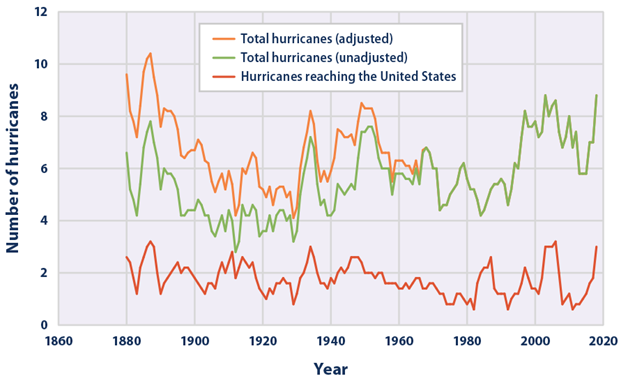
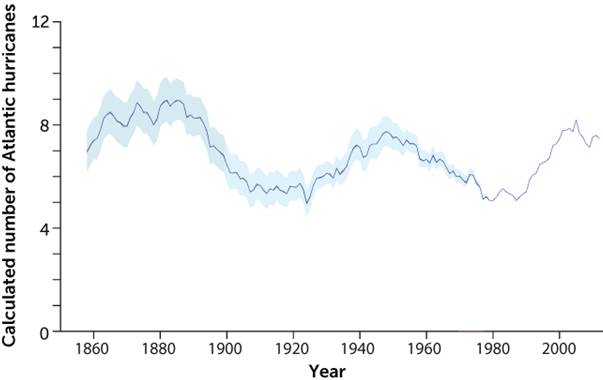
In addition to those annual cycles, hurricanes also follow decades-long cycles.  Below are some graphs showing such decades-long cycles.  The first one[1] is averaged to make the graph less “spikey”.  The second one[2] (the one from the U.S. E.P.A. i.e., the Environmental Protection Agency) is the non-averaged, “spikier” version of the first graph.  We see that both of them display a cyclical pattern that takes decades to repeat itself.

A graph showing the calculated number of Atlantic hurricanes

Line graph showing the number of hurricanes that formed in the North Atlantic Ocean and the number that made landfall in the United States each year. 

It would seem plausible that there would also be hurricane cycles that take centuries to repeat, just as there are centuries-long temperature cycles.[3]  But we have no information on that question, one way or the other.

Regarding these hurricane cycle graphs (above), notice that the U.S. E.P.A. graph refers to the pre-1972 data being “adjusted”.  The U.S. government began wide-spread use of weather satellites that year.  The U.S. government and academic researchers all adjust the pre-1972 data and they all agree that an upward adjustment is necessary because the pre-1972 data for hurricanes missed all hurricanes that did not reach landfall unless a ship at sea happened to see the hurricane.  It is reasonable and obvious to everybody that this pre-1972 tracking system missed many hurricanes and so the data is adjusted upward to account for this under-count in both government and academic records. 

Because hurricanes occur in cycles (like the weather more generally), this enables climate alarmists to manipulate the hurricane data to have it “prove” what they want.  So, e.g., “cutting” the data (i.e., starting their graph) at a low point allows the climate alarmists to claim that the upward slope of the normal hurricane cycle “proves” that there is an “alarming” hurricane increase (which they blame on a global warming emergency).

Although the government weather and climate services, as well as academia (university researchers) are controlled by the leftists, they cannot entirely avoid the truth that the climate data does not support climate alarmism.  So, when government or university reports dispel alarmist myths, those reports are “buried” and de-emphasized, all the while the leftist media, academia, and government agencies continue to insist on dire climate danger and the need for drastic reductions in human-caused carbon emissions.

One example of the truth coming out recently – but being “buried” – is a NOAA hurricane study that came out in October 2022.  Immediately below are NOAA’s conclusions regarding no trend in the strengthening of storms which would cause them to become major hurricanes:

After adjusting for changes in observing capabilities (limited ship observations) in the pre-satellite era, there is no significant long-term trend (since the 1880s) in the proportion of hurricanes that become major hurricanes.  We conclude that the historical Atlantic hurricane data at this stage do not provide compelling evidence for a substantial greenhouse warming-induced century-scale increase in frequency of tropical storms, hurricanes, or major hurricanes, or in the proportion of hurricanes that become major.[4]

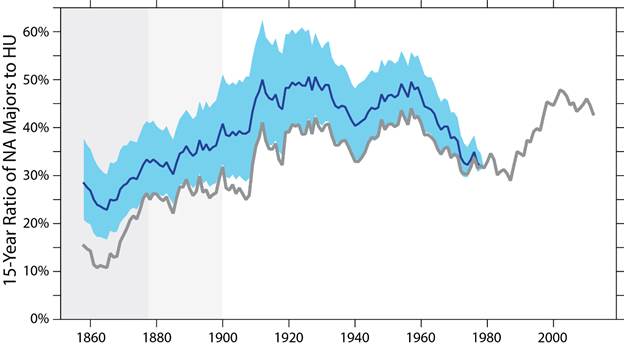
NOAA provides the graph (below) of 160 years of data, adjusted to account for inferior sighting and tracking ability before 1972.  This graph, is called “figure 4” in the NOAA report.  The graph not only does not show an increasing proportion of hurricanes becoming major, but rather it shows greater proportions of hurricanes being major in the 1960s hurricane cycle (compared to now) and an even-greater proportion of major storms in the 1910-1930s cycle.  See below.[5]    

NOAA is telling us that the evidence shows cycles but shows no “significant long-term trend (since the 1880s) in the proportion of hurricanes that become major hurricanes”.  NOAA adds (in the quote above) that there is no “compelling evidence” that greenhouse gases cause more storms to become major hurricanes – although the climate alarmists insist the opposite. 

NOAA (despite being controlled by leftists) admits that the data does not support the supposition that there is an increase in the severity of hurricanes, once a person adjusts (as all the studies do) for the obvious under-count which occurred when hurricanes were counted by chance ship observations rather than by ever-“watching” satellites, as occurred beginning about 1972.

Let us look again at the graph above.  We see from graphs such as this one that in roughly 1980, there was the bottom (trough) of a down cycle.  In fact, here is a lengthy study, Changes in Atlantic major hurricane frequency since the late-19th century, which observes on this issue:

Nevertheless, the recent increase in the proportion of NA HUs [i.e., North American Hurricanes] becoming MHs [i.e., major hurricanes], after adjustment, which is also reflected in the results of ref. 14, [which is a data source on which this report relies] is not a continuation or acceleration of a long-term trend, but rather is a rebound from a deep minimum in the decades surrounding the 1980s ….

We find that recorded century-scale increases in Atlantic hurricane and major hurricane frequency, and associated decrease in USA hurricanes strike fraction, are consistent with changes in observing practices and not likely a true climate trend. After homogenization, increases in basin-wide hurricane and major hurricane activity since the 1970s are not part of a century-scale increase, but a recovery from a deep minimum in the 1960s–1980s. …

Our results indicate that the recent increase in NA basin-wide MH/HU ratio or MH frequency is not part of a century-scale increase.  Rather it is a rebound from a deep local minimum in the 1960s–1980s.  …

[T]he inactive period in the late 20th century may have been the most inactive period in recent centuries.[6]

Notice in the graph above that a person could cut the graph at roughly 1980 if he wanted to fool gullible people into believing that hurricanes are becoming more intense.  This is because graphs or data sets that begin in roughly 1980 lack the context of the fact that 1980 is the trough of a prior cycle.  Such a graph misleadingly shows an increase in hurricanes and major hurricanes which make the graph or data look as if there is an alarming acceleration in these storms, as the climate extremists falsely claim.  This same hurricane study remarks about this false appearance in these words:

Furthermore, the 1980–2019 increases in basin-wide HU [i.e., hurricanes] and MH [i.e., major hurricanes] frequency are not a continuation of a longer-term trend, but reflect a recovery from a strong minimum in the 1970s and 1980s ….[7]

Now let us look at the leftists’ other alarmist hurricane assertion, viz., that anthropogenic (human-caused) greenhouse gases are causing a greater number of hurricanes. 

NOAA’s report concludes that, aside from the usual hurricane cycles, there is no trend toward an increasing number of hurricanes – after adjusting for under-counting in the pre-satellite data.  Here are NOAA’s conclusions:

After adjusting for a likely under-count of hurricanes in the pre-satellite era, there is essentially no long-term trend in hurricane counts.  The evidence for an upward trend is even weaker if we look at U.S. landfalling hurricanes, which even show a slight negative trend beginning from 1900 or from the late 1800s.[8]

NOAA’s report combines and summarizes its findings as follows:

We conclude that the historical Atlantic hurricane data at this stage do not provide compelling evidence for a substantial greenhouse warming-induced century-scale increase in frequency of tropical storms, hurricanes, or major hurricanes, or in the proportion of hurricanes that become major hurricanes.[9]

We see that even the leftist-controlled NOAA is admitting that it is false to say that greenhouse gases are causing a greater number of hurricanes or a larger number of major hurricanes.  But these truths do not change what the leftists are claiming in the mainstream media, academia, and government because the leftists are not seeking the truth (as Karl Marx did not seek the truth).  Instead, the leftists seek to complete their globalist power grab. 

The leftists would be embarrassed by reports such as the NOAA, Vecchi, and Nature reports above, if those reports became well-known to the public.  But the leftist know that few people will ever know the truth because their comrades in the media will “bury” these reports in silence and their comrades in the universities will continue to lie to their students that hurricane frequency and severity “prove” that there is an anthropogenic climate crisis.


Conclusion of Part 1 of this Article

We see that weather and climate go in cycles and that this applies to hurricanes, too.  We see that NOAA (and the studies it relies on) conclude that, after adjusting for the pre-1972 hurricane under-count, there is no upward trend in the number or in the severity of hurricanes. 

We see that there was a deep trough in the hurricane cycle – in approximately 1980 – which would allow a dishonest manipulation of the data by deceptively cutting the data there in order to give a false appearance of an alarming hurricane increase, as the climate alarmists fraudulently claim. 

Remember this trough in 1980 because next month we will look at deceptive alarmist graphs beginning then.

To be continued


[4]           Quoted from the report by the National Oceanic and Atmospheric Administration, Geophysical Fluid Dynamics Laboratory, found here: https://www.gfdl.noaa.gov/global-warming-and-hurricanes/ (parenthetical words in the original; emphasis added).

[5]           Quoted from the report by the National Oceanic and Atmospheric Administration, Geophysical Fluid Dynamics Laboratory, found here: https://www.gfdl.noaa.gov/global-warming-and-hurricanes/ at figure 4, ratio of Atlantic major hurricanes (Cat 3-5) to all hurricanes (Cat 1-5).  The gray curve is prior to adjustment; blue curves include an adjustment for estimated missing storms.  This graph and data were originally published in Vecchi et al. 2021.

The reference to “Vecchi et al., 2021” in NOAA’s graph description (quoted immediately above), is merely NOAA’s attributing the source of the graph that it was using.  This study and report, issued by the National Oceanic and Atmospheric Administration’s Geophysical Fluid Dynamics Laboratory, is available here: https://www.gfdl.noaa.gov/global-warming-and-hurricanes/

[6]           Changes in Atlantic major hurricane frequency since the late-19th century https://www.nature.com/articles/s41467-021-24268-5, citing (in the statements above) the following studies:

  Kossin, J. P., Knapp, K. R., Olander, T. L. & Velden, C. S. Global increase in major tropical cyclone exceedance probability over the past four decades, Proc. Natil Acad. Sci. USA 117, 11975–11980 (2020) in “ref. 14”;

  Chenoweth, M. & Divine, D. A document-based 318-year record of tropical cyclones in the Lesser Antilles, 1690 – 2007. Geo- chem. Geophys. Geosyst. 9, Q08013 (2008); and

  Nyberg, J. et al., Low Atlantic hurricane activity in the 1970s and 1980s compared to the past 270 years, Nature, 447, 698–701 (2007).

      Emphasis added and bracketed comments added for clarity.

[7]           Changes in Atlantic major hurricane frequency since the late-19th century, https://www.nature.com/articles/s41467-021-24268-5 Emphasis added.


[8]           Quoted from the report by the National Oceanic and Atmospheric Administration, Geophysical Fluid Dynamics Laboratory, found here: https://www.gfdl.noaa.gov/global-warming-and-hurricanes/

[9]           Quoted from the report by the National Oceanic and Atmospheric Administration, Geophysical Fluid Dynamics Laboratory, found here: https://www.gfdl.noaa.gov/global-warming-and-hurricanes/


Are You Faithful to Your State of Life? God Knows.

Your state of life is the position in life in which God has placed you, at least for now.  There are four states of life: marriage, the single state, the priesthood, and the religious state.  It goes without saying that our state of life is God’s plan for how we should live right now to reach our goal: happiness on earth and eternal much-greater happiness with God in heaven.   If you faithfully follow the state of life in which God has placed you, your life will not only be happy but meaningful and satisfying.  He will also give special graces needed for your state of life.

God gave us free will, so answering God’s call to your vocation is going to be a matter of much prayer and study.  Let’s lay out each state of life, starting with marriage.


Marriage

As a Catholic Candle reader and an uncompromising traditional Catholic, you understand that it is a state of life in which the husband as head of the family, and the wife as his helpmate, work together for a higher place in heaven.  The married couple will receive extra graces to bring into existence a God-fearing and loving family, a family steeped in virtue and love of the traditional Catholic Faith.  If the family does not meet these goals, the husband as head of the family is most responsible and will suffer for it.

Q. What are the chief ends of the Sacrament of Matrimony?

A. The chief ends of the Sacrament of Matrimony are:

1.    To propagate or keep up the existence of the human race by bringing children into the world to serve God;

2.    To enable the husband and wife to aid each other in securing the salvation of their souls; and

3.    To prevent sins against the holy virtue of purity by faithfully obeying the laws of the marriage state.

What are the duties of the husband?  Here is what the Council of Trent Catechism teaches us:

It is the duty of the husband to treat his wife generously and honorably. It should not be forgotten that Eve was called by Adam his companion.  The woman, he says, whom thou gavest me as a companion.  Hence it was, according to the opinion of some of the holy Fathers, that she was formed not from the feet but from the side of man; as, on the other hand, she was not formed from his head, in order to give her to understand that it was not hers to command but to obey her husband.

The husband should also be constantly occupied in some honest pursuit with a view to provide necessities for the support of his family and to avoid idleness, the root of almost every vice.  He is also to keep all his family in order, to correct their morals, and see that they faithfully discharge their duties.[1]

 Now let’s consider the duties of wives.  Here is what the Council of Trent Catechism teaches us:

To train their children in the practice of virtue and to pay particular attention to their domestic concerns should also be especial objects of their attention.  The wife should love to remain at home, unless compelled by necessity to go out; and she should never presume to leave home without her husband’s consent.  Again, and in this the conjugal union chiefly consists, let wives never forget that next to God they are to love their husbands, to esteem them above all others, yielding to them in all things not inconsistent with Christian piety, a willing and ready obedience.[2]

The Single State

This is a wonderful state of life important in God’s plan for the human race.  Everyone starts in this situation.  But not everyone is strong or healthy enough to provide for the needs of a family.  If a person chooses to remain single, he or she would be able to serve God better without the pressing daily demands of a family.  An unmarried woman is more intent on being holy, both body (i.e., virgin) and soul, making this state permanent by means of a vow.[3] 

In The Catechism Explained[4], the author explains regarding the unmarried state:

The unmarried state is better than the married because those who do not marry have far more opportunity[5] for attending to their spiritual welfare, and can attain a higher degree of glory hereafter.


The Priesthood

God calls a young man to the priesthood to dedicate himself wholly to caring for the spiritual life of the members of His Mystical Body, especially by offering Holy Mass.  He is a mediator between God and man.  He brings great gifts to man via the seven Sacraments for salvation.  The greatest gift he brings is Christ Himself in the Sacrament of Holy Eucharist.


The Religious State

God calls men and women to enter the religious state as brothers and sisters, and to consecrate themselves to Him by vows of poverty, chastity, and obedience.  They more directly live for God.  Christ said: “If thou wilt be perfect, go, sell what thou hast and give to the poor and thou shalt have treasure in heaven, and come follow Me.”  St. Matthew’s Gospel, 19:126-130.  

A priest can combine his priestly vocation with a religious state to combine the advantages of both states of life.

The Sacred Heart, the Help, Perfection, and Goal of All States in Life

It is obvious each state of life will have problems and challenges, but regardless of their state in life, Our Lord has made 12 Promises to St. Margaret Mary for souls devoted to Him and His Sacred Heart:

1.    I will give them all the graces necessary for their state in life.

2.    I will establish peace in their families.

3.    I will console them in all their difficulties.

4.    I will be their secure refuge during life, and more especially at the hour of death.

5.    I will shower down abundant blessings on all their undertakings.

6.    Sinners shall find in My Heart a Source and Boundless Ocean of Mercy.

7.    Tepid souls shall become fervent.


8.    Fervent souls shall rise speedily to great perfection.

9.    I will bless every place in which the picture of my Sacred Heart shall be exposed and honored.

10. I will give to priests the power of touching the most hardened hearts.

11. Persons who propagate this devotion shall have their names written in My Heart, and they shall never be effaced therefrom.

12. I will grant the grace of final repentance to all those who shall communicate (i.e., receive Communion)[6] on the first Friday nine months consecutively.  They shall not die in mortal sin, nor without having received the last Sacraments, for My Divine Heart will become their secure refuge at that last moment.

God will not place you to your state of life without much help to fulfill it for His greater honor and glory.  He wants very much for you to succeed in His vineyard, and you can depend on Him to help you, as He indicated in these words:

         “Come to Me all you that labor and are burdened, and I will refresh you.”[7]

With strong and serene hearts, let us strive to live perfectly the state in life in which God has placed us!


[1]           Catechism of the Council of Trent, section and subsections: Sacraments, Matrimony, Duties of Married People, Duties of a Husband, Joseph F. Wagner, New York, 1923, p. 352.

[2]           Catechism of the Council of Trent, section and subsections: Sacraments, Matrimony, Duties of Married People, Duties of a Wife, Joseph F. Wagner, New York, 1923, p, 352.

[3]           The single state is clearly a “state” and everyone enters the world in this situation from the beginning of his life.  Undoubtedly, God intends some persons to remain single all of their lives.  One clear example (out of many) is a man who lives his entire life paralyzed.  Further, cognitive or other inabilities, dramatic societal upheavals, and perhaps other situations might prevent a person from answering a call of a religious, sacerdotal, or matrimonial vocation.


There is a provisional character to the unmarried state unless it is fixed by a vow answering a religious or priestly vocation.  The single state is the condition of not having responded to God’s calling (i.e., a vocation) to the religious life, to the priesthood or to matrimony. 


One can see the provisional character of the single state by the fact that a person can change his mind over the years, thinking that he is called to be a monk and begin searching for an uncompromising monastery to enter.  Later, he can believe that he is instead called to the priesthood and begin looking for an uncompromising seminary and bishop.  Then after that, he can come to believe God Wills him to be married.  Only when his vocation is fixed by a vow does it become clear in what vocation he will serve God during the remainder of his life.  (Of course, the analogous circumstances can apply to a woman considering God’s Will for her in the convent or marriage.)


This single state is better in its opportunity, i.e., better in its potential, as compared to matrimony, because it affords the opportunity to serve God more full-time and more directly than is possible by someone in a married vocation out in the world, through an unmarried person’s living life under a vow of consecrated virginity.


As to whether the single state is a separate vocation apart from vocations to the priesthood and religious life, that question is beyond the scope of this article.  We note, however, that the Church provides particular rites and vows for those entering a priestly vocation, a religious vocation or a married vocation but not for laymen who simply remain in the single state by pursuing none of those vocations.

[4]           The Catechism Explained, Spirago, Benziger, 1921, Section II, The Sacraments, subsection 7, Matrimony, subheading: The Unmarried State, p. 667.

[5]           This single state is better in its opportunity, i.e., better in its potential, as compared to matrimony, because it affords the opportunity to serve God more full-time and more directly than is possible by someone in a married vocation out in the world, through an unmarried person’s living life under a vow of consecrated virginity.


[6]           Most people in the world, including the members of the Catholic Candle Team, do not currently have access to an uncompromising priest from whom to receive the Sacraments.  But we should all be at peace about that, for as long as that is God’s Will for us. 


Even if we don’t "feel" content with our feelings, nonetheless with our will and intellect (the important faculties) we should be perfectly content without the Mass and Sacraments when they are not available without compromise.  https://catholiccandle.neocities.org/faith/complete-contentment-without-the-mass-when-it-is-not-available-without-compromise.html


We urge all Catholics to not compromise by attending any compromise group to get the Sacraments, even where the group has valid Sacraments.  The Sacraments of compromise groups do not please God.  https://catholiccandle.org/2020/04/02/a-compromise-groups-masses-and-sacraments-do-not-give-grace-because-the-end-does-not-justify-the-means/


We encourage our readers to do what we do: we sanctify the Sunday at home using this method:  https://catholiccandle.neocities.org/faith/sanctifying-sunday-no-mass.html


[7]           Imitation of Christ, Thomas à Kempis; Bk. IV, Ch. 1.

Lesson #21 – On the Nativity, Second Contemplation

                    Mary’s School of Sanctity                   

Lesson #21  The Spiritual Exercises of St. Ignatius –—SECOND WEEK –THE SECOND CONTEMPLATION—THE NATIVITY

At this time St. Ignatius brings us to our Second Contemplation for his plan of the second week.  This contemplation will be about the Nativity.

As usual we will give the text of St. Ignatius and then give some further considerations.

Besides the Contemplation on the Nativity, we are including an additional Contemplation about the Doubts of St. Joseph.  This Contemplation, in an abridged format, will be set out first because St. Joseph’s doubts occurred prior to the Nativity.  Further, this allows the exercitant to combine some of these ideas with his contemplation about the Nativity if he so wishes.  The doubts of St. Joseph are not mentioned in St. Ignatius’s plan for the second week.  Still, knowing that we can draw great profit from studying the virtue of the Universal Patron of the Church, we thought it fitting to include this separate contemplation of St. Joseph’s doubts in the same Lesson as the Contemplation of the Nativity.  Indeed, this additional Contemplation may help us increase our appreciation of St. Joseph, the foster father of Our Lord.

*** THE EXTRA CONTEMPLATIONè THE DOUBTS OF ST. JOSEPH ***

The preparatory prayer is the same as usual, I ask God Our Lord the grace that all my intentions, actions, and works may be directed purely to the service and praise of the Divine Majesty.

The FIRST PRELUDE: I will review the history concerning St. Joseph’s doubts once he found that Mary was with Child.  He is a just man and we see how God informed him in his sleep what he ought to do.              

The SECOND PRELUDE: I will also form a mental image of St. Joseph bewildered when Mary returns from visiting St. Elizabeth in Judea and is clearly with child.  I will imagine St. Joseph sleeping and him seeing in his dream an Angel to guide him.

The THIRD PRELUDE: It will be the same and in the same form as it was in the preceding contemplation.  [In the preceding contemplations –This was to ask for what I desire.  Here I will ask for an intimate knowledge of Our Lord, Who has become man for me, that I may love and follow Him better.  And in particular how Providence ordained that good St. Joseph was specially chosen from all eternity to be the foster father of the Incarnate Word.]

The FIRST POINT: We will SEE St. Joseph noticing a physical change in the sweet Virgin maid.   

The SECOND POINT: I will also consider the THOUGHTS that St. Joseph is having concerning his intended spouse with whom he has an understanding since they both have made vows of consecrated virginity.

The THIRD POINT: I will also OBSERVE and CONSIDER how St. Joseph is sleeping and being enlightened about what to do with Mary.  I see him waking from slumber and obeying the Holy Ghost by taking her into his own home.  

The COLLOQUY: Conclude with a colloquy with St. Joseph, and as in the preceding contemplation, end with the “Our Father.”   

Considerations for the FIRST POINT: TO USE THE SENSE OF SIGHT

·         SEE the situation before Mary and St. Joseph came together as man and wife.  St. Joseph was reassured by an angel in a dream that he should take Mary as his wife.  [The following verses are from St. Matthew 1:18-24:]

When as his mother Mary was espoused to Joseph, before they came together, she was found with child, of the Holy Ghost.

Whereupon Joseph her husband, being a just man, and not willing publicly to expose her, was minded to put her away privately.  But while he thought on these things, behold the Angel of the Lord appeared to him in his sleep, saying: Joseph, son of David, fear not to take unto thee Mary thy wife, for that which is conceived in her, is of the Holy Ghost.  And she shall bring forth a son: and thou shalt call his name Jesus.  For he shall save his people from their sins.

Now all this was done that it might be fulfilled which the Lord spoke by the prophet, saying:  Behold a virgin shall be with child, and bring forth a son, and they shall call his name Emmanuel, which being interpreted is, God with us.  And Joseph rising up from sleep, did as the angel of the Lord had commanded him, and took unto him his wife.

Considerations for the SECOND AND THIRD POINTS: OBSERVE and HEAR what was spoken and the actions done.

We must remember that St. Joseph was espoused to Mary.  This was rather like a time of engagement.  Although, for the Jews, this really meant that the couple technically belonged to each other and could join together whenever they wished.

St. Thomas Aquinas explains several reasons why Our Lady was espoused and had a husband.  One reason was that she would not have the shame of being with child without a husband.  Another reason was because she would need a man’s protection when fleeing for the life of the Child.  Yet another reason was so the devil would not know about the Divinity of Our Lord, because God did not want the devil to know this truth and thereby prevent the crucifixion.[1]

St. Joseph was a just man and therefore he feared God and he feared sin.  He did not want to offend God.  He had vowed perpetual chastity, thus he feared that taking Mary in her condition would be a grave scandal.  He feared that he would be consenting to a sin by taking her within his home because there could be no other explanation for her condition other than adultery.  Nevertheless, St. Joseph had such a great opinion of Mary’s purity that he could not doubt her.  He could not understand the enigma.  Scripture says he “thought on these things”.  What turmoil this must have been for poor St. Joseph!  Truly a spiritual cross!  This was God’s will for St. Joseph to suffer this mental anguish for his higher sanctification and for our edification.  Mary must have likewise suffered greatly because it was not her place to tell St. Joseph the plan of God.   She would certainly have known that St. Joseph would wonder what was going on.  What suffering for both of them!   How faithful they were to God to simply trust that His Providence would take care of everything![2]

St. Joseph surely knew the scripture from Isaiah 7:14: “Behold a virgin shall conceive, and bear a son, and His Name shall be called Emmanuel.”  Did he think within himself, “Is Mary this virgin?”

St. Thomas says, “So also the Lord permitted Joseph to doubt concerning the chastity of Mary, that doubting he might receive the Angelic revelation, and by receiving might believe more firmly.”[3]    

St. Joseph did not make any rash decision about what to do with Mary’s situation.  He was prudent and waited for the Lord to instruct him.  Also St. Joseph wanted to take care of the situation showing Mary the most mercy, thus he considered putting her away quietly. 

St. Thomas explains that St. Joseph was a faithful believer in God’s plan and so it was fitting that an Angel should reveal to him what he needed to know.  “However, because a corporeal apparition is miraculous, such type of apparition was not becoming to him, since he believed and was faithful.”  It was fitting for Our Lady to receive a visible apparition because the message conveyed to her was more difficult to believe because it was at the beginning of the Incarnation, whereas St. Joseph could readily notice a physical sign of the revelation being true.[4]

The angel Gabriel addressed St. Joseph as the son of David because he was of the house of David.  We must notice, too, that the angel told St. Joseph, “Fear not”, just as St. Gabriel had also told St. Zachary and Our Lady.  This angel was sent from God and was a true messenger and so there was no reason to fear.  As soon as St. Joseph found out that her conception of Our Lord was from the Holy Ghost, he had no fears.  What a wonderful consolation for him!!  With what fervor and dedication he would embrace all the trials that would come concerning Him Who Mary was to bear!

Another very edifying example to note about St. Joseph is that he immediately obeyed the angel’s command and rose up to take Mary for his wife.

The COLLOQUY: Oh dear St. Joseph, you are such an edifying example for us of trust in God and His Plan for us.  Even though you were beset with unanswerable questions and doubts, you remembered that God’s Will is for our good.  You simply prayed for guidance and had confidence that God would answer your prayers and not leave you in uncertainty.  Please intercede for us, St. Joseph and beg God’s assistance for us in our present needs and tribulations.  

Now having finished our brief look at the Doubts of St. Joseph let us turn to the main part of our Lesson, namely, the study of the Nativity of Our Lord.

CONTEMPLATION ON THE NATIVITY

The preparatory prayer is the same as usual, I ask God Our Lord the grace that all my intentions, actions, and works may be directed purely to the service and praise of the Divine Majesty.

The FIRST PRELUDE: I will review the history of the Nativity.  How Our Lady, almost nine months with child, set out from Nazareth, seated on an ass, as may piously be believed, together with Joseph and a servant girl leading an ox.  They are going to Bethlehem to pay the tribute that Caesar has imposed on the whole land.

The SECOND PRELUDE: I will form a mental image of the scene and see in my imagination the road from Nazareth to Bethlehem.  I will consider its length and breadth, and whether it is large or small, whether high or low, and what it contains.

The THIRD PRELUDE: It will be the same and in the same form as it was in the preceding contemplation.  [The preceding contemplations were to ask for what I desire.  Here I will ask for an intimate knowledge of Our Lord, Who has become man for me, that I may love and follow Him better.]

The FIRST POINT: I will SEE the persons: our Lady and St. Joseph, the servant girl, and the Child Jesus after His birth.  I will become a poor, miserable, and unworthy slave looking upon them, contemplating them, and ministering to their needs, as though I were present there.  I will then reflect within myself in order that I may derive some fruit.

The SECOND POINT: I will OBSERVE, consider what they are SAYING and to reflect within myself that I may derive some profit.

The THIRD POINT: I will OBSERVE and CONSIDER what they are doing: the journey and suffering which they undergo in order that Our Lord might be born in extreme poverty, and after so many labors; after hunger and thirst, heat and cold, insults and injuries, He might die on the cross, and all this for me.  I will then reflect in order to gain some spiritual profit.

The COLLOQUY: Conclude with a colloquy as in the preceding contemplation and with the “Our Father.”  {Note: the preceding contemplation had the following colloquy suggestion from St. Ignatius—I will now think of what I should say to the Three Divine Persons, or the eternal Word Incarnate, or to His Mother and Our Lady.   I will ask help according to the need that I feel within myself, so that I may more closely follow and imitate Our Lord Who has just become Incarnate.  Close with the “Our Father”.} 

Now let us take some time to review the events surrounding the Nativity. Here is the Scriptural account: [The following are verses from St. Luke 2:1-20]

And it came to pass that in those days there went out a decree from Caesar Augustus that the whole world should be enrolled.  This enrolling was first made by Cyrinus, the governor of Syria.  And all went to be enrolled, every one into his own city.

 And Joseph also went up from Galilee, out of the city of Nazareth, into Judea, to the city of David, which is called Bethlehem: because he was of the house and family of David. To be enrolled with Mary his espoused wife, who was with child.  And it came to pass that when they were there, her days were accomplished that she should be delivered. And she brought forth her first born son and wrapped him up in swaddling clothes and laid him in a manger: because there was no room for them in the inn.

And there were in the same country shepherds watching and keeping the night watches over their flock.  And behold an angel of the Lord stood by them and the brightness of God shone round about them: and they feared with a great fear. And the angel said to them: Fear not; for, behold, I bring you good tidings of great joy that shall be to all the people: For, this day is born to you a Saviour, who is Christ the Lord, in the city of David.  And this shall be a sign unto you. You shall find the infant wrapped in swaddling clothes and laid in a manger.

And suddenly there was with the angel a multitude of the heavenly army, praising God and saying: Glory to God in the highest: and on earth peace to men of good will. And it came to pass, after the angels departed from them into heaven, the shepherds said one to another: Let us go over to Bethlehem and let us see this word that is come to pass, which the Lord hath shewed to us.

And they came with haste: and they found Mary and Joseph, and the infant lying in the manger.  And seeing, they understood of the word that had been spoken to them concerning this child.  And all that heard wondered: and at those things that were told them by the shepherds.  But Mary kept all these words, pondering them in her heart.  And the shepherds returned, glorifying and praising God for all the things they had heard and seen, as it was told unto them.

Considerations for the FIRST POINT: TO USE THE SENSE OF SIGHT

·          SEE the journey to Bethlehem

What a trial it must have been for St. Joseph and Our Lady who was with Child, the Incarnate Wisdom!  The journey from Nazareth to Bethlehem took several days.   Certainly it would be slower with Mary’s condition.  Dear reader, you can imagine they have a donkey as St. Ignatius suggests or if you wish, you could imagine them walking because they were very poor.  To travel from Galilee, they would have to pass through Samaria and this course was known to be dangerous because of thieves which were prevalent on this route. 

The weather was cold and damp— bone-chilling cold.  Poor St. Joseph must give up his work in order to fulfill the command of Caesar and go to the town of David.  This foreign ruler did not care about the Jewish people.  He only cared to know the count of his people so he could get more revenue out of them.

If Our Lord had been born at their home in Nazareth, it would not have been a rich palace by any means, but it would have been easier for the Holy Family.  Even though the Holy Family was poor at Nazareth, they were in far poorer conditions in Bethlehem.  Let us not forget that these circumstances were exactly as God willed them to be.

·         SEE their arrival at Bethlehem

Imagine their arrival at Bethlehem.  St. Joseph looks for lodging for Mary and the Child soon to be born.  The town is packed with people also coming to be enrolled in the Census.  The cobblestone streets are narrow and crowded.  All the inns are full and the only place that the Holy Family can find to get out of the wind is a cave used as a stable.  “He came unto His own and His own received Him not.”

They descend the steep steps to find a cloverleaf shape set of rooms—three symbolizing the Trinity. Watch how St. Joseph cleans the place the best he can without having cleaning tools.  Mary takes the handmade swaddling clothes she has brought out of her small bundle of belongings.  She prays in holy expectation of the moment of the sublime birth of her God made Man.

·         SEE  the moment of the Nativity

Let us see this wondrous Birth which is the pivot point of all human history.  This is the miraculous Birth of Our Lord shining forth as light through a glass.  Our Lady suffers nothing and remains ever-virgin. We shall consider more of the details below under the point of considering actions.   

Considerations for the SECOND POINT: HEAR what Mary and St. Joseph might say on their way to Bethlehem and during the time that St. Joseph was looking for lodging for himself and his expectant wife.  

 Can we hear what St. Joseph and Mary might say to each other?  They mostly walk in prayerful silence.  When they do speak, they have words of mutual edification and resignation.  They are determined to do God’s Will no matter what is involved.

It has been a long and tiring journey and now that they have arrived in Bethlehem, they meet with noisy crowds of complaining travelers.  St. Joseph stops at inn after inn and is refused entrance, sometimes with harsh words and other times with flimsy excuses.  He sorrowfully tells Mary the results.  They neither complain nor murmur but thank God for doing His Will through them. 

Consider how God treats His chosen ones—especially this holy couple.  He gives them the choicest crosses and sanctifies them still further.  They win abundant merits.

We can compare our wretched sinfulness to this holy pair.  Fr. Hurter, S.J., has some moving words on this point.  He says,

How often did Our Savior wish to come to you, and you did not receive Him.  You closed your heart and turned your back on Him.  Many a time, especially at Christmas, you think: Had I been living in Bethlehem at the time, how willingly I should have received Our Divine Savior in my house and waited upon Him.[5] 

Fr. Hurter exhorts us further saying,

What was not possible for you then, you can do now.  For what you do to one of your brethren the Savior considers as done to Himself.  How consoling the thought that by works of Christian charity you can make up for the cold-heartedness of the inhabitants of Bethlehem![6]

Considerations for the THIRD POINT: TO CONSIDER ACTIONS

Consider the actions of the people in Bethlehem at the time of Our Lord’s Nativity.  Consider also the actions of St. Joseph, Our Lady, and Our Dear Savior after His Birth.

What did the people of Bethlehem care about on such a momentous night?  They only cared about being as comfortable as possible in the inns.  Little did they know that the King of kings and Lord of lords had now been born physically into the world.  Fr.  Hurter has these edifying words, to say about Our Lord’s birth:

Adore the newborn Savior in the manger.  Affectionately participate in the ineffable joy of the Virgin Mother and of St. Joseph, who now forgot all hardships, privations and humiliations, since for them the stable has become a paradise.  Search into the mystery here consummated before your eyes.   All the divine perfections of goodness, mercy, love, and omnipotence shine forth from it, more than from the creation of the universe.  Already in the manger the Infant Jesus, by His example, teaches us a lesson of all virtues in a heroic degree, which later as the dying Savior He wished to recommend as a compendium from the cross.  The manger and the cross—what effective pulpits!  Learn especially one virtue from the Infant Jesus in the manger.  As humility shines from the Incarnation, so the love of poverty from His birth.  Humility and poverty are the pillars of the following of Christ.[7]

Fr. Hurter instructs us about Our Lord’s poverty.  He tells us that His poverty was perfect. Our Lord lacked necessaries and a child could not come into the world under poorer conditions.[8]

He tells us that Our Lord’s poverty was His own choice. “And this is to be wondered at since He could have redeemed us if He had been rich.”[9]

Lastly, he informs us that Our Lord’s “poverty was intended and sought.  He permitted the decree of Augustus to be issued at this time that He might come into the world among strangers and very poor.  At Nazareth the maternal solicitude of Mary would have made it too comfortable for Him.”[10] 

Yes, the actions of the Holy Parents are so inspiring for us—their willingness to suffer all things for Christ their Son and King.  They knew that they were so blest to be the guardians of their Savior.

Let us now briefly consider the message of the Holy Angels who appear to the shepherds in the fields.  These simple and poor shepherds are found worthy to hear the tremendous news that the Christ, the Messiah, has been born.  They are told that He can be found in swaddling clothes, the prefigurement of the Holy Winding Sheet and that He is lying in a manger.  Well do these shepherds know about mangers and so they know which cave to find the Infant Savior.  They go with haste to see Him.  They report to the holy couple what they have seen and heard.

Mary, His Mother, files all of what they say deep in her heart to ponder again and again.  The shepherds can see that St. Joseph is a tender protector of the Holy Family.  They can also see that this tiny Infant is indeed special. 

Our Infant King, we must keep in mind has perfect use of His reason being both God and Man.  And yet, He acts and appears like a helpless Infant.  What humility! The very one Who created heaven, earth, and all creation is allowing Himself to exist in such a lowly state.

Concluding thoughts: we will let Fr. Hurter supply our closing comments:

We shall close this meditation with a fervent prayer to the dear Infant Jesus to communicate to us that love of poverty which in the manger He so much recommended; and we shall resolve, in case we are not in duty bound to it by vow, to practice it at least in spirit by detaching our hearts from earthly goods, by bridling  our too strong inclinations towards them, by being content with the means we possess, and by reducing our superfluous expenses, so that we may dispose of the money thus saved for the greater honor of God!

COLLOQUY: Dearest Babe in the manger, oh Incarnate Word, how can I thank Thee enough for becoming Man.  Oh glorious Hypostatic Union, so mysterious to us that one Person can have two Natures.  How happy I am that Thou hast accomplished this Union and will remain so for all eternity.  Thou teacheth us so many lessons by being born so.  Such humility!  Such poverty! Such detachment from things of this world!  Clearly Thy birth in a stable shows us that the things of this world should be as nothing to us.  Unite me to Thee, O Infant King, and never let me separate myself from Thee.  I thank Thee also for giving us such holy examples in St. Joseph and our tender Mother Mary. 

Oh Mary, dear Mother of God, intercede for me.  Instruct me in the ways of poverty and detachment.  Teach me, too, how to accept all God has planned for me.  Thank you, Mary, for being such a model of virtue for your children.

Dear St. Joseph, help me to lean on thee for protection and strength.  Help me to follow your edifying examples of trust and confidence in God.  Help me to pray for guidance like you did and humbly submit to God’s plan for me.

We have done the meditations on the Incarnation and the Nativity.  St. Ignatius has us go through several scenes of Our Lord’s Life in the second week of the Spiritual Exercises. We can take topics from the Gospel of Our Lord’s Life before He began His Public Life.  For our next lesson we will set out the contemplation/meditation of the Trials of the Holy Family.  Of course, a separate meditation could be done on each of the Trials. We will consider the Flight into Egypt, the Return from Egypt and the Finding of the Child Jesus in the Temple.


[1]               This information is taken from St. Thomas Aquinas’s Lectures on St. Matthew’s Gospel.


[2]            Some of this information is taken from St. Thomas Aquinas’s Lectures on St. Matthew’s Gospel.


[3]           This quote is taken from St. Thomas Aquinas’s Lectures on St. Matthew’s Gospel.

[4]               This quote is taken from St. Thomas Aquinas’s Lectures on St. Matthew’s Gospel.

[5]               Considerations from Sketches for the Exercises of An Eight Days’ Retreat by Hugo Hurter, S.J., Ph.D., D.D., Professor Emeritus of Theology in the Catholic University of Innsbruck, copyright 1918; third edition, 1926, St. Louis, MO and London, Page 149.


[6]               Considerations from Sketches for the Exercises of An Eight Days’ Retreat by Hugo Hurter, S.J., Ph.D., D.D., Professor Emeritus of Theology in the Catholic University of Innsbruck, copyright 1918; third edition, 1926, St. Louis, MO and London, Page 148.


[7]           Considerations from Sketches for the Exercises of An Eight Days’ Retreat by Hugo Hurter, S.J., Ph.D., D.D., Professor Emeritus of Theology in the Catholic University of Innsbruck, copyright 1918; third edition, 1926, St. Louis, MO and London, Page 149.


[8]               Considerations from Sketches for the Exercises of An Eight Days’ Retreat by Hugo Hurter, S.J., Ph.D., D.D., Professor Emeritus of Theology in the Catholic University of Innsbruck, copyright 1918; third edition, 1926, St. Louis, MO and London, Page 150.


[9]           Considerations from Sketches for the Exercises of An Eight Days’ Retreat by Hugo Hurter, S.J., Ph.D., D.D., Professor Emeritus of Theology in the Catholic University of Innsbruck, copyright 1918; third edition, 1926, St. Louis, MO and London, Page 150.


[10]         Considerations from Sketches for the Exercises of An Eight Days’ Retreat by Hugo Hurter, S.J., Ph.D., D.D., Professor Emeritus of Theology in the Catholic University of Innsbruck, copyright 1918; third edition, 1926, St. Louis, MO and London, Page 150.


Words to Live by – from Catholic Tradition


The great value and advantage of suffering chastisements


St. Alphonsus de Liguori gives us these consoling words to encourage us to appreciate the Crosses we receive from the loving Hand of God:


“God”, say St. Augustine, “is angry when He does not scourge the sinner.”  (In Ps., LXXXIX).  When we see a sinner in tribulation in this life, we may infer that God wishes to have mercy on him in the next, and that He exchanges eternal for temporal chastisement.  But miserable is the sinner whom the Lord does not punish in this life!  For those whom He does not chastise here, He treasures up His wrath and for them He reserves eternal chastisement.


Quoted from St. Alphonsus de Liguori, Sermon #2, for the 2nd Sunday of Advent, first point, §10.


Lesson #20 – On the Incarnation, First Contemplation

                    Mary’s School of Sanctity                   

Lesson #20 – The Spiritual Exercises of St. Ignatius – SECOND WEEK – FIRST DAY AND FIRST CONTEMPLATION – THE INCARNATION

Now at this point of the Spiritual Exercises St. Ignatius changes the method in which he sets up his meditations because he wants us to do our meditations in a slightly different manner.  Because St. Ignatius wants to encourage us to imitate Our Lord, he sets forth a series of meditations which will be an in-depth study of Our Lord’s Life and virtues.  He will take us through the key mysteries of the life of Christ and have us spend some time in pondering each of them.  However, in these meditations he wants us to paint a scene with our imagination and focus on what we see, hear, and observe actions in the given particular scene.  He has us do this so we can draw lessons for our souls which will bring with them many fruits.  One of these fruits is a greater dedication to Our Lord in our service of Him.

First, we will give the text of what St. Ignatius calls the First Contemplation of the Second Week which is on the Incarnation.  Then we will give some further ideas for the present considerations we are making.  Here we are going to study the circumstances surrounding this very important aspect of Our Catholic Faith, the Incarnation— Our Lord becoming Man through the Hypostatic Union, namely, the Second Person of the Blessed Trinity uniting to human nature in the womb of the Blessed Virgin Mary.

The preparatory prayer is the same as usual, I ask God Our Lord the grace that all my intentions, actions, and works may be directed purely to the service and praise of the Divine Majesty.

The FIRST PRELUDE: is to recall to mind the history of the subject I am about to contemplate.  Here it is how the Three Divine Persons were looking upon the whole extent and space of the earth, filled with human beings.  They see that all were going down into hell, and They decreed, in Their eternity, that the Second Person should become man to save the human race.  When the fullness of time had come, They sent the Angel Gabriel to Our Lady.

The SECOND PRELUDE: is a mental representation of the place.  I will see, in imagination the great extent and space of the world, where dwell so many different nations and peoples.  I will then see particularly the city of Nazareth in the province of Galilee, and the house and room where Our Lady dwells.

The THIRD PRELUDE: is to ask for what I desire.  Here I will ask for an intimate knowledge of Our Lord, Who has become man for me, that I may love and follow Him better.

The FIRST POINT: First, I will SEE all the different people on the face of the earth, so varied in dress and in behavior.  Some are white and others black; some at peace and others at war; some weeping and others laughing; some well and others sick; some being born and others dying, etc.

Second, I will SEE and CONSIDER the Three Divine Persons seated on the royal throne of the Divine Majesty.  They behold the entire face and extent of the earth and They behold all nations in such great blindness, dying, and going down into hell.

Third, I will SEE Our Lady and the angel who greets her.  I will reflect that I may draw profit from this scene.

The SECOND POINT: I will HEAR what the people throughout the world are saying, how they converse with one another, how they swear and blaspheme, etc.  I will also listen to what the Three Divine Persons are saying, that is, “Let us work the redemption of mankind,” etc.  I shall then listen to what the angel and Our Lady are saying.  I will then reflect upon what I hear to draw profit from these words.

The THIRD POINT: I will CONSIDER what the people throughout the world ARE DOING; how they are wounding, killing, and going to hell, etc.  I will also consider what the Three Divine Persons are doing, namely, accomplishing the most Holy Incarnation, etc., also what the angel and Our Lady are doing, as the angel fulfills his office of ambassador, and Our Lady humbles herself and gives thanks to the Divine Majesty.  I will then reflect to derive some profit from each of these things. 

The COLLOQUY: I will now think of what I should say to the Three Divine Persons, or the eternal Word Incarnate, or to His Mother, Our Lady.   I will ask help according to the need that I feel within myself, so that I may more closely follow and imitate Our Lord Who has just become Incarnate.  Close with the “Our Father”.


Considerations for the
FIRST POINT: TO USE THE SENSE OF SIGHT

·         SEE the world before and at the time of the Incarnation;

Let us bring to our minds, dear reader, what the world was like before the Incarnation.  Paganism was everywhere.  The Israelites were sorely tempted by idolatry and often fell into the worship of false gods.  Very few of the Israelites were faithful to the Commandments of God and the belief in the Redeemer to come, both of which were required for salvation in the Old Testament.  We can think about the few just people waiting in anticipation for the promised Redeemer.   Mary and St. Joseph were among them.

The Roman Empire had conquered most of the known world at that time.  The Romans occupied all of the land around the Mediterranean Sea including the entire coastline of northern Africa.  They owned all of Spain, France, the Netherlands and all along the English Channel in the north.  In fact, they owned most of the island we now know as Britain.  Also, in the northeast, they owned up to the Black Sea and of course they occupied the Holy Land in the east.  In this we can see God’s Providence because when Our Redeemer would set up the one true Church, He could establish His Church on the foundation of the Roman civil order.  Yet, consider how the majority of people were living in the darkness of Paganism.  On the other continents of the world where people migrated, there was the even greater emptiness of ignorance and sin.  Worldwide unhappiness prevailed.

·          SEE the Trinity overseeing the world before the Incarnation;


Behold in your mind’s eye, dear reader, how God, in His infinite mercy pitied mankind.  Try to picture the great Council of the Trinity looking down on the entire world.  Remember, Jesus is called the Angel of the Great Council.[1]

·         SEE the scene of the Annunciation:

Picture Our Lady praying in her small home in Nazareth.  The Angel Gabriel appeared to her.  Scripture tells us that she was troubled by his voice and his message.  Does this mean that she was not looking at the vision of the angel?  She, no doubt, had perfect custody of her eyes, so we can imagine that she wasn’t looking at the angel.  Or was it that she already had such a life of contemplation that the visitation of angels was a common occurrence and that it was not the vision of an angel which troubled her soul?

Considerations for the SECOND POINT: TO USE THE SENSE OF HEARING

·         HEAR the world in the period before Christ.

Picture the pagan and confused world as St. Ignatius speaks of it in his words given above; let us hear the tumult of the world.  Let us listen to the crowds of the entire world.  The people are going through life completely ignorant regarding the purpose for which they were created. 

As St. Ignatius describes for us in his text above, we can imagine the people as they scream and shout.  They laugh at all types of crude and banal things.  They chatter unceasingly about worthless things.  What a mass of confusing babble!

·         HEAR the Trinity conversing about working out the Incarnation;

As in Genesis God promised to send a Redeemer saying, “I will put enmities between thee and the woman, and thy seed and her seed: she shall crush thy head, and thou shalt lie in wait for her heel” [Gen. 3:15].   God is about to fulfill His promise.  The Trinity, in our imagination, is setting out that now is the time to work the crushing of the head of Satan.  Imagine God the Father saying, “Now let us work the redemption of mankind.  Thou, My Only Begotten Son, Oh Word, shalt take flesh.   Behold Thy Mother, Our Masterpiece, will be told of Our Divine Plan.  We know that she will humbly accept the Plan and will be the Cause of Joy to Our adopted sons and daughters.”

·          HEAR what is occurring between Gabriel and Mary.

The actual Scriptural text is given here: St. Luke 1: 26-56

And in the sixth month, [of St. Elizabeth’s expectancy] the angel Gabriel was sent from God into a city of Galilee, called Nazareth, to a virgin espoused to a man whose name was Joseph, of the house of David: and the virgin’s name was Mary.  And the angel being come in, said unto her: Hail, full of grace, the Lord is with thee: blessed art thou among women.

Who having heard, was troubled at his saying and thought with herself what manner of salutation this should be.

 And the angel said to her: Fear not, Mary, for thou hast found grace with God.  Behold thou shalt conceive in thy womb and shalt bring forth a son: and thou shalt call his name Jesus.  He shall be great and shall be called the Son of the Most High. And the Lord God shall give unto him the throne of David his father: and He shall reign in the house of Jacob forever.  And of his kingdom there shall be no end.

 And Mary said to the angel: How shall this be done, because I know not man?

And the angel answering, said to her: The Holy Ghost shall come upon thee and the power of the Most High shall overshadow thee.  And therefore, also the Holy which shall be born of thee shall be called the Son of God.  And behold thy cousin Elizabeth, she also hath conceived a son in her old age: and this is the sixth month with her that is called barren.  Because no word shall be impossible with God.

And Mary said: Behold the handmaid of the Lord: be it done to me according to thy word. And the angel departed from her.

 And Mary rising up in those days, went into the hill country with haste into a city of Juda. 

And she entered into the house of Zachary and saluted Elizabeth.  And it came to pass that when Elizabeth heard the salutation of Mary, the infant leaped in her womb. And Elizabeth was filled with the Holy Ghost.  And she cried out with a loud voice and said: Blessed art thou among women and blessed is the fruit of thy womb.  And whence is this to me that the mother of my Lord should come to me?  For behold as soon as the voice of thy salutation sounded in my ears, the infant in my womb leaped for joy.  And blessed art thou that hast believed, because those things shall be accomplished that were spoken to thee by the Lord.

And Mary said: My soul doth magnify the Lord.  And my spirit hath rejoiced in God my Savior.  Because He hath regarded the humility of His handmaid: for behold from henceforth all generations shall call me blessed, because He that is mighty hath done great things to me: and holy is His name.  And His mercy is from generation unto generations, to them that fear Him. He hath shewed might in his arm: He hath scattered the proud in the conceit of their heart.  He hath put down the mighty from their seat and hath exalted the humble.  He hath filled the hungry with good things: and the rich he hath sent empty away.  He hath received Israel His servant, being mindful of His mercy.  As He spoke to our fathers: to Abraham and to his seed forever.  

And Mary abode with her about three months. And she returned to her own house.

Considerations for the THIRD POINT: to consider actions

CONSIDER THE ACTIONS of the people in the world before and at the time of the Incarnation:

In the above sections, we have brought out the sights and sounds of the pagan world before Christ and at the time of the Incarnation; we need now to consider the actions of the people more.

They are living a banal existence.  They do not have any eternal perspective and therefore have no goal or purpose for living.  The people war against each other and the victor enslaves the defeated.  What poor people!  Think of the overall fear that the majority of people are feeling!  They have to fight for survival every day.  Not only do they have to provide for themselves from day to day, but they live in constant fear of being invaded by thieves or some foreign army.  What a terrifying existence for those who do not know God!  The people of most of the nations have no Mosaic Law for guidance and likewise they have no God-given orders about the sacrifices that God wants.  These peoples live for sensual pleasures, riches, pursuit of power.  What an empty existence they must have!  Most of them were working out their damnation and live without any hope of happiness!

They try to tell themselves that they are happy; yet, they know in their hearts that they are not convinced of this.  They commit murders and steal.  They cheat each other and gossip.  They do not trust one another. The Roman soldiers are patrolling the towns and villages.  These soldiers are watching to keep some kind of order. 

CONSIDER THE ACTIONS of the Holy Trinity– the loving providence and compassion that God has for mankind:

As we heard the Council of the Trinity above, we now consider the fulfillment of God’s promise.  Even though the human race was living unmindful of God, He is ever mindful of the human race.   As He said in Jeremiah, “I have loved thee with an everlasting love”.  [Jeremias, 31:3]  God shows that He wants the redemption of the world. “God so loved the world that He sent His Only Begotten Son.” [St. John’s Gospel, 3:16]

From all eternity God knew that He would work the Redemption by sending His Son.  He also knew when He would accomplish this task.  God now sends St. Gabriel with the joyful task of conveying to Our Lady the special mission God has for her, namely, to be the Mother of God.

Let us consider how we have not appreciated His loving care of us as we ought.  We could never be thankful enough for the gifts that God has given us.  The Incarnation alone is a wonderful gift to mankind and we must not forget that the purpose of the Incarnation was in order to atone for the sins of man and to open the gates of heaven which had been closed to man ever since the fall of Adam.  Indeed, where would we be without this Great Act of Love? 

The beautiful reality of the Hypostatic Union of God the Son to human flesh is awe-inspiring in Itself.  God the Son became man and will remain so for all eternity.  What condescension!  What a humiliation!  He wanted to give us a chance to save our souls and He wants to be our friend.    He also wanted to be a model for us to follow.


CONSIDER THE ACTIONS: of St. Gabriel and Our Lady

Let us now take some time to consider this beautiful scene of the messenger of God announcing to the Blessed Virgin, God’s Plan for her, and asking for her consent.

The entire text of this scene is given above as well as the wondrous scene of the Visitation and the Sanctification of St. John the Baptist in his mother’s womb.  We include the entire interchange between Mary and St. Elizabeth because we want to get an intimate understanding of Mary, as well as Our Lord.  Mary’s response to St. Elizabeth, which is known as her Magnifcat, shows her very profound humility.

So, the Angel Gabriel comes to Mary and tells her she is found special in the Eyes of God.  Why is she special?  It is precisely because she is full of grace.  She was full of grace ever since the moment she was conceived because the merits of the Redemption were applied to her long before Our Lord suffered His Passion and Death.  God can make an exception to His decree that all humans contract original sin.  Since He is not limited by the bounds of time, He chose to prevent original sin from ever sullying the soul of the Virgin Mary.

Thus, Mary is a pure vessel of honor and God willed her to be the place where the Hypostatic Union would occur.  Mary has ever been God’s willing handmaid.  Her parents presented her in the Temple when she was three years old.  She was taught in the Temple.  Therefore, she knew the Scriptures very well. 

What did she think when Gabriel announced that she would conceive a son and He would be called Jesus and He would be the Son of the Most High?  And of His kingdom there would be no end?  Her humility was being tested.  She would have known the passage from Isaiah, “Therefore the Lord Himself shall give you a sign.  Behold a virgin shall conceive, and bear a son, and His name shall be called Emmanuel.”

She wondered if Isaiah’s prophesy applied to her.  She was cautious lest the Angel Gabriel’s words were a trap of the devil in order to tempt her to pride.  Her response shows that she did not trust the praise she had been given.  She tests the apparition to see if it is indeed from God.  She knows that she made a vow of perpetual virginity and this vow was done purely out of love for God.  God had showed her that He accepted her vow.   So now, how can this be that she could conceive since she is a virgin and not at all interested in breaking that vow?   So, she inquires of the angel how this conception can take place and indicates to him that she is a consecrated virgin. 

The angel tells her that the Holy Ghost will cause the Conception and therefore the Child so conceived will be called the Son of God.  He also reveals to her the remarkable news that her elderly cousin Elizabeth had conceived a son even though she had been considered barren.  The angel tells her this as his way of proving to her that nothing is impossible with God.

When Mary hears of this extraordinary expectancy of her aged cousin, she is convinced that this apparition is from God.  Therefore, she readily submits her will to God saying, “Behold the handmaid of the Lord, be it done unto me according to thy word.”  She only wants to do the Will of God.  For her His Will is the only thing that matters.  Then, at that moment, the “Word became Flesh.”  Wisdom became incarnate; hence Wisdom became man.

We must remember that Mary was well-schooled in the Scriptures.  She knew that the Messiah was to be the Savior and Redeemer.   She knew that He would suffer a miserable death and be the “Man of Sorrows and the outcast of His people.”

As a mother she would suffer from this future suffering of her Son, and yet, she does not worry about her own future suffering, she only is concerned about doing what God wants.  Again, for her, His Will is the only thing that matters.

She humbles herself and immediately goes to be of assistance to her cousin Elizabeth who must be in need being so old and with child.  Mary’s generosity is “with haste.”

Then we see and hear Mary’s humility again when she sees her cousin and her cousin praises her.  She recites her beautiful canticle giving God all the glory of making her the Mother of God.

We have few words of Mary in the Gospels.  The Magnificat is a masterpiece of eloquent praise of God and giving Him all the credit for the glory and fame which is and will be associated with her.  “He that is mighty hath done great things to me.” 

Concluding thoughts:

Let us be astonished about how God is so loving and merciful to men as to become like unto them.  Ponder the humiliation of the Son of God at His Incarnation.  As St. Paul says, “Who being in the form of God thought it not robbery to be equal to God; emptied Himself, taking the form of a servant, being made in the likeness of men, and in habit found as a man.  He humbled Himself, becoming obedient unto death, even to the death of the cross.” [Phil. 2:6-8]

Think about how Our Lord wanted to become our model so we could imitate His virtues and His love.  “No greater love hath a man than to lay down his life for his friend.”  What priceless love to not only become man, but to die for the sake of the salvation of men!  When Adam rejected the goodness of God in favor of Eve, Our Lord, the new Adam, reverses this dastardly act by embracing a life of suffering and the most shameful death on the Cross.  He wants us to learn humility, for His whole life was one continuous act of humility.

Think also with wonder about how Mary, the new Eve, rejected anything to do with the serpent – the evil one.  Instead, she exclaims that she owes everything to God.   She proclaims that she wants only to serve God and not act like Eve who wanted to become as a god.

COLLOQUY: How do I begin to thank Thee, O my Supreme Good for Thy mercies in becoming man to save us from hell fire?  O Holy Trinity, how sweet and how loving of Thee to give us an opportunity to share Thy divinity with us!  O, God the Father, how Thou dost provide in the extreme for us by sending Thy beloved Son to be butchered for us wretched sinners!  O, Thou Incarnate Wisdom, our words cannot praise Thee enough for Thine example of a most holy life!  Thou didst become man to be our Model, our Hope, our Savior, our Redeemer, our Friend, and our Beloved Spouse.  What more could we ask for?  Thou hast given all!  O, Holy Ghost, can our lips utter sufficient words to thank Thee for overshadowing Our dear precious Mother Mary and making her the true singular vessel of honor?  Help us, O most Holy Trinity, to love Thee with an ardent love and serve Thee ever more faithfully.  We do not deserve all Thy tender mercies shown towards us.  Help us to humble ourselves ever more and more in Thy Presence and pour forth our hearts in tearful gratitude of love. 

O dear tender Mother Mary, guide us in our homage and love of God.  Help us to imitate Thy virtues, o sweet Virgin Mary.  We, like thee, want to be generous to God and give ourselves completely in His service.  Teach us, O Mary, the countless ways we can sacrifice ourselves for God.

The possibilities for our colloquy are numerous.  The above is only a sample of what could be said.

Now that we have begun our intimate study of Our Lord, we hunger to increase our knowledge of Our Beloved Lord and Redeemer.  We have laid a foundation of desire to imitate the virtues and love of Our Lord.  Hence, in our next lesson we will continue our study of Christ by doing what St. Ignatius refers to as the Contemplation on the Nativity. 


[1]           Taken from the Litany of the Holy Name of Jesus

Let Us Undergo the Trials that God Sends Us!

Catholic Candle note: The article below is a reminder of the benefit we receive from the trials that God sends us. 

This article is a “companion piece” to Catholic Candle’s prior article, Strategies for Lightening the Crosses You Now Have, which can be found here: https://catholiccandle.org/2020/04/01/77/

St. John Chrysostom gives five reasons why God permits us to undergo trials and tribulations, even very severe ones.  Here are his words:

Whoever thou art then that after thy baptism sufferest grievous trials, be not troubled thereat; for this thou receivest arms, to fight, not to sit idle.  God does not hold all trial from us:

·         firstly, that we may feel that we are become stronger;

·         secondly, that we may not be puffed up by the greatness of the gifts we have received;


·         thirdly, that the Devil may have experience that we have entirely renounced him;


·         fourthly, that by it we may be made stronger; and


·         fifthly, that we may receive a sign of the treasure entrusted to us; for the Devil would not come upon us to tempt us, did he not see us advanced to greater honors.[1]

Let us examine each of these reasons why God permits us to suffer trials.

1.   God permits us to undergo trials that we might feel that we become stronger.

We need encouragement and (reasonable) confidence in spiritual battles.  If we never fight spiritual battles, we will be afraid to do so.  We would wonder “how would I do?”  Because of this insecurity, we would shrink back like cowards from future spiritual battles that God wishes us to fight, for His glory and for our reward.

An army’s general values his battle-tested and battle-hardened soldiers because they know from experience that they can succeed and they know what they must do in order to succeed.  Those veteran soldiers gain in courage and confidence by fighting battles, so that they feel ready to fight future battles.

Similarly, Christ, our “General” in the Church Militant, gives us trials to help us Soldiers of Christ to be battle-tested and battle-hardened spiritual warriors.  Through trials, we test our spiritual armaments, our (spiritual) combat skills, and our strength in the spiritual battles of this life.  We learn by experience that the devil cannot conquer us provided that we do not let him do so (by consenting to sin).  We know that, with God’s help and if we do our part, we will conquer all demons. 

For this reason, God sends us trials so that we might gain courage and (reasonable) confidence that we are able to fight life’s spiritual battles for God’s glory and for the salvation of souls.

2.   God permits us to undergo trials that we may not be puffed up by the greatness of the gifts we have received.

When we are inside our home while a wild storm rages outside, we feel secure, like a sailor looking out from the security of a safe harbor at a storm raging at sea.[2]  By contrast, when a sailor is caught out at sea, with his ship almost capsizing, fighting for survival amidst the buffeting waves, then he remembers that he needs God and that his own efforts are very weak and small.

Let us apply that principle to the spiritual life:

The angelic spirits are truly awesome – greatly exceeding our comprehension:

  The angelic nature is so great that it would be a greater thing for us to understand the nature of the lowest angel than it would be for us to know everything about all material creation combined.

  The lowest angel is so powerful that he could very easily destroy all of material creation, if God permitted him to do so.

The devils have such very high angelic natures.  Their rebellion against God did not change the greatness of their natures.

Suppose we found all trials to be easy.  Suppose that, for us, avoiding temptation was “child’s play” and that when the devil tempted us, we could simply “snap our fingers in the devil’s face” (as it were) and that we could prevail against his temptations without need to make any serious effort to resist him.

If all trials were so easy for us, our pride would grow exceedingly.  Thus, God lovingly sends us the precious gift of trials in order to deflate our pride by forcing us to fight hard for the life of our souls, in the spiritual storms that rage in this world.

It is during spiritual trials that we best know that we need God’s help.  At such times, we best remember that we are small and weak and that we are not the great spiritual champions that we would otherwise imagine ourselves to be.  We remember then that we would be deluding ourselves to think that we can terrorize all devils and put them to flight because of our great holiness and spiritual power.

For this reason, God sends us trials – including severe trials – in order that these trials would remind us of our weakness so that we do not get puffed up by the magnificent spiritual gifts that God gives to us Catholics who follow the full traditions of the Church.

3.   God permits us to undergo trials in order that the Devil may have experience that we have entirely renounced him.

It is appropriate that the devil should have discernable evidence that we belong to God and are soldiers in His army.  It is fitting that the devil sees that the soldiers of Christ fight for Him and that the devil sees that we fulfill our baptismal vows to “renounce Satan and all of his works and pomps”.

It befits the Divine honor that we, who are Our Lord’s servants and friends, do not render Him service which is so indiscernible that the devil is able to mock Our Lord that he can’t even tell that we are serving the Divine Majesty.

God must not only triumph in us but must also be seen to triumph in us.  This is good and fitting just as it is good and fitting that, at the end of the world, not only will justice be done at the General Judgment but also that it will be seen to have been done.

Thus, God sends us trials to make manifest that we belong to Him and not to the devil.

4.   God sends us grievous trials in order that, by this spiritual combat, we can be made stronger.

A soldier is given weapons in order that he can fight.  If he were not supposed to fight, he would not have been given weapons.  If he were supposed to remain idle, he would have been given pillows instead of weapons.

Similarly, St. John Chrysostom teaches us that we Soldiers of Christ receive spiritual weapons for the very purpose of we fighting God’s battles in the trials He sends us.  St. John Chrysostom teaches us that God wants us “to fight, not sit idle”.  Id.

Just as hard physical exercise causes our bodily muscles to gain strength, likewise grievous spiritual trials and tribulations strengthen our “spiritual muscles”.  That is, our wills gain strength in virtue through hard spiritual work. 

We should welcome the trials that God sends.  We should generously enter into the penitential times (e.g., Lent, Ember Days, vigils of high feasts, Advent), valuing them as opportunities and as blessings, not as misfortunes which we must endure.  We should not approach such times with a stingy heart, doing the minimum required, and making as little change in ourselves as possible. 

We should look upon penitential times as occasions of great liberty, freeing ourselves from the burden of our lower nature which pulls us downward.  We should also view the Great Apostasy in which we live as a blessing and as a trial meant for our good.[3]  For we know that such trials “work together unto the good, for those who love God”.  Romans, 8:28.

Thus, God sends us trials in order to make us stronger in His service.

5.   God permits us to undergo trials that we may receive a sign of the treasure entrusted to us; for the Devil would not come upon us to tempt us, did he not see us advanced to greater honors.

Suppose we inherited an old painting of little apparent value from a distant relative.  As we receive it, suppose we also receive an offer from a rich art collector to purchase it for $25 million.  That offer would cause us to regard this painting much differently.  We would keep it safe and not throw it away or otherwise disregard it.

Suppose we learned that an art thief planned to steal that painting.  We would take great care to not allow this valuable possession to be stolen.

Analogously, we possess a far greater treasure: sanctifying grace (which is always accompanied by Charity and the indwelling of the Holy Ghost).  That grace is infinitely valuable, although it can seem to people that it is like that old worthless-seeming painting we inherited. 

However, when we know that the devil is trying to “steal” this priceless treasure from our souls, it helps us to remember the incomparable value of grace.  Just as the art thief’s desire to steal our painting warns us of the value of that painting and reminds us to protect it from theft, likewise, the devil’s desire to “steal” the grace in our soul reminds us to take all precautions to protect the life of grace.

Thus, we see that God permits the devil to tempt us through trials to remind us of the infinite value of the grace we have in our souls.

Conclusion

Let us appreciate the trials and tribulations that our Dear Lord generously gives us! 

Let us value them more than all material goods and more than a life of ease, since those trials are a crucial means for our salvation. 

Let us thank God for those trials and use them for God’s greater honor and glory and for maximum merit!


[1]           Catena Aurea on St. Matthew ch.4, v.1.  St. Thomas Aquinas, greatest Doctor of the Catholic Church, chooses and quotes these words of St. John Chrysostom, Doctor and Father of the Church, from St. John’s sermon #13 on St. Matthew’s Gospel

[2]           Here is how the Roman philosopher Lucretius explained the comfortable security that a person has when he sees others, but not himself, undergoing great tribulations:

Pleasant it is, when on the great sea, the winds trouble the waters, to gaze from shore upon another’s great tribulation: Not because any man’s troubles are a delectable joy, but because to perceive what ills you are free from yourself is pleasant.

Lucretius, De Rerum Natura, Book II, line 1.

[3]           This time of Great Apostasy is a glorious time to be Catholic and to live for Christ the King!  https://catholiccandle.neocities.org/faith/it-is-a-blessing-to-live-during-this-great-apostasy.html

The Traditional Catholic Faith – the Greatest of God’s Gifts


A gift, yes indeed!  But how many appreciate it and thank God daily for this greatest[1] of gifts?  God came to earth, suffered and died to establish the Faith and demonstrate how to live a happy life on earth and to be perfectly happy forever in heaven.  Here are Our Lord’s words, as set forth in the Imitation of Christ, beautifully echoing St. John’s Gospel, 14:6:

          Follow Me.  I am the Way, the Truth, and the Life.  Without the Way,

          there is no going.  Without the Truth, there is no knowing.  Without

          the Life, there is no living.  I am the Way which you must follow, the

          Truth which you must believe, the Life for which you must hope.  I

          am the inviolable Way, the infallible Truth, the unending Life.[2]


This gift of Faith comes with an obligation to do our part and to do our best to keep

liberalism and compromise out!  Here is Thomas à Kempis’ exhortation to us:

          Take courage, brethren, let us go forward together and Jesus will be

          with us.  For Jesus’ sake, let us persevere with it.  He will be our help

          as He is also our leader and guide.  Behold, our King goes before us

          and will fight for us.  Let us follow like men!  Let no man fear any

          terrors![3]

Webster defines compromise as a “process or a result of settlement by arbitration,

or by consent reached by mutual concessions – surrender.  There is no place

for compromise or liberalism in God’s perfect gift of Faith.


It is sad to say that, after the Second Vatican Council, the substance of this gift of Faith has been thrown away by 99% of those who describe themselves as Catholics.  This includes the “lukewarms”, and the majority of people who thought of themselves as Catholics but didn’t bother to notice that our leaders in Rome (and in every diocese) are heading in the opposite direction from Our Lord.  With little thought they surrendered various Catholic principles and jumped on the conciliar bandwagon, encouraged by a Rome that has lost the Faith[4] and is the driving force behind the anti-Catholic Conciliar church. 


However much this makes life difficult for Traditionalists, who must fight endlessly to preserve the True Mass, valid Sacraments, and cherished traditions, be assured that Our Lord sees all and will reward those who fight the good fight and do not surrender their principles.  Here are Our Lord’s words, as set forth in the Imitation of Christ:


          My child, patience and humility in adversity are more pleasing

          to Me than much consolation and devotion when things are

          going well.[5]


In order for us Traditional Catholics to avoid all compromise, we must stand our ground and not give in to criticism for the stand we take for Christ the King.  We must be willing to forgo the compromise Sacraments and parish life.  Christ suffered daily for 33 years to establish a perfect Faith.  We can certainly suffer some to do our little part to keep the Faith as pure and holy as He intended. 


God knows what we need and is sure to provide the necessary help and strength as required to carry on in the current drive by political forces to stamp out God and traditional Catholicism, e.g.., Latin Mass Catholics (now designated “violent extremists” by the FBI.)[6]


[1]           In one way, Charity is the greatest of God’s gifts and is the greatest of the Theological Virtues.  As St. Paul teaches: “there remain Faith, Hope, and Charity, these three: but the greatest of these is Charity”.  1 Corinthians, 13:13.


On the other hand, as St. Paul teaches: “without Faith it is impossible to please God.”  Hebrews, 11:6.  Thus, although Charity is greatest absolutely, Faith is not only very great but is necessary for possessing Charity.  That is, if a person does not have the Catholic Faith, he will not have Charity either.  So, in that sense, Faith is greatest – because it is a necessary condition for possessing Charity.

[2]           Imitation of Christ, Thomas à Kempis; Book III, Ch. 56.


[3]           Imitation of Christ, Thomas à Kempis; Book III, Ch. 56.


[4]           Our Lady of La Salette predicted in 1846: “Rome will lose the Faith and become the seat of the Antichrist.”

[5]           Imitation of Christ, Thomas à Kempis; Book III, Ch. 57.


[6]           https://www.heritage.org/religious-liberty/commentary/the-fbis-targeting-radical-traditional-catholics-bodes-ill

More Information to Remind Us to Avoid the Covid “Vaccine”

Catholic Candle note: The so-called Covid “vaccine” is not really a vaccine but is really gene therapy.[1]  This “vaccine” is a mortal sin to accept just like all vaccines developed through abortion.  https://catholiccandle.org/2021/01/01/reject-the-covid-vaccines/

The SSPX used to uphold this Traditional Catholic position that vaccines developed through abortion are always mortally sinful to receive.  But the now-liberal SSPX has completely reversed itself and now accepts the conciliar position.  To read the SSPX’s prior prohibition and its current permissive words, read part 3 of this article: https://catholiccandle.org/2021/01/01/reject-the-covid-vaccines/ (citing to the SSPX’s own sources).  The “new” SSPX’s current liberal position includes permitting not only receiving abortion-related vaccines but also the Covid so-called “vaccine”.

Further, this Covid “vaccine” is very harmful in many ways, especially harming the immune system[2] and causing grave cardiac problems.[3]  As explained below, the “vaccine” offers negative protection even for Covid itself nor does it “stop the spread” as the leftists lied that it would.

The short article below is merely a reminder to avoid the Covid “vaccine” for all of these reasons.

We hope and pray that Catholic Candle’s readers had the good judgment and firmness of principles to not get the Covid jab(s).  Our lives should be a principled stance against all of the evils of our time, including this “vaccine”.

However, to help our readers to inform others, we report to you an interesting risk-benefit analysis performed recently which examined the impact of Covid booster mandates for university students.  The test group was people in the age bracket of 18-29.

As shown in the study discussed below, this risk-benefit analysis shows that the Covid gene therapy (the so-called “vaccine”) does more harm than good.  Of course, the more important point is that receiving these Covid boosters constitutes mortal sins since they are cooperating in the murders of innocent babies in abortion, and the further evil of the vivisection of those babies without anesthesia to enhance their “cell lines” for research purposes. 

But this summary of the recent interesting study reminds us to avoid this evil “vaccine” and also to not trust the leftists who control the mainstream channels of information.


The recent risk-benefit analysis on young adults

This risk-benefit analysis which was recently conducted examines the impact of booster mandates for North American university students.  It concludes that:

  Between 22,000 and 30,000 previously uninfected adults (aged 18 to 29) must be boosted with an mRNA “vaccine” to prevent one COVID-19 hospitalization.

  For each hospitalization prevented, the jab will cause 18 to 98 serious adverse events, including 1.7 to 3 “booster-associated myocarditis cases in males, and 1,373 to 3,234 cases of grade ≥3 reactogenicity which interferes with daily activities”.

  That means mandating a third COVID shot for university students will result in “a net expected harm”.


  The study emphasizes that the results are actually worse than that because “Given the high prevalence of post-infection immunity, this risk-benefit profile is even less favorable.”[4] 

The study concludes that university booster mandates are unethical for five reasons:

1.    There has been no formal risk-benefit assessment pertaining to this age group;


2.    The vaccine mandates may result in a net expected harm to individual young people;

3.    The mandates are not proportionate: the expected harms are not outweighed by public health benefits – given the modest and transient effectiveness of vaccines against transmission;


4.    U.S. mandates violate the reciprocity principle because rare serious vaccine-related harms will not be reliably compensated due to gaps in current vaccine injury schemes; and


5.    The mandates create wider social harms. The study’s authors consider counter-arguments such as a desire for socialization and safety and show that such arguments lack scientific and/or ethical support.

This interesting risk-benefit analysis was financed by the leftist Wellcome Trust.  The study is currently in “preprint” advanced publication.  The study’s principal author is Dr. Kevin Bardosh, from the School of Public Health, University of Washington, USA, and the Division of Infection Medicine, Edinburgh Medical School, University of Edinburgh, UK.[5]

Dear Readers, if anyone wonders why/how this study “came out of the blue”, then he is not keeping himself informed.  This study is merely one of many.

There is a constant trickle of new studies – mostly ignored by the mainstream media – showing how harmful the Covid “vaccine” is.  Each study comes from a different “angle”.  The studies are not all exactly the same but they all show, in their own way, that the Covid “vaccine” is dangerous and is harmful to the recipients.  (We also know that it is an additional mortal sin since it causes the recipients to share culpability for the murder of those innocent babies). 

Another recent news report concerns a new study from researchers in the Netherlands which shows area-by-area of that country, the close correlation between Covid “vaccine” rates and the all-cause mortality rates in those same areas.[6]  In other words, wherever, in the Netherlands, the Covid “vaccine” rate is higher, the all-cause mortality rate is higher.  Wherever one rate is lower so too is the other rate.  It makes sense to look at the all-cause mortality rates in relation to the Covid jab because it causes so many serious health problems of so many types.

Yet another recent study showed that, in college and professional athletes, there is close correlation between Covid “vaccine” uptake and career-ending heart inflammation, especially in previously-healthy young men.[7] 

A different study showed that the rate of professional athletes who are dropping dead without warning, is many times higher than the annual averages “pre-Covid-vaccine”.  As our readers might know, the professional sports leagues require Covid “vaccination” for all of their players.[8]

A further study showed a higher rate of catching Covid for those who are “vaccinated”.  These studies show a very short protective benefit, followed by “negative protection”.[9]

Another study showed a higher rate of hospitalization and a higher rate of death from Covid for those who are “vaccinated”.[10]

The “experts” are supposedly puzzled by the onset of “sudden adult death syndrome”.[11]  But people who do not gullibly believe the mainstream media lies and spin are able to “put two and two together”.

There are so many other studies.  They show, each in its own way, that the Covid “vaccine” is harmful.

A person might naively wonder why our leaders don’t know about these studies.  The answer is: they DO know!  There are several reasons why they are acting the way they are – and all of those reasons are evil, e.g., to reduce the world’s population to make it easier for the globalist to achieve control.

This is a good reminder, too, that we should not rely on the public health “experts” and mainstream media concerning the harm of accepting that booster.


[4]           You can find the entire study here: https://papers.ssrn.com/sol3/papers.cfm?abstract_id=4206070


[5]           You can find the entire study here: https://papers.ssrn.com/sol3/papers.cfm?abstract_id=4206070