CC in Brief – Sedevacantist questions

Catholic Candle note: Sedevacantism is wrong and is (material or formal) schism. Catholic Candle is not sedevacantist. We recommend a small book explaining the errors of sedevacantism. It is available:

Below is the first of a series of CC in Brief articles which cover specific aspects of the error of sedevacantism.


CC in Brief

Sedevacantist Questions

Q. If a pope publicly preaches heresy, does he cease to be pope?

A. Your question does not provide enough information (i.e., context) for a simple answer, and makes us wonder if you are perhaps failing to distinguish between a person being a public heretic and a formal heretic. If any person understands (i.e., knows) that he is denying what he is required to believe in order to be Catholic (i.e., to belong to the Catholic Church), then that denial causes him to cease to be Catholic. This is to be a formal heretic.

Such a person ceases to be Catholic even if he never reveals the matter to anyone. Such a person would not be excommunicated by Church authorities since (as we supposed in this example) he never revealed his opinion to anyone. But the very fact that this person holds a statement that he understands to be incompatible with being Catholic – i.e., by his being a formal heretic – he ceases to be Catholic and could not go to heaven because Outside the Church there is No Salvation.

But suppose that a person holds a heretical opinion but he does not know it to be incompatible with being a Catholic. Then in that case, he would hold the “matter” of heresy but would not cease to be a member of the Catholic Church, outside of which there is no salvation. In other words, by unknowingly holding his error about the Faith he would be a material heretic.

It is not uncommon for a person to hold material heresy but it is, of course, always a bad thing. So, e.g., suppose a seven-year-old child holds that God has a body (which is a heresy). Suppose he thinks that this is what the Catholic Church teaches. He is a material heretic but remains a member of the Catholic Church. He is not a formal heretic because he does not understand that he is contradicting the Catholic Faith which is revealed by the Church.

No matter how publicly he declares his understanding that God has a body, he is a material heretic and is not a formal heretic. The child remains a Catholic – but is one who is in error on a matter of the Faith.

Even a pope is not immune from denying a dogma of the Faith. But if that pope did not know that he was denying a doctrine that he was required to believe in order to be Catholic, then he remains a Catholic and remains the pope.

The case of Pope John XXII (who lived in the 14th century) is a useful example.

But before we get to that example, let us recall some important truths of the catechism which are necessary in order to understand the remainder of this article:


  • All that God has divinely revealed to man is called Divine Revelation.


  • Divine Revelation has two founts (i.e., sources): Sacred Scripture and Sacred Tradition.


  • Since God is its author, all that is contained in Divine Revelation is certain, true, and is part of the Catholic Faith.


  • The Catholic Church is the guardian and sole interpreter of Divine Revelation, and teaches the Faithful all the contents of Divine Revelation.


  • To help her teach without err, God has given the Church the gift of infallibility – the gift of being unable to err when authoritatively teaching the whole Church anything about Faith or morals.


  • All of these truths which she teaches infallibly are called dogmas (i.e., doctrines).


  • Her teaching authority is called Her Magisterium.


  • She can teach dogmas to the Faithful using either Her extraordinary infallible Magisterium or Her ordinary infallible Magisterium. The easier method to understand, and the one most Catholics are familiar with, is the extraordinary Magisterium, which most Catholics associate with precisely-worded ex cathedra statements from the popes.


  • Both the ordinary and extraordinary magisterial methods faithfully transmit dogmas to the Faithful without error, but the extraordinary Magisterium has this advantage: that it is easier for the Faithful to recognize that a truth from Church authorities is indeed infallible, and must therefore be believed.

  • When the Church infallibly formulates the specific, precise wording of a dogma, She is said to define that dogma.


  • The Church has defined only a small percentage of all dogmas; thus, notice that although all dogmas are part of Revelation and thus infallible, yet not all dogmas have been precisely defined. That is the very beautiful advantage of the Church’s definitions: they give us exact wording which incapsulates the meaning (substance) of the dogma. For this reason, the Faithful can rejoice when the Church defines a dogma.


With those reminders stated, we can now investigate the case of Pope John XXII, who publicly denied a dogma of the Faith but was not a formal heretic.


Pope John XXII (reigned 1316-1334)


It is a defined dogma of the Catholic Faith that the saints see the Beatific Vision immediately after they die (and after they have been purged in Purgatory, if necessary).1 However, this dogma was not always defined.


In fact, Pope John XXII lived before this dogma was defined by the Church’s Extraordinary Magisterium. He publicly denied that the saints immediately see the Beatific Vision after they die, i.e., before the General Judgment.2


But further, before Pope John XXII became pope, he wrote a book publicly denying this dogma of the Catholic Faith, viz., that the saints see the Beatific Vision immediately after they die (and after they have been purged in Purgatory, if necessary).3 Instead, he taught the opposite heresy. Id.


Not only before Pope John XXII’s papal reign but also during it he caused a “great commotion” by denying this doctrine of the Catholic Faith on several occasions and publicly teaching the opposite heresy.4 Yet he reigned as pope until his death.5


Yet both before and after this doctrine was defined, the Church has always recognized the validity of Pope John XXII’s election and reign as pope.6 In other words, his public teaching of this heresy did not prevent his election or his reigning as pope.


We know that dogmas are already true and have always been doctrines of the Faith, even before those dogmas become defined by the Church’s Extraordinary Magisterium. In other words, the Church’s extraordinary definition of a dogma does not all of a sudden “make” a doctrine true (and make it part of the Faith).


Rather, an extraordinary definition of a doctrine of Faith merely gives certitude to anyone in doubt concerning a truth which was already a dogma of the Catholic Faith. This is why the First Vatican Council declared: “the Holy Ghost was promised to the successors of Peter not so that they might, by His revelation, make known some new doctrine”.7


Thus, we know that the dogma which Pope John XXII denied was always true and was a doctrine of the Faith at the time he denied it.


As scandalous as it was for Pope John XXII to publicly teach heresy, he was elected pope while professing this heresy and reigned as pope while continuing to profess this heresy.


Thus, we see that a pope who publicly teaches heresy would remain Catholic if he does not know that his teaching is a rejection of what he must believe in order to be Catholic. In other words, a pope who teaches heresy remains the pope if he is a material heretic. However, if the pope were to become a formal heretic, then he would cease to be a Catholic and cease to be pope (since a pope cannot be the head of the Church if he is not a member of the Church).


Afterword


When Pope Francis teaches heresy, that does not tell us whether he remains pope precisely because we do not know that Francis knows he is contradicting the Catholic Faith. He would have to make it known that he knows he is contradicting the Catholic Faith.


But the sedevacantists would reply (often in a tone of exasperation): “Oh, come on! He knows he is contradicting the Catholic Faith.” That reply raises the topic of the sedevacantists’ sin of rash judgment. Beware of that sin! But that sin is a topic that we will cover in a different CC in Brief.

1 Council of Florence, Pope Eugene IV, Bull Laetentur coeli, 1439; Pope Benedict XII Benedictus Deus, 1336, Denz. #530-531.

2

1917 Catholic Encyclopedia, entry: Pope John XXII.

3

1917 Catholic Encyclopedia, entry: Pope John XXII.

4

1917 Catholic Encyclopedia, entry: Pope John XXII. The phrase in quotes is the description in the Catholic Encyclopedia.

5

1917 Catholic Encyclopedia, entry: Pope John XXII. See also, the Annuario Pontificio editions 1939, 1942, and 1959.

The Annuario Pontificio is the Church’s official list of popes and the years of their reign. These lists not only include Pope John XXII as a pope but list his reign as ending when he died, rather than some earlier date as if he lost the pontificate because of his (material) heresy.

6

1917 Catholic Encyclopedia, entry: Pope John XXII; see also, the Annuario Pontificio editions 1939, 1942, and 1959.


The Annuario Pontificio is the Church’s official list of popes and the years of their reign. Pope John XXII is listed in all of those lists of the Church’s popes.

7

Vatican I, Session 4, ch.4 (emphasis added).
Lesson #37: About the Temperaments – Continuation of the Choleric Temperament

Philosophy Notes

Catholic Candle note: We apologize for our editing error of misnumbering the last Lesson in Mary’s School of Sanctity. It should have been numbered #36.

In the article below, the word “choleric” is used both as an adjective to refer to a particular one of the temperaments and also as a noun referring to a person with that temperament.

Mary’s School of Sanctity

Lesson #37: About the Temperaments – Continuing Our Study of the Choleric Temperament

In our last lesson we briefly described the general strengths of a choleric of good will. We must recall how we explained that if a person with a choleric temperament doesn’t guard himself and strive to love God, he can easily slip into the weaknesses of his temperament. In our last lesson we listed the weaknesses as follows:

Weaknesses of the Choleric Temperament:

  • Hardness

  • Nurtures hatred and desires revenge

  • Obstinacy

  • Insensibility

  • Anger

  • Pride (includes over-confidence; unreasonably criticizing others; and excessive competitiveness)

  • Ambition

  • Violence, cruelty, and arrogance upon meeting with resistance

  • Lack of delicacy of feeling, insensitive to the feelings of others

  • Coldness

  • Indifference

  • Impetuosity

Let us take the time now to explain these weaknesses. We can see that some of the weaknesses listed here can be linked together. Indeed, hardness, insensibility, and coldness seem to be closely related to each other. Since the choleric has good powers of concentration and lots of determination, he can show hardness of heart and coldness. Hence, he is insensible to the feelings and/or the needs of others. Thus, he appears to go full steam ahead without regard for others. People view the choleric as someone who bulldozes his way along in order to get to his goals. He does not make it a priority to put himself in the “shoes” of another and so he has a one-track mind.

Obstinacy –– The choleric with bad will is seen as being “bull-headed” and stubborn because he is so resolute in getting his way. He lets nothing stop him.

Indifference — Because of his stubbornness, the choleric comes across as being completely indifferent to obstacles. In fact, he doesn’t consider anything as a legitimate obstacle. In his view, all opposition is unreasonable and must be overcome at any cost.

Again, we can see that due to the fact that he allows no opposition, he shows the weaknesses of violence, cruelty, and arrogance upon meeting resistance. People tend to cower in his presence and get out of his way, so this headstrong choleric readily acts like a bully and usually gets his way.

Yet, if anyone resists him, he tends to nurture hatred and a desire for revenge. Furthermore, it is not uncommon for a choleric to harbor long-lasting grudges.

Now let us look at the remaining weaknesses from our list and see how they connect with the choleric being swept away in his determination to gets what he wants.

Anger – Anger, one of the irascible passions found in the soul, has been commonly associated with the person of the choleric temperament. St. Thomas Aquinas explains that the objects of the irascible passions are good and evil in a certain elevation or arduousness. (Summa Theologica I-II Q.46, article 3 Respondeo). The choleric certainly tends to see his goal as extremely important so it makes sense that he would be easily provoked to anger.

Furthermore, St. Thomas tells us that “the fervor of anger has a certain bitterness with a tendency to destroy for it seeks to be avenged on the contrary evil: whence it is likened to the heat of fire and of the bile, and for this reason [St. John] Damascene says (in his work on the Faith1 Bk II, 16) that it [anger] ‘results from an exhalation of the bile whence it takes its name chole’ ” (Summa Theologica I-II Q.48, article 2 Reply to Objection #1, bracketed words added). So, we see the name choleric comes from this exhalation of bile. Since, as we have said, the very extraverted choleric temperament has its actual name ascribed to it because of this inclination toward anger.

Pride – The choleric is such an external type of person it naturally follows that when he is bent on the wrong path and not desiring the good of his soul as he ought, he is prone to an extreme pride. He easily convinces himself that he is right and that anyone who does not think like him must be wrong. He asserts his will on everyone and expects everyone to see his importance and/or the importance of his wishes.

He is often over-confident and believes he has knowledge of something about which he is often misinformed or clueless. He boldly asserts things and “puts his foot in his mouth” (as the expression goes).

The choleric is very prone to criticize others. He might even seem to make being critical his hobby. As is typical with our fallen human nature, when we find fault with our neighbor it is often the case that we do not try to see our own failings. In this way we assuage our consciences telling ourselves that we are not as bad as someone else is.

Another classic form of pride for the choleric is his excessive competitiveness. Again, because he wants to be noticed as excelling, he thrives on “proving” how skilled or great he is in some field.

This brings us to the next weakness on our list, ambition.

Ambition—Webster’s dictionary defines ambition as an ardent desire for rank, fame, or power. (A Merriam-Webster © 1975)

When a choleric does not have his salvation as his highest priority, he can easily get distracted by the temptation to seek fame and power. The choleric is often given the label of “control freak”. This means that the choleric has an intense desire to be in charge which can grow to such an extent that he appears to want to always be in command of everything.

Impetuosity— The word impetuosity comes from the word impetuous which in turn comes from impetus. Impetus means: 1) marked by force and violence of movement or action; and 2) marked by impulsive vehemence or passion. (A Merriam-Webster Dictionary ©1975).

Once again, the choleric, not guarding himself from acting unreasonably, often acts abruptly without careful deliberation.

A Preview …

In our next lesson we will investigate more about the spiritual struggles a choleric may have, especially if he has made little progress in knowing his weaknesses and combating them. We will discuss the weaknesses in greater length and see how they intermingle with each other. In this manner we can gain knowledge of the common snares the devil uses on the choleric and can form strategies on how to counteract those snares.

1 This work is entitled An Exact Exposition of the Orthodox Faith.

Words to Live by – from Catholic Tradition


Do we seek the glory of Christ?
If so, then we must seek the cross.


St. John of the Cross, Mystical Doctor of the Church, teaches:


He who seeks not the cross of Christ seeks not the glory of Christ.


Maxims on Love, #23
.


If the above words of the great Mystical Doctor inspire you to seek to be more generous with Our Lord Jesus Christ, you might be aided by praying this short prayer every day:


Dear Lord, I freely choose and beg Thee for a life completely full of trials and tribulations, crosses and difficulties, to imitate Thee, to please Thee, out of pure love for Thee and for the greater honor and glory.

True Freedom

Catholic Candle note: The article below is a “companion” article to these two previously published articles:

  The Leftist Attack on the Moral Fiber of Society: https://catholiccandle.org/2023/10/29/the-leftist-attack-on-the-moral-fiber-of-society/


  We Should Not Dress Like Cultural Revolutionaries!  https://catholiccandle.org/2024/02/20/we-should-not-dress-like-cultural-revolutionaries/

True Freedom

All around us, we see so many people with impoverished characters – whose highest values and goals are comfort, convenience, pleasure, entertainment, conformity, and being coddled.

Let us contrast those misplaced priorities with what it takes to be a free man and to be a free people.  Most people in our society are willing to “sell” their freedom for the mess of pottage of a comfortable life in the nanny state.  Because the people of our society are increasingly like this, it appears likely that our freedom is nearing its end.

This is because true freedom is not free.  By true freedom, we mean the lack of constraint which would prevent us from serving God, practicing the full Traditional Catholic Faith, living life according to virtue, and acquiring and spreading the truth.  In past decades, the freedom existing in society was certainly not perfect – because error and sin were allowed to sprout and to thrive like so many poisonous mushrooms that leached off of the previous good of the Christendom which has been steadily-decaying for hundreds of years.  But this freedom we had in those past decades was much greater than what we have now and what will (apparently) exist in the future, as the good and the true are (and will be) much more restricted and persecuted.

True freedom – especially in a very complete form – is of priceless value but is very costly to acquire and to maintain.  Freedom requires accountability and responsibility.  These are neither convenient nor comfortable.  Freedom requires sacrifice and at least the possession of some virtue (the greater the virtue, the greater the true freedom).  These are the opposite of the values of the weak men of today.

Even after true freedom is possessed, it must be continually earned through sacrifice – every year and also by each generation.  That is the high cost of true freedom.  Parents can pass on to their children the true freedom they themselves enjoy but that next generation will lose that freedom unless they also receive the formation in virtue and good character which is necessary to guard this true freedom from destruction by their own wounds of Original Sin and by evil men.

It is true that some of these people, though possessing weak characters nonetheless work hard for leftist causes (e.g., climate alarmism, racial “justice”, economic “justice”, “saving the rainforests”, “justice” for those persons who are deluded into claiming that they belong to the opposite sex, etc.).  Such empty leftist causes do not require virtue in those people or even require them to seek virtue.  Thus, these people do what their fallen human natures desire but do not do what results in their true happiness: viz., follow their reason, live for God, serve Christ the King, and acquire virtue.

That is why the leftists are more unhappy and depressed than conservatives are[1] – although those “conservatives” are themselves, for the most part, not very conservative (except in comparison to the leftists) and are merely conserving the lesser liberalism of a few decades ago. 

These empty, leftist causes do not make a satisfying and happy life.  As St. Augustine, Doctor of the Church, taught:

Thou hast made us for Thyself, O Lord, and our hearts are restless until they rest in Thee.

Confessions, Bk.1, ch.1.

People nowadays, who more or less follow their leftist leaders are rewarded by receiving the acceptance and approval of their “crowd” as well as (sometimes) rewarded by receiving financial incentives such as government, corporate, and academic grants, employment positions, awards and honoraria, favorable book publishing deals, favorable media coverage, social media “likes”, etc.

The current generations of immature and insolent “activists” are not resilient.  They are neither strong of will nor well-formed in mind, (i.e., they are not formed in the truth, which is the good of the mind).  These “activists” only serve to destroy what others have built.  They are destroyers like Satan is.

We must fight those trying to enslave us in a nanny state!  It is true that the circumstances are against us.  We might lose this fight, (i.e., God might allow that) but God is in charge.  The Blessed Virgin Mary told us at Quito, Ecuador, that she will triumph when everything seems hopeless.  Here are her words:

When everything will seem lost and paralyzed, that will be the happy beginning of the complete Restoration. This will mark the arrival of My hour, when I, in a marvelous way, will dethrone the proud and cursed Satan, trampling him under My feet and chaining him in the infernal abyss.[2]

God did not assign us the “problem” of how to turn around all of society and to “save the world”.  That is God’s concern to save what He wants to save and to punish what He decides to punish.  Our focus must be on serving Him well and faithfully in whatever capacity He created us to fill.  That is, we must be valiant soldiers of Christ as well as men and women of character.  The rest is God’s concern. 

We must be “apostles” of virtue and of truth, and of taking responsibility.  We must be “Jeremias” to warn against the rot of incessant self-indulgence which is all around us. 

Let us fill this role with strong hearts and with the confidence of a soldier who is on the winning side – that is, on God’s side!


[2]           Words of Our Lady of Quito, Ecuador, in 1634, to Mother Marianna de Jesus.

Man’s Proneness to Be Deceived by Climate Alarmism

Because of our fallen human nature, people have a propensity to be subject to irrational and emotional fears about the climate and weather.  They tend to suppose that climate-doom is “just around the corner”.

Our fears of what could happen make us expect climate disaster.  This, of course, is not rational.  But we (i.e., people in general) irrationally fear pain and hardship.

Because of our fallen human nature, we incline away from living according to reason.  This causes in us a tendency toward climate foreboding which makes manifest in us (i.e., people generally) a lack of supernatural Faith and Trust in God.  We don’t live the infallible truth (that we should know) that God’s Will is always the best and wisest and that we are secure in God’s tender Providential care for us.  Our lives don’t manifest the certainty that we should have, namely, that all things, including tribulations,work together unto the good, for those who love God”.  Romans, 8:28.

Instead, we fear that we will have to suffer from “something really bad” coming soon.  But God guides His friends to have confidence in Him and to have contentment, peace, and a freedom from such groundless fear.  This is part of the resilience of character that faithful and informed Catholics enjoy.[1]

Original Sin is the initial cause of unreasonable climate fear which is a tendency going all of the way back to Adam.  Sixteen hundred years ago, St. Augustine, Doctor of the Church, described this same foolish tendency of man to regard the weather with unreasonable foreboding.  Here is one way he describes it:

Not only did our elders complain about their days, their grandparents too complained about their [own] days.  People have never been pleased with the days they lived in.  But the days of the ancestors please their descendants, and they too were pleased with the days they hadn’t experienced – and that’s precisely why they thought them pleasant.  It’s what’s present that is sharply felt.  I don’t mean it comes nearer, but it touches the heart every day.  Practically every year when we feel the cold we say “It’s never been so cold.”  “It’s never been so hot.”  “It,” “it” – “it” is always in our minds.  But blessed is the man whom You instruct, Lord, to claim him from baleful days, while a pit is being dug for the sinner.[2]

At its root, St. Augustine is describing man’s tendency to suppose that things (such as the weather and climate) used to be very good and pleasant but now it has begun to become bad and painful.

Notice St. Augustine’s own serenity in his words.  That is how a reasonable man should be – and a man of Faith.  See how this great Doctor is not disturbed in the least by the childish outlook of the climate alarmists.

We greatly need “more St. Augustines” today!  We need strong, manly men!  We need men of (the true Catholic) Faith and reason!

Instead, we have “scaredy-cats” who look with foreboding at the weather.  Those men are all around us today.  But men such as this not only live now and lived in St. Augustine’s time, but throughout history.

One somewhat-older example is George Perkins Marsh who is called the “father of American ecology” but could more accurately be called “the father of American ecology alarmism”.  He was an American professor, politician, and diplomat, whose writings on ecology were exceedingly influential during the last 160 years.[3]  His principal climate-alarm book was sold all over the world and was translated into five languages.[4]

In the mid-1800s, he predicted doom and concocted alarmism that everything was about to become an ecological disaster.  Here is one way he sounded the (false) alarm:

The earth is fast becoming an unfit home for its noblest inhabitant, and another era of equal human crime and human improvidence … would reduce it to such a condition of impoverished productiveness, of shattered surface, of climatic excess, as to threaten the depravation, barbarism, and perhaps even extinction of the species.[5]

Marsh blamed man because:

There are parts of Asia Minor, of Northern Africa, of Greece, and even of Alpine Europe, where the operation of causes set in action by man has brought the face of the earth to a desolation almost as complete as that of the moon ….[6]

It seems that the climate alarmists generally predict the annihilation of the human race (roughly) ten years into the future.  Some climate alarmist predictions are a little further into the future, some a little nearer.  For example, that globalist tool and dupe, Greta Thunberg, predicted (more than six years ago) that “climate change will wipe out all of humanity unless we stop using fossil fuels over the next five years.”[7]

In Marsh’s case, he sounded the (false) alarm roughly 160 years ago.  His warning about environmental doom and about the “extinction of the species” (viz., man) is as absurd today as it was then, to any thinking man.

Nonetheless, Marsh’s influence continues to the present and Vermont’s only national park is named after him (as well as the park being also named after the Rockefellers who, jointly with Marsh, are responsible for establishing the park).[8]

So we see that climate alarmism is not new.  Such irrational fears are as old as man.  Fallen man has always leaned toward exaggerating any unpleasant current weather, ready to suppose that the weather was better in the past and quick to project climate disaster into the near future.  Because of our fallen human nature, this makes us easy targets for the New World Order elites in their attempts to perpetrate a climate-scare fraud on society, to aid their global power grab.[9]

We have nothing to fear because God is in control of the world which He created as the best possible universe.[10]  God reminds us of His loving, Providential care for us in these words:

Can a woman forget her infant, so as not to have pity on the son of her womb? and if she should forget, yet will not I forget thee.  Behold, I have graven thee in My Hands.

Isaiah, 49:15-16

Nor let us fear God’s enemies who use climate alarmism as a tool of gaining control of society.  St. Paul strengthened us against fearing God’s enemies, using these words:

If God be for us, who is against us?

Romans, 8:31.

Let us go forth in the strength of Christ!


[1]           Read this article about the importance of resilience of character: https://catholiccandle.org/2024/01/10/the-leftist-attack-on-personal-resilience/


[5]           George Perkins Marsh, Man and Nature; or, Physical Geography as Modified by Human Action, London: S. Low, Son and Marston, 1864, p.44.


[6]          
George Perkins Marsh, Man and Nature; or, Physical Geography as Modified by Human Action, London: S. Low, Son and Marston, 1864, p.43.

[7]           Read this article: Greta Thunberg and the “Doom Coming Soon” Alarmism: https://catholiccandle.org/2024/01/23/greta-thunberg-and-the-doom-coming-soon-scam/


[8]           https://www.nps.gov/mabi/index.htm


[9]           Read this article about the globalist power-grab behind climate alarmism:             https://catholiccandle.org/2019/12/01/climate-change-serves-to-usher-in-the-new-world-order/


[10]        
Here is St. Thomas’ fuller explanation of this truth:


It is the part of the best agent to produce an effect which is best in its entirety; but this does not mean that He makes every part of the whole the best absolutely, but in proportion to the whole; in the case of an animal, for instance, its goodness would be taken away if every part of it had the dignity of an eye. Thus, therefore, God also made the universe to be best as a whole, according to the mode of a creature; whereas He did not make each single creature best, but one better than another.  And therefore, we find it said of each creature, “God saw the light, that it was good” (Genesis 1:4); and in like manner of each one of the rest.  But of all together it is said, “God saw all the things that He had made, and they were very good” (Genesis 1:31).


Summa, Ia, Q.47, a.2, ad 1 (emphasis added).

When We Sin, We Cause Our Lord to Suffer

Catholic Candle note: The article below is a “companion” article to the previously published Catholic Candle article showing that all sin is an infinite evil in three ways and mortal sin is an infinite evil of a fourth way too.  The previous article is available here: https://catholiccandle.neocities.org/faith/the-infinite-evil-of-sin .

Most people fail to understand the extent of Our Lord’s suffering which is caused by the sins we commit. 

To steal is wrong and has consequences.  Thus, a lad wouldn’t steal even a single apple if the store’s owner was watching him.  So why do people sin when God is always watching them?  In fact, I believe that when a person commits a venial sin, it’s like slapping Our Lord in His face.  For a mortal sin, it’s as if the sinner punches Him and gives Him a Bloody Nose – or really, it is more like crucifying Him, since mortal sin kills the Divine Life of Grace in the soul.  

These comparisons are meant to help us to better understand the evil of sin.  For, how could we ever want to hurt our loving and sweet Lord that way?  He, Who has done so much for us!  He, Who created us and keeps us in existence!  He it is Who also suffered and died because of our sins!

Let us take a closer look at sin and what it really is:

Sin is nothing else than a morally bad act. (St. Thomas, "De malo", Q. vii, a. 3), an act not in accord with reason informed by the Divine law.  God has endowed us with reason and free will, and a sense of responsibility; He has made us subject to His law, which is known to us by the dictates of conscience, and our acts must conform to these dictates, otherwise we sin.  (Rom., xiv, 23)[1]

And if we don’t form a good conscience and avoid all sin, we develop a habit of sin called vice.

What is vice? Vice is a habit of sin formed by repeated acts of sin.

One who makes a practice of stealing has the vice of theft.  One who habitually drinks to intoxication has the vice of drunkenness.  One who frequently sins against chastity has the vice of impurity. …..

A vice is easily acquired.  This is one reason why we must be very careful not to commit sin.  If we should be so unhappy as to fall into sin, we must at once cut off the possibility of forming vice by contrition, penance, and a resolution not to sin again. 

After the first fall, one more readily yields to the next temptation.  Each yielding weakens the will for the next.  Thus, step by step, one who starts a sin will find himself the slave of a vicious habit.  “He that contemneth small things shall fail by little and little.” (Ecclesiasticus. 19:1).

A vice is easy to break off in the beginning, difficult to break when fully formed, but always capable of being overcome by a resolute will with God’s grace.[2]

So, we must avoid all sin.  Well, how can we do that?  Keep in mind that God is always watching us.  This is called “keeping in the presence of God”.  Let us remember that, if we sin, we slap Him or punch Him, giving Him a bloody nose – or even much worse!  With that always in mind, a person will have committed his last sin!


[1]           Catholic Encyclopedia, The Gilmary Society, New York, 1912, article title: Sin, vol.14, p.4.

[2]           My Catholic Faith, Bishop Morrow, My Mission House, Kenosha, WI, 1949, Ch. 75, p. 151, emphasis added.

Lesson #36 About the Temperaments – The Choleric Temperament

Philosophy Notes

Mary’s School of Sanctity

Lesson #35:  About the Temperaments – Beginning our Study of the Choleric Temperament

In this lesson we begin our study of the choleric temperament.

As we stated in lesson #34, we speak of four basic types of temperaments.  Yet we usually see that a person is a combination of two.  There is a predominant temperament and a secondary one.  One curious and very interesting thing we find when we get to know more about the temperaments, and when we discover our own particular temperament or blend of temperaments, is that we wouldn’t want to trade temperaments.  We are used to ourselves and only really know what it is like being just the temperament(s) we are – in other words, we have no experiential knowledge of actually being another temperament.

So how do we recognize the other temperaments?  The answer is that all the temperaments have certain key traits that are recognizable.  Suppose someone were to think, “What is all this stuff about temperaments?” or  “I have gotten along fine not knowing about them.”  In such a case, we respond that we are examining in a more careful and refined manner the same distinctions that society at large often makes about how some people are naturally outgoing and are called extroverts.  There are others who are quieter and reserved and are called introverts.  Thus, society commonly recognizes the traits called the temperaments, although in a less precise way than is our goal in this series of articles.

In this lesson we will be discussing the general descriptions of the typical strengths and weaknesses of the choleric temperament.  Of course, no two persons are exactly alike so we must to be careful and not think that if someone has the typical traits of the choleric temperament that he is exactly like another person who has these same traits.

In Lesson #35 we set forth the overall scheme in examining each temperament.  The first point we said we would investigate is the typical strengths and weaknesses of each of the four temperaments.

General Strengths and Weaknesses[1]

Strengths of the Choleric temperament:

·         Great energy and activity

·         Sharp intellect

·         Strong and resolute will

·         Good powers of concentration


·         Constancy

·         Magnanimity


·         Liberality/Generosity

·         Good at planning projects

·         Industrious

·         Strong leadership abilities

Weaknesses of the Choleric Temperament:

·         Hardness

·         Nurtures hatred and desire for revenge


·         Obstinacy

·         Insensibility

·         Anger

·         Pride

·         Ambition

·         Violence, cruelty, and arrogance upon meeting with resistance

·         Lack of delicacy of feeling, insensitive to the feelings of others

·         Coldness

·         Indifference

·         Impetuosity

In General – Ways to Use Strengths and Conquer Weaknesses[2]

Humans are expected by God to want to live a moral and reasonable life.  If one is disposed to live correctly, then he is said to be of good will.  In order to foster good will for a person with the choleric temperament, he should in general do the following:

·         Mistrust his first inclinations

·         Cultivate true humility


·         Develop compassion for the weak and uninstructed

·         Refrain from exerting superiority

·         Practice detachment from self

·         Manifest a generous love towards others

·         Restrain and moderate himself

So far we have only given general lists about the choleric temperament and indeed, it is surely important to explain the lists given above.  Before explaining the list, however, let us take a quick peek at a couple of unique facts about people with the choleric temperament.  

Since the choleric temperament is the most extraverted of the four temperaments, the traits of this temperament are extremely prominent.  With this in mind one can readily see that a choleric person can have a great impact on the lives of others.  Therefore, his influence is widely felt for good or for ill.  If he has virtue and holiness, he can be an instrument for much good to society.  On the other hand, if he is vicious, he can cause great harm to souls!

If the choleric is of good will then his strengths shine out and one does not notice that he has weaknesses.  It is often said that the choleric temperament makes great saints.  Indeed, many of the greatest saints were choleric, e.g. St. Paul, and St. Peter.

By contrast, if the choleric is of bad will, then his strengths are used for ill and his weaknesses are so enhanced that only his weaknesses are noticeable.  We can easily bring to mind the worst tyrants in human history and see that they were vicious men with a choleric temperament.

So out of all the four temperaments, when Our Lord says, “By their fruits you can know them,” persons with the choleric temperament show their fruits in the most noticeable way.  We can easily see these external fruits of the “choleric” because his face is expressive and his interior attitude shows up readily in his body language.  Thus, a choleric person’s good will or bad will is easily detected.  In this way we can see that his will seems to play a much bigger role in determining his exterior actions and his impact on others.

It is interesting to note that the strengths and weakness of the other temperaments do not show as extreme an opposition as we find in the choleric temperament.  This opposition is directly related to good will versus bad will in the choleric.

So, let’s start by briefly analyzing the strengths listed above and seeing some of the effects they can cause.  We will be focusing here on the “choleric” of good will, keeping in mind what we have just said above that if the “choleric” does not use these strengths with proper caution and Fear of the Lord, then the strengths will easily turn into the bad tendencies, namely the weaknesses listed above.  At a later point, after likewise treating the weaknesses and some of their effects, we will delve into more of the spiritual aspects of this temperament.   

Great energy and activity

The “choleric” seems to never sit still.  He has lots of energy; some would say ‘nervous energy’.   “Cholerics” are always on the go.  They don’t seem to run out of things to do.  A “choleric” with good will has great zeal to work for God.   For example, look at St. Paul in his epistle to the Corinthians where he lists the many sufferings he had on his numerous missionary journeys.  He had a great love for God so he wanted to accomplish many things for souls. 

Keen intellect

Those with the choleric temperament have good intellects.  They can readily draw proper conclusions.   They can spread the truth and the Catholic faith with ardor.  Again, we take the example of St. Paul who had a philosophical mind and was an eloquent preacher and writer.

Strong and resolute will

The choleric person is well recognized for his strong and resolute will.  As we stated above, it is crucial that the will be trained in the good.  We especially see the need for a life of virtue for a choleric person because he is bound to attract attention and he must not lead others to a life of sin.

Good powers of concentration

A person having the choleric temperament has a lot of determination and therefore, he focuses strongly on his goals.  One might say that they have a one track mind, but of course, this is an exaggeration.  If their attention is properly placed, they can achieve their goals with tremendous success.

Constancy

The choleric person can handle pressure and stress.  They have fortitude in the face of duress.  This is why the “choleric” makes a good leader.  He can lead when others are discouraged or confused.

Magnanimity

The choleric person has high ideals and noble pursuits.  He is very enthused about his ideas and this, too, makes him a sort of “born leader”.

Liberality/Generosity

The choleric person is very giving.  He is sometimes considered “generous to a fault”.  He would give someone “the shirt off his own back” (as the saying goes).  He of course has to use prudence to moderate himself.

Good at planning projects

The choleric person is said to be a “go-getter”.  He likes to plan projects.  He has good organizational skills.

Industrious

Having an abundance of energy, the choleric person likes to accomplish tasks and goals.  He is an asset for an employer and he also makes a driven entrepreneur.

Strong leadership abilities

Because the choleric person is an extravert who is enthusiastic about plans and goals he has set, he naturally has leadership skills.  He is a “take-charge” type of person.

A Preview …

In our next lesson we will briefly analyze the typical weaknesses of the choleric temperament given in our list above.  We will also discuss the results of these weaknesses.   After making this analysis, it will be easier for us to see the spiritual needs of the person with the choleric temperament and efficacious strategies that should be used for one’s salvation.


[1]           These are taken from a chart that will be given at the end of this Temperaments series and is based on work done by Father Antonio Royo Marin O.P. published in a series of articles run in the Catholic Family News about 15 years ago.

[2]           These are taken from a chart that will be given at the end of this Temperaments series and is based on work done by Father Antonio Royo Marin O.P. published in a series of articles run in the Catholic Family News about 15 years ago.

CC in brief — Essence of Prayer

Catholic Candle note: Catholic Candle normally examines particular issues thoroughly, at length, using the teachings of St. Thomas Aquinas and the other Doctors of the Church.  By contrast, our feature CC in Brief, usually gives an extremely short answer to a reader’s question.  We invite every reader to submit his own questions.

CC in Brief

What is Essential to Prayer


Q.
      There seem to be different ways to pray.  What is common to them that makes them all to be called “prayer”?
           

A.        In St. Thomas’ lectures on St. John’s Gospel, in Chapter 11 where Our Lord raises Lazarus from the dead, St. Thomas discusses prayer, as he talks about Our Lord’s prayer to His Father, quoting the Gospel:


And Jesus lifting up his eyes said: Father, I give thee thanks that thou hast heard me.  And I knew that thou hearest me always; but because of the people who stand about have I said it, that they may believe that thou hast sent me. 


St. John’s Gospel, 11:41-42.


St. Thomas characterizes prayer as the lifting of the heart and mind to God.  St. Thomas lectures on St. John, #1151. 


Similarly, the Baltimore Catechism #4 asks:


Q. #304:       What is prayer?


A.                    Prayer is the lifting up of our minds and hearts to God ….


This is a beautiful and perfect explanation of the essence of prayer.


We must lift up our minds to God, because we are not praying if our minds are not thinking about (i.e., focused on) God and the things of God (or if we are not at least trying to do so).  We should be aware of God and “put ourselves in His presence” as a friend has the awareness of being with his friend.


By contrast, if we are intentionally thinking about other things, such as making plans regarding the activities of our day, or focusing on our deadlines and projects, then any words of prayers that we say are not real prayer since our mind is not engaged in our prayers.  With our mind knowingly disengaged, we are like a parrot (which has no mind) repeating the sounds of prayers. 


In addition, we must lift our hearts to God also.  If we were to lift only our minds to God –  and not our hearts – this is plainly not prayer since even demons and humans who hate God might lift their minds to Him while they are expressing their hatred.  So also, a philosopher lifts his mind to God in some way while he is considering the attributes of God that are known by human reason.


Similarly, if we are carefully meditating about Our Lord’s Passion but we are doing it as if it were merely a historical event and not treating Our Lord as being our Divine Friend Who is present with us, then this is not prayer but is merely analysis of historic events.  We must have a heart-felt interchange with Our Lord (and/or His Mother, the saints, etc.)[1] 


That is why, in the Spiritual Exercises of St. Ignatius of Loyola, there is a colloquy which accompanies each mediation.  St. Ignatius explains:


The Colloquy is made, properly speaking, as one friend speaks to another, or as a servant to his master; now asking some grace, now blaming oneself for some misdeed, now communicating one’s affairs, and asking advice in them.[2]


Whether we are praying our morning prayers, or the rosary,[3] or are engaged in some activity such as brushing our teeth: we can – and should – as much as possible raise our minds to put ourselves in God’s presence and raise our hearts to God to love Him – whether we are using words or not. 


Doing this is something that every person can and should do, even the beginner and even the illiterate man.  So, the essence of prayer is simple and should be practiced as much as we can.  Our Lord instructs us that “we ought always to pray, and not to faint”.  St. Luke’s Gospel, 18:1. 


Further, the great St. Augustine teaches that “Prayer is the key with which to open up heaven”.[4]  Not only is prayer the key to heaven but it is also the key to living the virtuous and happy life of being a friend of God in this life. 


We Catholics must be men (and women) of prayer!  A life which is not centered on prayer is a failed life that ends in a failed afterlife. 


[1]           Concerning how to do a meditation, read this article: Lesson #2 – Meditation – How & Why, which is found here: https://catholiccandle.org/2021/09/03/lesson-2-meditation-how-why/

[2]           Spiritual Exercises of St. Ignatius, First Exercise, Second Point.

[3]           For a further explanation on how to pray the rosary, read these articles:


Ø  https://catholiccandle.org/2019/12/23/the-rosary-how-why/


Ø  https://catholiccandle.org/2019/01/08/1570/


[4]           Council of Trent Catechism, Section: On Prayer, subsection, Concerning the Second Fruit of Prayer.

The Devil’s Lies Bring the Devil’s Unhappiness

Catholic Candle note: This article is a “companion” piece to these two articles:

  The Connection Between Virtue and Happiness – Part 1:  https://catholiccandle.org/2023/11/26/the-connection-between-virtue-and-happiness-part-1/

  The Connection Between Virtue and Happiness – Part 2:  https://catholiccandle.org/2023/12/18/the-connection-between-virtue-and-happiness-part-2/

Satan is always exceedingly unhappy.  He hates us and hates our happiness.  He hates the fact that we can be happy on earth by living according to God’s law and His truth.  He hates the fact that we have a chance to be perfectly happy in heaven for all eternity. 

Those who fall for Satan’s lies and traps necessarily become unhappy and depressed.  The more a person falls for the devil’s snares, the more that person obtains the devil’s results: unhappiness and depression (as well as sin and damnation).

The correlation between leftist positions (which are satanic lies) and the resulting (satanic) depression and unhappiness is shown in an interesting pair of studies conducted recently by the Department of Psychology at the University of Turku, in Turku, Finland.

These university researchers were interested in determining whether there is a correlation between those persons who support leftist positions such as transgenderism, Marxism, and “anti-racism”, and those persons who report themselves having greater instances of unhappiness as well as depression and other “mental health” problems.  The researchers discovered that there is such a correlation.[1]

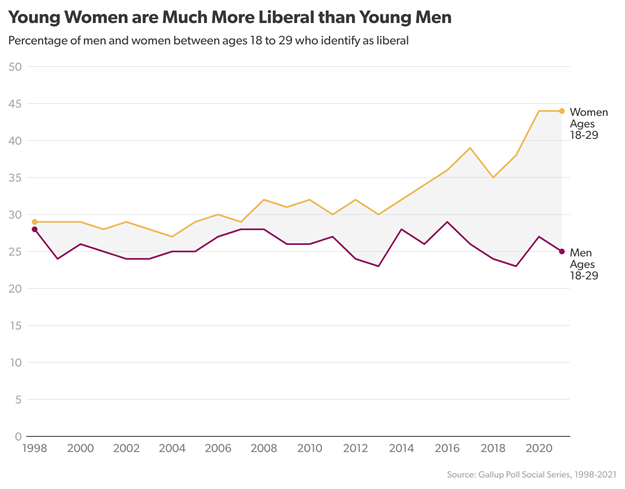
These same two studies also showed that, of those who held these leftist positions, there was twice the percentage of women compared to men.[2]  This distribution between the sexes fits with the Gallup polling data which showed that young women are more liberal than young men.  Here is that graph of Gallup polling data:

This Gallup poll data is from the Gallup Poll Social Series and it available here: https://www.americansurveycenter.org/featured_data/the-growing-political-divide-between-young-men-and-women/

These two Finnish studies were published in the Scandinavian Journal of Psychology and examined the relative level of depression and unhappiness in persons who ascribed to ideology which the researchers called a “Critical Social Justice Attitude” (“CSJA”).  This attitude involved persons who perceive others “foremost as members of identity groups and as being (witting or unwitting) perpetrators or victims of oppression”.[3]  Further, these attitudes included conclusions such as:

·         “If white people have on average a higher level of income than black people, it is because of racism.”

·         “University reading lists should include fewer white or European authors.”

·         People who are not gender-confused “should state their gender pronouns in, for instance, their social media profiles.”

·         So-called “trans women” [i.e., gender-confused men] – are women.

·         Limiting speech rights of privileged people is not justified. (reverse scored).[4]

·         There are only two biological sexes in the human species. (reverse scored).

·         A person should not say things that might offend an oppressed person.

·         The police are institutionally racist.

·         The ideas of Karl Marx should not have more influence in national politics. (reverse scored)Bottom of Form

.[5]

People were given a questionnaire about these positions, which the researchers then scored.[6]  The higher CSJA scores (which indicated greater acceptance of leftist positions) correlated closely with the group of people who self-reported higher incidences of depression, anxiety, and unhappiness.[7]

To Catholics, God’s all-wise plan is evident here: God created us to follow His law, embrace His truth, and follow our Reason.  He created us to live lives of virtue.  He created people to be happy by living this way and holding the truth.  Of course, no one can escape being unhappy who is living the opposite way – viz., a godless life, rejecting the truth; a life of vice, unruly passions, and unreasonable emotions.

The leftist, anti-God way of life always leads to a greater incidence of depression and unhappiness, as a foretaste of the unhappiness that awaits the servants of Satan in the afterlife.  This is a necessary reminder that we must strive for virtue and holiness!  Let us do so always and in everything!


[1]           Lahtinen, O. (2024), Construction and validation of a scale for assessing critical social justice attitudes, Scand J Psychol, 65: 693-705. https://doi.org/10.1111/sjop.13018


[2]           Lahtinen, O. (2024), Construction and validation of a scale for assessing critical social justice attitudes, Scand J Psychol, 65: 693-705. https://doi.org/10.1111/sjop.13018

[3]           Lahtinen, O. (2024), Construction and validation of a scale for assessing critical social justice attitudes, Scand J Psychol, 65: 693-705. https://doi.org/10.1111/sjop.13018

[4]           Reverse scoring is a technique used to ensure that all answers on a questionnaire have a consistent direction.  For example, suppose that a questionnaire is scored on a scale of 1-10 and if, for most of the questions a high answer (10) indicates strong leftist sentiment, then any question which was phrased so that a high answer would indicate a strong anti-leftist position, then the answer to that question would be “reverse scored” so that a response of “1” (which would indicate a strong disagreement with the conservative position), would be treated as mirror-image answer of “10”, showing the respondent strongly supports the opposite (leftist) position.

This technique allows the questionnaire to be scored so that the larger the total for all of the answers, the more strongly the questionnaire shows an overall leftist sentiment.

[5]           Lahtinen, O. (2024), Construction and validation of a scale for assessing critical social justice attitudes, Scand J Psychol, 65: 693-705. https://doi.org/10.1111/sjop.13018

 (bracketed words added for clarity; parenthetical words in the original).


[6]           Lahtinen, O. (2024), Construction and validation of a scale for assessing critical social justice attitudes, Scand J Psychol, 65: 693-705. https://doi.org/10.1111/sjop.13018


[7]           Lahtinen, O. (2024), Construction and validation of a scale for assessing critical social justice attitudes, Scand J Psychol, 65: 693-705. https://doi.org/10.1111/sjop.13018

Words to Live by – from Catholic Tradition


Prepare thyself like a man to resist the wicked attacks of the devil; bridle gluttony, and thou shall the easier restrain all carnal inclinations.


My Imitation of Christ by Thomas a Kempis, (c)1982, Confraternity of the Precious Blood, 5300 Fort Hamilton Parkway, Brooklyn, N.Y. 11219, Bk. 1 ch.19.                                                                          


It is Important to Keep in Mind the Fires of Purgatory


Most people go through life focusing only on the fact that God is merciful, kind, and helpful, and they don’t want to think about the punishment they deserve for their sins.  Well, they’d better change and think deeply about the very real punishments in Purgatory, for if they understood the real pain of fire, they would think twice and make more of an effort to avoid sin.  No one is going to “sneak into” Heaven.  God is at the door.  And He is all-just.


To many, Our Lord’s command, “Deny thyself, take up thy cross and follow Me”, (Matthew 16:24)  seems hard; but it would be much harder to hear that final word: “Depart from Me, ye cursed, into everlasting fire.”  (Matthew 25:41).  This phrase “everlasting fire” refers to the fires to hell.  But now let us consider the fires of Purgatory. 


Here is a crucial reminder from Fr. Paul O’Sullivan:


The fire of Purgatory is the same terrible fire as the fire of Hell.  We may be kept in this awful fire for many years for a deliberate venial sin.  God could never punish us too severely.  He does not send us to Purgatory because He is angry with us, but because the malice of a deliberate venial sin is simply awful – mortal sin much more so.[1]


Here is the wholesome teaching of My Catholic Faith:


St. Augustine believed that the sufferings of the poor souls are greater than the sufferings of all the martyrs.  St. Thomas believed the least pain there is greater than the greatest on earth.  The greatness and the duration of a soul’s sufferings in Purgatory vary according to the gravity of the sins committed.  One who has lived a long life of sin, but is saved from hell only by a deathbed repentance, will stay in the purging fires of Purgatory longer, and suffer there more intensely than a child, who has committed only the venial sins of an ordinary child.[2]


It is important that one understands the real pain of the fires of Purgatory.  That understanding will greatly help to avoid all sin.   Avoiding all sin is possible even for those who are without (most of) the Sacraments – as faithful and informed Catholics currently are in all of those places in the world where the Sacraments are not available without compromise.  God knows what we need and provides it.


There is a way to begin to understand and to feel the pain which is a little like Purgatory’s fire.  (Obviously, be very careful not to injure yourself.)  Light a candle and hold your hand about seven inches above the flame and feel the heat.  Then lower your hand little-by-little until you understand much better the real pain of fire which is suffered by those persons in Purgatory.  Then reflect that such suffering in Purgatorial fire could last for years. 


Think also, that God created the fires on earth to serve and help man.  By contrast, God created the fires of Purgatory to inflict much more pain than the fires on earth because He created those fires to punish man.


Now, with your new understanding of what sinners suffer in Purgatory, let us begin by promising God that we will sin no more.


We know we must be a saint in order to get to heaven.  So let us love God, hate sin, pray devoutly and often, and we will be “ordinary saints” who will spend all eternity in the complete happiness of heaven.


[1]           An Easy Way to Become a Saint, Fr. Paul O’Sullivan, O.P., Tan Books and Publishers, Inc., Rockford, Ill. 1990, p.101.


Note: Every sin is an infinite evil in three ways and mortal sin is an infinite evil of a fourth way too.  Read an explanation of this truth here: https://catholiccandle.neocities.org/faith/the-infinite-evil-of-sin

[2]           My Catholic Faith, Bishop Louis Morrow, My Mission House, Kenosha, Wis., ©1949, p.158.

Lesson #35 About the Temperaments – further reasons why we study them

Philosophy Notes

Mary’s School of Sanctity

Lesson #35 About the temperaments – further reasons why we study them

More about why we study the temperaments – what’s the point?

Because we humans were made to praise, revere, and serve God[1], and because we carry out this precept in the way we deal with our neighbor, it is important to try to understand ourselves and our neighbor well.  To better understand our neighbor, we should start with self-knowledge, which includes knowing our own inclinations.

We can and do know that by our fallen human nature we humans have general tendencies, i.e. concupiscence of the flesh, concupiscence of the eyes, and the pride of life,[2]  but we must not forget that each of us also has his own natural dispositions and inclinations.   Hence, we study the inclinations people naturally have when we study the basic four temperaments.  One important aspect of our study of the temperaments, AND a goal we have in our study, is to find our own strengths and weaknesses and to use our strengths to overcome our weaknesses.  This is a means to our perfection. 

Each of the temperaments has a set of typically found strengths and weaknesses.  So, our challenge in our life is to work out our salvation by discovering our strengths and weaknesses, and with God’s help, of course, to use our strengths to overcome our weaknesses.  Thus, God intends for us to hew away at the things of our temperaments which are not favorable to a charitable relationship with Him and our neighbor.  In this way, too, He wills us to use the God-given strengths we have to glorify Him.  This is indeed what the saints did.[3]

Therefore, when we study the temperaments, we can come to better appreciation of our neighbor by recognizing his temperament and thereby seeing how we can work more harmoniously with him.  Another beneficial aspect of this knowledge is that it helps us to avoid rashly judging our neighbor, and in turn, this fosters our practice of compassionating our neighbor.   

With all this in mind, we can easily see that there are many good reasons to learn about the four basic temperaments and the possible combinations of these, and how people with the temperaments interact with each other.

One important additional consideration to make is to reflect upon Our Lord and Our Lady.  Both Our Lord and Our Lady had in their genetic make-up a perfect mixture of the four temperaments.  How do we know this?  They were both immaculately conceived and without any stain of sin for the entire duration of their lives.   It is also fitting that they would both be a perfect blend and balance of the four temperaments and would have nothing that would stand out as a genetic weakness.  God intended that they both would be models for us to imitate.

Setting forth the overall scheme of looking at each of the temperaments.

·         For each temperament, we will set out a listing of its general strengths and weaknesses.


·         We will discuss how a person with each temperament, who is of good will, uses the strengths to overcome the weaknesses.


·         We will discuss how a person with each temperament, who is of bad will, does not use the strengths to overcome the weaknesses.


·         We will discuss aspects of the prayer life/spiritual life of each temperament.


·         We will discuss the typical temptations which impact each temperament and how the temptations can be counteracted.

 In our next lesson, we will begin our treatment of the choleric temperament


[1]           See the series on the Spiritual Exercises of St. Ignatius of Loyola, especially these two articles:


v  https://catholiccandle.org/2022/05/24/lesson-9-the-principle-and-foundation-part-i/


v  https://catholiccandle.org/2022/06/27/lesson-11-the-principle-and-foundation-part-ii/


[2]           “For all that is in the world, is the concupiscence of the flesh, and the concupiscence of the eyes, and the pride of life…”  1 John, 2:16.


[3]           One well known example of saintly reform is St. Vincent de Paul.  He was known for his choleric temper but he mastered himself so well that he was thought to be phlegmatic. 

The Evils of Social-Emotional Learning

Catholic Candle note: The article below is a “companion” article to an earlier Catholic Candle article about the leftists’ use of an excessively-emotional and unreasonable counterfeit empathy.

That earlier article contrasts false empathy with true empathy and is entitled Empathy – a Tool for Good or for Evil.  The article can be found here: https://catholiccandle.org/2021/04/02/empathy-a-tool-for-good-or-for-evil/

The leftists have concocted an additional tool to ruin the minds of students.  It is called social-emotional learning (“SEL”).  It is currently one of the main programs that the leftists are pushing for the schools, especially the public schools.

SEL combines the leftists’ longstanding aim to dumb-down the education of the population and their aim to make the people more emotional and less able (as well as less ready) to use their reason.

Let us start our look at this evil trend (viz., social-emotional learning), by recalling some truths about reason:

  Reason is our highest faculty.  It is what makes us (our souls) immortal.

  Reason makes us capable of virtue.  Reason makes every human action either good or bad.  Every action which is not from reason is not a properly human action but stems from instinct and is on the level of the actions and impulses of beasts.

  The object and the perfection of the mind is truth.  Truth is the mind’s conformity with reality and our reason allows us to know the truth.  In other words, through our intellects, we know reality.

  Reason makes it possible for us to know universal, eternal truth.  (In other words, our reason makes us capable of knowing what is always and everywhere true.)
   

  Reason makes us capable of knowing the highest Truth – that is, God – Who is Truth Itself.  Reason is what makes the blessed capable of “seeing” and enjoying the Beatific Vision – which is an intellectual understanding of God’s Essence, that makes the blessed perfectly happy.

  Reason causes us to have free will, since our will is the rational appetite.  That is, our will is the power of desire regarding all things known by the mind.

  Reason makes us capable of receiving sanctifying grace and actual grace. 

  Reason makes us able to gain supernatural merit.
 

  Reason is a cause of all human achievements in the history of the world and is necessary for any deeds of honor, valor, or glory which were ever undertaken and attained.

  Reason is an essential foundation of true culture.  Reason is the well-spring of all of the arts and sciences.

  Reason is an essential cause of knowledge and wisdom. 

  Reason underpins happiness, and man cannot be happy except by following his reason.

  Reason is the basis for all justice, harmony, and peace in society.

  True education perfects the mind by facilitating the mind’s development in the truth.

Now let’s contrast these truths (above) with the leftist’ program for the schools which is called “social-emotional learning” (“SEL”).  As even the name indicates, “social-emotional learning” emphasizes:

  social conformity-training – so that the student parrots the same leftist (politically correct) conclusions as everyone else in the class, and


  emotional conditioning – so that the student is habituated to “feel” emotionally, instead of to think logically.

Proponents of “social-emotional learning” openly focus on feelings and downplay reasoning.  Here is the (fuzzy) way in which one prominent SEL website stated this:

Emotion is more important than understanding because, in lieu of all of our willful rationality and effortful pursuit of universal truths, we are ‘wired’ for emotion and it drives us forward – up, away, and back again in countless and quiet little cycles of life.  In the human brain, the neocortex facilitates ‘reason’ but is often encouraged to do so through feedback loops and dopamine rewards.[1]

Of course, the SEL jargon – like the phrase “emotional intelligence” – is really an oxymoron.  Emotions are not at all intelligent except to the extent that they are habituated to conform to the higher principle – viz., reason – through being trained like a dog.

Likewise, the phrase “social-emotional learning” makes no sense because emotions do not learn.  Learning occurs in the intellect.

The perfection of the mind is the truth, and truth is attained by reasoning, debating, discussing, by evidence, syllogizing, and careful analysis.  These are habits of mind that the leftists abhor and which the leftists blame for creating the injustice and oppression in the world.

Instead, the leftists use storytelling and counter-storytelling to appeal to the passion of fear and to other emotions.  They also use subjectively-interpreted “lived experience”.  These are the basis for their declaring their victimhood, e.g., on issues such as their promoting deviant, unnatural vice or attacking the strong virtue of purity. 

The leftists are unequipped and would never debate whether unnatural impurity is objectively evil.  Instead, they would insist on how much those (perverted) people feel “hurt” to be “marginalized” and not “seen” and “respected”.  They would demand that people of that ilk be given a “voice” which is “heard” and that they see in the public forum celebrities that are “like themselves”.

These leftist-trained dupes cannot think-through, discuss, and debate ideas with those who disagree with them.  They are entirely unequipped to evaluate rational discourse.  Such people are conditioned to simply demand the “cancelling” of those who disagree with them.

Thus, society has come to the chaotic condition in which emotionalism dominates debates and discussions throughout the U.S., especially on college campuses.  A claim that someone’s words are “triggering” or  “offensive” is not just an expression of one’s own subjective feeling of being offended.  It is, rather, a public charge that the speaker has done something objectively wrong.  It is a demand that the speaker apologize or be punished by some authority for committing a (supposed) offense. 

In our society, the “greatest sin” is to saying something which is labeled “offensive”.  By contrast, there is little mention of whether a person’s position is objectively false or true.  Instead, there is fuzzy reference to “your truth” and “my truth” as if the truth is not one (and as if the truth were not a transcendental concept which is convertible with being).

Truth is a “transcendental” concept – meaning that it is present in all categories of “what is and not only some categories.  The truth is mind’s conformity with reality and so, however much a person’s mind knows being, (i.e., knows reality) to that extent he possesses the truth.  For this reason, we say that “truth is convertible with being” – viz., the more a mind is conformed with objective reality, the more truth the mind has.  Truth is objective because reality is objective.  There is no “your truth” and “my truth” because there is no “your reality” and “my reality”.

Social-emotional learning does not aim at teaching a student how to think.  It aims at teaching him what to think – that is, politically-correct conclusions.

The ultimate goal of SEL is to erode traditional morals, beliefs, attitudes, and worldviews of students.  The goal is to manipulate students into accepting the latest leftist ideology.  This is one of the evils of SEL.

When one becomes attuned to listen for such emotion being substituted in the place of reason, then one begins to hear this occurring all around him.  It is everywhere in the media, too.  For example, in a mainstream radio “news” story on the day this article was begun, this is what one person said:

When I heard that [a particular event] occurred, I was so angry.  Then when I realized it could happen again, I was so scared.

As we wrote above, SEL uses social conformity and emotion-based reactions to erode traditional morals, beliefs, attitudes, culture, and practices of students.  The goal is to manipulate students into accepting the latest leftist indoctrination.

The promoters of SEL declare this goal themselves.  For example, the main promoters of SEL explain that SEL is very helpful as a way to inculcate into the students an “anti-racist” agenda.[2]  Such an “anti-racist” program attempts to convince blacks that they have been victimized and are owed monetary and/or non-monetary entitlements (freebies) because other persons in history with the same color skin were mistreated (and, in some cases, only allegedly mistreated) by people who are now dead but who had a different skin color.

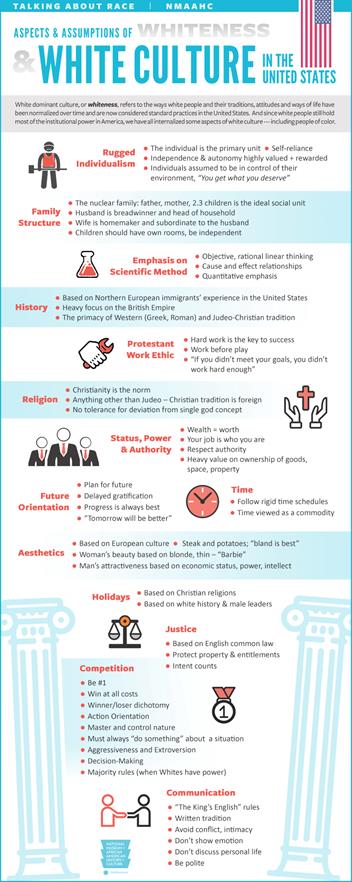
The blacks are told that they don’t need to live disciplined, orderly lives because that is “for white people”.  Here is how the government inculcated this message in a poster[3] financed by the Smithsonian’s National Museum for African American History and Culture:

Thus, SEL’s so-called “anti-racist” training seeks to convince blacks that they are victims and that whites are the oppressors.  In other words, the SEL program seeks to do what Marx sought to do, viz., to stir up dissatisfaction and promote a feeling of victimhood in one part of society, by promoting (as he put it) a “ruthless criticism of all that exists”.[4]

This “anti-racist” training also seeks to make white people ashamed that they are white, including conditioning them “to try to be less white” as one (so-called) Diversity, Equity, and Inclusion program phrased it.[5] 

Such a message foments division and disharmony between groups (blacks and whites).  The Marxists’ chief strategy is to create such division in order to gain control of society.   As Pope Pius XI warned, the “preachers of Communism are proficient in exploiting racial antagonisms, political divisions, and oppositions.”[6]

SEL is also designed and promoted to serve other Marxist goals.  For example, SEL is promoted as a “lever for equity”.  So-called “equity” is one of the leftists’ core aims in order to re-make society according to “diversity, equity, and inclusion”.[7]

Let us examine a “case study” of SEL showing its results in practice.  The Chicago public school system is the nation’s leader in implementing “social-emotional learning”.  Let us see the effect of SEL on the Chicago Public School System (CPS).

Chicago’s school system has been committed to social-emotional learning since 2012 and has become a national leader in SEL.[8]  Chicago was aided in implementing SEL by the State of Illinois having created a statewide SEL curriculum; Illinois is the first state in the nation to pass standards for social emotional learning.[9]

But the Chicago Public Schools are among the worst in the nation.  The city’s own accountability report card demonstrates that huge majorities of students in the city’s worst schools – 75% in elementary and 95% in high school – failed to meet Illinois’ very low, dumbed-down state standards.[10]

Moreover, only 30% of Black students meet or exceed reading standards in the third grade, and only 14% of 11th graders do so, according the Illinois State Board of Education’s own data.[11]

Because it is so shameful that the Chicago Public Schools are failing so badly, Chicago’s leftist mayor (Brandon Johnson) decided that Chicago would no longer “grade” its school system by how well it teaches the students but would instead begin to “grade” the schools only by the total amount of money per student that Chicago spends on its schools.  As Johnson declared in a public interview:

“My responsibility is not simply to just grade the system, but to fund the system ….  That’s how I’m ultimately going to grade whether or not our public school system is working: based upon the investments that we make to the people who rely on it.”[12]

So, the Chicago Board of Education followed Mayor Johnson’s lead and scrapped its school rating policy, which had been designed to rate schools according to how well students learned.[13]

According to the Illinois State Board of Education’s own data, not even one student in the 22 schools analyzed in a widely read report can read at grade level.[14]  In 18 of those schools, there wasn’t a single student who demonstrated proficiency in math or reading.  Despite this, some of these same schools were given the rating “commendable.”[15]

Despite the Chicago Public Schools being such obvious failures, it is not because of a lack of funding.  CPS spends almost $30,000 per student!  (The exact number is $29,400 according to NPR.)[16]  That is more than double the national average ($14,347) of per student public school spending.[17]

So, by Mayor Brandon Johnson rating Chicago’s public schools according to spending rather than according to performance, (i.e., learning), Chicago’s schools with their heavy use of SEL, thereby go from one of the worst school systems in the country to one of the best! 

However, no thinking person would rate schools that way if he truly cared about education or about truth.  But Johnson and the leftists don’t care about real education or about the truth.  They care only about leftist indoctrination of the students.  That is the whole reason they use SEL, because it is an effective tool for their goal, which is to develop foot soldiers for their leftist revolution.

This is a good reminder about the lies continually told by the leftist politicians and teachers’ unions.  The problem is not a lack of funding but a failure to pursue the mission of education of the students, with discipline, common sense, and the methods that work well in private schools which only spend a tiny fraction of the excessive spending of the public schools.


[1]           https://www.teachthought.com/pedagogy/social-emotional-learning/ (emphasis added; initial capital added to the quote).

[2]           See, e.g., this SEL promotional video: https://www.youtube.com/watch?v=DPFMfultXSY

[4]           Here is the longer quote from Marx:


Now philosophy has become mundane, and the most striking proof of this is that philosophical consciousness itself has been drawn into the torment of the struggle, not only externally but also internally.  But, if constructing the future and settling everything for all times are not our affair, it is all the more clear what we have to accomplish at present: I am referring to ruthless criticism of all that exists, ruthless both in the sense of not being afraid of the results it arrives at and in the sense of being just as little afraid of conflict with the powers that be.


Letter of Marx to Arnold Ruge, Kreuznach, September 1843, found here: https://www.marxists.org/archive/marx/works/1843/letters/43_09.htm

[6]           Divini RedemptorisOn Atheistic Communism, by Pope Pius XI, 1937, paragraph 15.  Note, as quoted here, we remove the word “also” before the word “proficient”, because the other exploitations to which the pope refers are not part of the quote we give here.


[8]           See these brag-pieces, asserting the Chicago Public School System’s preeminence in this field:


Ø  https://www.cps.edu/about/departments/office-of-social-and-emotional-learning/ &


Ø  https://www.k12dive.com/news/chicago-public-schools-leads-on-sel-with-collaborative-approach-to-implemen/439713/

The Crisis in Society is Caused by Unmanly Men

Catholic Candle note: In our corrupt times, men have “forgotten” how to be men, just as women have “forgotten” how to be women.  The article below is a beginning of a “reminder” and examination of conscience for men, regarding what God expects of them. 

In a way, the article below is a “companion” article to these articles for women:

  https://catholiccandle.org/2019/12/02/the-role-and-work-that-god-gave-to-woman/

  https://catholiccandle.org/2020/10/01/the-importance-and-need-for-stay-at-home-moms/


There is a spiritual and moral crisis we see all around us in civil society and in the human element of the Church.  All other problems, such as crime, dysfunctional families, a broken education system, disastrous economy, etc., flow from this.

One way to assess the root cause of all of these problems is that they are caused by men, much more than by women or children.  If men did not fail to be true men, these problems would not have occurred in society or in the human element of the Church.  Further, if men did not fail to be true men, there would not be the big problems that also exist in women and children.

Men are more responsible because of the leadership role God gave to them as part of His Providential plan, and also because He made them the protectors, defenders, and advisors of the rest of society. 

Here is how St. Thomas Aquinas explains this truth:

Men are wiser and more discerning and not so readily deceived as women are.  …  Man is the head and counselor of the woman.[1]

So, men have failed themselves as well as failed the women and children by allowing society and the Church’s human element to become so corrupt.

St. John Chrysostom denounced men who are like this, who are so weak as to not only fail to lead their wives, but to be led by them.  Here are his words, speaking to men:

You are the head of your wife, and she has been created for your sake; but you have inverted the proper order; not only have you failed to keep her on the straight and narrow but you have been dragged down with her, and whereas the rest of the body should follow the head, the contrary has in fact occurred, the head following the rest of the body, turning things upside down.[2]

There is a secular proverb which points out the same greater responsibility of the men for what happens in society (and in the human element of the Church).  It shows that men are more blamable than women or children for corrupt times:

Weak men make hard times.  Hard times make strong men.  Strong men make good times.  Good times make weak men.

In other words, men who are soft and self-indulgent cause bad times, i.e., a deterioration in society.  Such bad times test and toughen men’s character, pushing them to be virtuous and manly (as they always should be).  Virtuous and manly men cause society to become more peaceful, prosperous, and virtuous.  Peaceful and prosperous times cause men to become weaker and more self-indulgent.

Doctor of the Church, St. Hilary of Poitiers, taught the truth that peaceful and easy times tend to weaken a person’s virtue.  Here is how St. Hilary teaches this truth, focusing on the Virtue of Faith:

When our Faith is attacked, it increases.  Therefore, in dangers, our Faith is secure; in security, our Faith is in danger.[3]

Another common proverb points to this same truth, in a general, secular way:

From blue collar, to white collar, to blue collar in three generations.

This means that a man in difficult circumstances, who uses determination, sacrifice, and hard work, causes his sons to have education and opportunities that he (their father) did not have.  This results in greater affluence and ease for these sons and for their own families.  Such affluence and ease tend to cause a softness and self-indulgence in the children of those families.  Thus, their characters are weaker than their grandfather’s – undermining what he tried to instill into his descendants. 

So, we see that men’s failures are due to their becoming soft, unmanly, and self-indulgent, as commonly happens when times get easy and everything is peaceful.

Although God created men to lead their families and to lead society, the feminists want men to be led by women.  Pope St. Pius X fought the earlier part of the same satanic feminism.  Here is one way he warned against a variation of this evil:

Women in war or parliament are outside their proper sphere, and their position there would be the desperation and ruin of society ….[4]

These words of Pope St. Pius X echo the principle set forth by the prophet Isaias, who measured the extent of the perversity in Israel, by saying:

As for my people, their oppressors have stripped them, and women have ruled over them.

Isaias, 3:12.

St. Paul shows that God created men – not women – to be the leaders of society.  Here is one way he infallibly declares this truth:

But I would have you know, that the head of every man is Christ; and the head of the woman is the man; and the head of Christ is God.

1 Corinthians, 11:3.

St. Paul’s analogy here is that, just as the head of a physical human body is its source of direction, so likewise, God made man to direct woman.

Further, a woman is not the head of her own family.  She must obey her husband.  St. Paul taught: “Let women be subject to their husbands, as to the Lord”.  Ephesians, 5:22.

As perverse as it would be for a woman to be head of her family and to rule over her husband, how much more perverse it would be for a woman to be the ruler of a country and have authority over all of the men of the country!

This authority of man over woman is not only part of the revealed Divine Law and the teaching of the Church, but it is also part of Natural Law.  St. Thomas Aquinas shows this when he cites St. Paul (regarding the Divinely Revealed Law on this issue) and then cites the great philosopher Aristotle regarding this same principle in the Natural Law.  Here are St. Thomas’ words:

According to the Apostle [1 Tim. 2:11; Titus 2:5], woman is in a state of subjection: wherefore she can have no spiritual jurisdiction, since the Philosopher [i.e., Aristotle] also says (Ethic. viii) that it is a corruption of public life when the government comes into the hands of a woman.[5]

We see the “tail” of the devil in feminism.[6]  Satan and his servants hate God and they hate the Natural Law which He created.  They hate His creation and in particular how God created manhood and womanhood.

The devil seeks to destroy womanhood through the evil of feminism and he seeks to corrupt women by twisting them into an unnatural equality[7] with men and into being unwomanly caricatures of men. 

Similarly, Satan and his tools are trying to destroy men and their manhood.  The devil tries to make men unmanly, soft, emotional, and self-indulgent.  He tries to make men into unmanly caricatures of women.

We know that Our Lord is especially the model for all men (just as Our Lady is especially the model for all women).  The magnificent St. Gregory Nazianzen, Doctor of the Church, taught us one aspect of Our Lord’s example to men.  He said:

There is in Him [i.e., Christ] nothing womanly, nothing unmanly.[8]

We see from St. Gregory Nazianzen’s wise words that it is a mark of perfection for a man to be a manly man and to be in no way womanly. 


Leftists Portray Men as Helpless and as Needing Women to Show Them How Men Should Act and How Men Can Avoid Being Failures.

The lies and perversions promoted by the leftists are everywhere.  The leftists twist manhood “upside down”, saying that women should teach men how to be men.  Leftists say that “men are in crisis”.[9]  They declare that “men are lost”.[10]  For example, the leftists promote a rabid feminist (Christine Emba) to give men (as the Washington Post says) “a map out of the wilderness”.[11]

Leftists tell men that male traits are harmful.  Here is one way they spew that anti-God poison:

Traditional masculinity – marked by stoicism, competitiveness, dominance, and aggression – is, on the whole, harmful.[12]

Leftists tell men that men should stop being like men.  Here is one way that they promote that evil idea:

Achievement, eschewal of the appearance of weakness, and adventure, risk, and violence, … these standards are damaging to mental and physical health.[13]

Leftists tell men that men should be like women.  Here is one way that they say this, attempting to destroy the manhood which was created by God:

To the extent that any vision of “nontoxic” masculinity is proposed, it ends up sounding more like stereotypical femininity than anything else: Guys should learn to be more sensitive, quiet and socially apt ….[14]

So, turning manhood upside down, the leftists say that a man is strong when he is acting like a woman.  Here is one way the leftists state their oxymoronic position:

There’s a lot more of an effort now to broaden the idea of what masculinity really can be, … and how there can be strength in doing some things that ordinarily would be considered feminine – like talking about your feelings or crying in front of others.[15] 

Plainly, we see the wickedness of this leftist attack on Nature.  This is an attack on all of society.  But in particular it is an attack on each man who does not resist and guard himself from becoming a wimpy shadow of a woman, instead of a real man.  By this destruction of what God made him to be, he becomes a failed pile of wreckage and an unhappy freak of Nature. 


General Traits of Men – in Contrast to Women

We must now look at what True Manhood is, as God and Nature intend it to be.  Such manhood is the only way a man can be happy.  It is the only way he can make a success of his life (in all of the important ways) and attain the true goal of his life, which is Eternal Salvation. 

Let us start by considering traits of manhood.  Men have many prominent traits which contrast with the traits of women.  For example, they tend to be:

  Larger and stronger in body;[16]

  Greater in physical endurance;

  Wiser, stronger in mind, with clearer powers of reasoning;[17]

  More focused on ideas and abstract matters;

  Less focused on persons and their individual differences;

  Less focused on details and more focused on the “big picture”;

  More focused on a legacy of accomplishment in the world and less focused on his children being his legacy;

  More focused on causal reasoning and less on intuition;

  Less emotional;

  Firmer of will to adhere to resolutions made;

  More decisive in making decisions and more prone to stubbornness;

  Greater willingness to take risks, as well as more prone to rashness;

  Greater self-mastery;

  More self-reliant;

  Bolder and more courageous;

  Less prone to take social cues and less prone to act in a particular way because other people act that way too;

  Less concerned about his neighbors’ lives and activities;

  Prone to be a leader;

  Less compassionate and considerate of the feelings of others;

  Less vain and less concerned about his own appearance;

  Less prone to be humble;

  Less prone to be pious;

  Not graceful;

  Does not tend to seek to ornament himself and his surroundings and to focus on beauty;

  Is more competitive;

  More mechanically inclined and is better at designing and operating machinery;

  More apt at mathematics, the physical sciences, philosophy, and theology;

  Less generous and giving;[18]

  Less attentive to manners, etiquette, civility, and decency;

  Less home-oriented and more focused outside the home;

  More willing to resort to conflict and more prone to use force and violence;

  Greater proneness to be protective of others (as well as himself); and

  Greater proneness to provide for others (as well as himself).

Our experience shows us that some of these traits are more central to manhood than are other traits.  The most important trait of manliness and man’s key strength is for him to conquer and to control himself. 

In other words, the greatest mark of true manhood and the greatest strength of a man is for him to master his own lower nature.  For this reason, we see that a man who is seething with unruly passions (i.e., not firmly controlled by his reason) is a poor, weak sort of a man.  He is a slave, really.  This is true regardless of how capable he is of conquering others.   

A manly man must not be selfish, nor carried away by his emotions or passions.  He must control himself and always live according to his reason.  That is why a man can be a manly man and can show the truth of manliness even when he is 106 years old and is wheelchair-bound.  Thus, e.g., St. John the Evangelist showed manly firmness and courage when he fearlessly endured being boiled in a cauldron of oil in his later years.

One way the leftists attempt to corrupt manhood is by referring to the “feminine side of a man”.  Further, we see how disgraceful it is for a man to wear pink, wear earrings, or in other ways to blur the differences between the sexes, their roles and actions, and their clothes.

Whereas God made women more emotional, it is a great disgrace for a man to be as emotional as a woman.  This is like the great disgrace it is for a woman to lack a woman’s heart of compassion and generosity.

St. Thomas Aquinas – who is not only the greatest Doctor of the Church but also the greatest man of reason – elaborates on the salient point of manhood, viz., that God created man to be wiser than woman:

The reason for this subjection of woman to man is that the husband is the head of the wife, and the sense of sight is localized in the head — “The eyes of a wise man are in his head” (Eccl. 2:14) – and hence a husband ought to govern his wife as her head.  “The head of the woman is the man” (1 Cor. 11:3).  Then he [viz., St. Paul] brings in his example when he says: as Christ is the Head of the Church.  God “has made Him head over all the Church, which is His Body” (Eph. 1:22-23).  This is not for His own utility, but for that of the Church since He is the Savior of His Body.[19]

Just as Christ is the Head of the Church for the good of the Church, likewise, God made man to be the head of the woman for the good of the woman.  St. Paul shows us this parallelism in these words: 

But I would have you know, that the head of every man is Christ; and the head of the woman is the man; and the Head of Christ is God.

1 Corinthians, 11:3.

As man has a duty to be wise and guide with his wisdom the woman under his care, so God made parents to be wiser than the children they are raising, so they can guide their children with their wisdom.

God gave the man the attributes of manhood in order to serve Him (viz., God) through his manhood and for the good of the woman and children under his care.  This difference (between men and women) is the wellspring from which chivalry and gentlemanliness arise, since a man is chivalrous and is a gentleman for the good of the woman, using his manhood (including his authority over her) to benefit her.

Let men serve God as manly men, teaching their sons to be real men!  Let women be womanly and show their daughters the example of how to be real women!  In this way, faithful and informed Catholics of both sexes will serve God the way He wants to be served and will be the leaven in society that God created them to be!


[1]           Quotes from St. Thomas, Lectures on St. Matthew’s Gospel, ch.23, #1859.

[2]           Quoted from St. John Chrysostom, Homilies on Genesis 17:17, English version, The Fathers of the Church, vol. 74, p. 231.

[3]           Catena Aurea on St. Matthew’s Gospel, St. Thomas Aquinas, editor, quoting St. Hilary of Poitiers, ch.20, §5.

[4]           Words of Pope St. Pius X in his 1909 Address to Delegation of the Union of Italian Catholic Ladies.

[5]           Summa Supp., Q.19, a.3, ad4.  Note: due to the great respect and admiration that St. Thomas Aquinas and other great Medieval thinkers had for Aristotle, they called him “The Philosopher”.

[6]           To examine how the Feminist Program is the same as that of Satan and Marx, read this article: https://catholiccandle.org/2022/08/26/the-feminist-program-is-the-same-as-that-of-satan-and-marx-part-vii/

[7]           The Merriam-Webster Dictionary defines “feminism” as a theory of equality:


Feminism: the theory of the political, economic, and social equality of the

sexes.


https://www.merriam-webster.com/dictionary/feminism


For an examination of the role and great work of a woman’s life as provided by Catholic teaching and by the Natural Law, read this article:

https://catholiccandle.org/2019/12/02/the-role-and-work-that-god-gave-to-woman/


[8]               St. Gregory Nazianzen, Doctor of the Church, quoted from his sermon On the Holy Easter II, published in Sunday Sermons of the Great Fathers, translated by M.F. Toal, D.D., Henry Regnery Co., Chicago, © 1957, vol. 2, page 252 (emphasis added).

[9]           Men are lost. Here’s a map out of the wilderness, Washington Post, found here:              https://www.washingtonpost.com/opinions/2023/07/10/christine-emba-masculinity-new-model/


[10]         Men are lost. Here’s a map out of the wilderness, Washington Post, found here: https://www.washingtonpost.com/opinions/2023/07/10/christine-emba-masculinity-new-model/


[11]         Men are lost. Here’s a map out of the wilderness, Washington Post, found here: https://www.washingtonpost.com/opinions/2023/07/10/christine-emba-masculinity-new-model/


[12]         Men are lost. Here’s a map out of the wilderness, Washington Post, found here: https://www.washingtonpost.com/opinions/2023/07/10/christine-emba-masculinity-new-model/


[13]          Men are lost. Here’s a map out of the wilderness, Washington Post, found here: https://www.washingtonpost.com/opinions/2023/07/10/christine-emba-masculinity-new-model/


[14]         
Men are lost. Here’s a map out of the wilderness, Washington Post, found here: https://www.washingtonpost.com/opinions/2023/07/10/christine-emba-masculinity-new-model/

 (bold emphasis added).


[15]         Men are lost. Here’s a map out of the wilderness, Washington Post, found here: https://www.washingtonpost.com/opinions/2023/07/10/christine-emba-masculinity-new-model/ (bold emphasis added).


[16]          For example, a man’s bones are larger and he has more muscle. 

[17]         St. Thomas Aquinas teaches: “men are wiser and more discerning and not so readily deceived as women are.”  St. Thomas lectures on St. Matthew, ch.23, #1859.

[18]         St. Thomas Aquinas teaches: “Women have a disposition to be more giving.”  Then, as fitting with this principle, St. Thomas quotes St. Paul to show this ready disposition towards giving: “As befits women, professing piety through good works.”  1 Timothy, 2:10.  St. Thomas lectures on St. Matthew, ch.23, #1859.

[19]         St. Thomas Aquinas, Commentary on Ephesians, Ch. 5, Lecture 8.