Catholic Candle note: The article below pertains to another scandalous error of Pope Leo XIV. However, a reader would be mistaken if he assumed that Pope Leo’s grave error somehow means that he is not the pope.
Sedevacantism is wrong and is (material or formal) schism. Catholic Candle is not sedevacantist. On the contrary, we published a series of articles showing that sedevacantism is false. At the following link is a list of 18 articles showing the errors of sedevacantism: https://catholiccandle.org/2026/03/31/since-pope-john-paul-ii-was-a-real-pope-was-archbishop-lefebvre-was-excommunicated/
Here is what St. Bernard of Clairvaux, Doctor of the Church, teaches concerning the need to recognize and respect the authority of a superior – such as the pope – even when he is very bad:
Even should the life of any superior be so notoriously wicked as to admit of no excuse or dissimulation, nevertheless, for God’s sake, Who is the source of all power, we are bound to honor such a one, not on account of his personal merits, which are non-existent, but because of the divine ordination and the dignity of his office.1
However, even while recognizing the pope’s authority and our duty to obey him when we are able, we know we must resist the evil he says and does. Read more about this principle in this article: Our Catholic Duty: Resist the Harm Done by a Bad Pope But (Of Course) Recognize His Authority: https://catholiccandle.org/2025/07/24/our-catholic-duty-resist-the-harm-done-by-a-bad-pope-but-of-course-recognize-his-authority/
Note Preceding the Analysis of Pope Leo XIV’s Recent Teachings Against Fighting in a Just War
The following Catholic Candle article concerns Pope Leo XIV’s heretical and unreasonable teaching which condemns any persons fighting any war, even a just war. Although Pope Leo made these comments in the context of Trump’s war against Iran, that does not change the fact that Pope Leo did not simply condemn Trump’s war against Iran but broadly condemned both sides of every war.
Pope Leo XIV Denies the Catholic Truth that Countries Have a Right to Engage in a Just War
The Pope Promotes Passivism – i.e., Refusing to Fight in any War Regardless of the Circumstances
Pope Leo XIV heretically2 and unreasonably rejects the truth that a country has a right under the Natural Law3 to engage in a just war and/or to defend itself against unjust aggression.
In a sermon on March 29, 2026, Pope Leo XIV stated:
Brothers and sisters, this is our God: Jesus, King of Peace, who rejects war, whom no one can use to justify war. He does not listen to the prayers of those who wage war, but rejects them, saying: “Even though you make many prayers, I will not listen: your hands are full of blood” (Is 1:15).4
Please note these two points that the pope (falsely) asserts here:
-
God never wants anyone to fight a war: (“no one can use [God] to justify war”); and
-
God would never help or grant the prayers of either side of a war: (“He does not listen to the prayers of those who wage war”).
Pope Leo XIV then elaborated on these heretical and unreasonable teachings against any fighting in any war – including all who fight a just war. Here are his words:
God does not bless any conflict. Anyone who is a disciple of Christ, the Prince of Peace, is never on the side of those who once wielded the sword and today drop bombs. Military action will not create space for freedom or times of #Peace, which comes only from the patient promotion of coexistence and dialogue among peoples.5
Please note the two points that the pope (falsely) asserts in this second passage:
-
God is never pleased with and would never help either side fighting in a war – (“God does not bless any conflict”); and
-
A good man would never support or condone those fighting on either side of any war – (“Anyone who is a disciple of Christ, the Prince of Peace, is never on the side of those who once wielded the sword and today drop bombs.”)
Pope
Leo XIV’s Position Resembles the Usual Leftist Position of
Promoting Gun Control Rather than Responible
Use of Guns
When considering Pope Leo XIV’s blanket condemnation of the use of military weapons (rather than condemning the unjust use of those weapons), we see the similarity between his position and the leftists’ usual condemnation of guns and demand for gun control. (In contrast to this, conservatives generally emphasize that all guns and military weapons can be good but must be used justly and responsibly.)
Since the time when Pope Leo XIV became pope, we see that he tends to follow the positions of Pope Francis on most issues. We see that tendency here too. Pope Francis falsely taught that nuclear weapons are inherently evil and even possessing them is evil. Note: the now-liberalizing SSPX supports Pope Francis’s false, leftist position which requires unilateral nuclear disarmament.6 (By contrast, the Catholic truth is that neither the possession nor use of nuclear weapons is inherently sinful but the sin arises from their unjust use.)7
In the article below, we show the truth of the Catholic Faith and of the Natural Law that it is not a sin to use swords, bombs, and other military weapons, but the sin arises from using them unjustly.
Let
Us Compare Pope Leo’s Blanket Condemnation of Both Sides of Every
War (Given Above), to the True Traditional Catholic Teaching
St. Thomas Aquinas, Greatest Doctor of the Catholic Church
St. Thomas declares that “it is meritorious to wage a just war”.8
St. Thomas explains that a country has a right to wage war as long as its cause is just. Further (St. Thomas continues):
In order for a war to be just, three things are necessary.
-
Firstly, the authority of the sovereign by whose command the war is to be waged. For it is not the business of a private individual to declare war, because he can seek for redress of his rights from the tribunal of his superior. Moreover, it is not the business of a private individual to summon together the people, which has to be done in wartime. And as the care of the common weal is committed to those who are in authority, it is their business to watch over the common weal of the city, kingdom or province subject to them. And just as it is lawful for them to have recourse to the sword in defending that common weal against internal disturbances, when they punish evil-doers, according to the words of the Apostle (Rom. 13:4): “He beareth not the sword in vain: for he is God’s minister, an avenger to execute wrath upon him that doth evil”; so too, it is their business to have recourse to the sword of war in defending the common weal against external enemies. Hence it is said to those who are in authority (Ps. 81:4): “Rescue the poor: and deliver the needy out of the hand of the sinner”; and for this reason Augustine says (Contra Faust. xxii, 75): “The natural order conducive to peace among mortals demands that the power to declare and counsel war should be in the hands of those who hold the supreme authority.”
-
Secondly, a just cause is required, namely that those who are attacked, should be attacked because they deserve it on account of some fault. Wherefore [Saint] Augustine says (QQ. in Hept., qu. x, super Jos.): “A just war is wont to be described as one that avenges wrongs, when a nation or state has to be punished for refusing to make amends for the wrongs inflicted by its subjects, or to restore what it has seized unjustly.”
-
Thirdly, it is necessary that the belligerents should have a rightful intention, so that they intend the advancement of good, or the avoidance of evil. Hence [Saint] Augustine says (De Verb. Dom.): “True religion looks upon as peaceful those wars that are waged not for motives of aggrandizement, or cruelty, but with the object of securing peace, of punishing evil-doers, and of uplifting the good.”
For it may happen that the war is declared by the legitimate authority, and for a just cause, and yet be rendered unlawful through a wicked intention. Hence [Saint] Augustine says (Contra Faust. xxii, 74): “The passion for inflicting harm, the cruel thirst for vengeance, an unpacific and relentless spirit, the fever of revolt, the lust of power, and such like things, all these are rightly condemned in war.”9
Although it is the duty of the sovereign to declare war (as shown in condition #1 above), St. Thomas explains that the individual citizens/subjects have the duty to fight in the war when called upon and using the virtue of fortitude. This is a part of men’s duty to be society’s protectors.10 Here are his words, quoting St. Augustine:
[Saint] Augustine says: “The fortitude which defends one’s country from barbarians, or at home defends the weak, or defends companions from robbers, is full justice.” And in this way the precept is for subjects [i.e., individual men, not only the ruler] ….11
Quoting St. Augustine, St. Thomas gives a further argument on behalf of the soldier, based on the authority of St. John the Baptist’s counseling a soldier as recounted in St. Luke’s Gospel:
[Saint]
Augustine says in a sermon on the son of the centurion [Ep. ad
Marcel. cxxxviii]:
If the Christian Religion forbade war altogether, those who sought salutary advice in the Gospel would rather have been counselled to cast aside their arms, and to give up soldiering altogether. On the contrary, they were told: ‘Do violence12 to no man . . . and be content with your pay’ [*Luke 3:14]. If he commanded them to be content with their pay, he did not forbid soldiering.13
Summary of St. Thomas’s teaching: Thus, we see that a war must fulfill certain conditions to be just, but if the war is just, then it is not only permitted but it can also be a duty and meritorious to fight in the war.
St. Bernard of Clairvaux, Doctor of the Church
St. Bernard of Clairvaux, Doctor of the Church, strongly praised those who fight in a just war for the sake of Our Lord. He taught that it is “an abundant claim to glory” to kill the enemy in the battles of Our Lord. Here are St. Bernard’s words:
THE KNIGHTS OF CHRIST may safely fight the battles of their Lord, fearing neither sin if they smite the enemy, nor danger at their own death; since to inflict death or to die for Christ is no sin, but rather, an abundant claim to glory. In the first case one gains for Christ, and in the second one gains Christ himself. The Lord freely accepts the death of the foe who has offended him, and yet more freely gives himself for the consolation of his fallen knight.
The knight of Christ, I say, may strike with confidence and die yet more confidently, for he serves Christ when he strikes, and serves himself when he falls. Neither does he bear the sword in vain, for he is God’s minister, for the punishment of evildoers and for the praise of the good. If he kills an evildoer, he is not a mankiller, but, if I may so put it, a killer of evil. He is evidently the avenger of Christ towards evildoers and he is rightly considered a defender of Christians. Should he be killed himself, we know that he has not perished, but has come safely into port. When he inflicts death it is to Christ’s profit, and when he suffers death, it is for his own gain. The Christian glories in the death of the pagan, because Christ is glorified; while the death of the Christian gives occasion for the King to show his liberality in the rewarding of his knight. In the one case the just shall rejoice when he sees justice done, and in the other man shall say, truly there is a reward for the just; truly it is God who judges the earth.
I do not mean to say that the pagans are to be slaughtered when there is any other way to prevent them from harassing and persecuting the faithful, but only that it now seems better to destroy them than that the rod of sinners be lifted over the lot of the just, and the righteous perhaps put forth their hands unto iniquity.
What then? If it is never permissible for a Christian to strike with the sword, why did the Savior’s precursor bid the soldiers to be content with their pay, and not rather forbid them to follow this calling? But if it is permitted to all those so destined by God, as is indeed the case provided they have not embraced a higher calling, to whom, I ask, may it be allowed more rightly than to those whose hands and hearts hold for us Sion, the city of our strength?
Thus when the transgressors of divine law have been expelled, the righteous nation that keeps the truth may enter in security. Certainly it is proper that the nations who love war should be scattered, that those who trouble us should be cut off, and that all the workers of iniquity should be dispersed from the city of the Lord. They busy themselves to carry away the incalculable riches placed in Jerusalem by the Christian peoples, to profane the holy things and to possess the sanctuary of God as their heritage. Let both swords of the faithful fall upon the necks of the foe, in order to destroy every high thing exalting itself against the knowledge of God, which is the Christian faith, lest the Gentiles should then say, “Where is their God?”14
Notice that St. Bernard does not teach that “pagans are to be slaughtered” anytime, and anywhere. But that there are times when it is necessary to kill in war, such as in the Crusade he was preaching against the Turks.
Summary of St. Bernard of Clairvaux’s teaching: A war for Christ is glorious and meritorious. But the war must be just and must be for sufficiently grave reasons.
Pope Pius XII’s Teaching Regarding Wars Waged in Self-Defense
Pope Pius XII taught the Catholic truth as it applies to fighting wars of self-defense.
Pope Pius XII taught that:
War – for effective self-defense and with the hope of a favorable outcome against unjust attack – could not be considered unlawful.15
Pope Pius XII also taught the same thing in these words:
The only constraint to wage war is defense against an injustice of the utmost gravity which strikes the entire community and which cannot be coped with by any other means ….16
Summary of Pope Pius XII’s teaching: In a war of self-defense, the war must be not only just but also not hopeless and must be waged for a sufficiently grave reason.
Examples
Contrary to Pope Leo XIV’s Heresy
Above, we gave a few of the examples of the Doctors’ and Papal teachings that contradict Pope Leo XIV’s heretical and unreasonable assertion that fighting in a war is always evil.
But there are also very many historic examples that contradict Pope Leo XIV’s position.
One of these is the Catholics’ fight against the Infidel Turk’s (Muslims) at The Battle of Lepanto. Let us look at that battle and its surrounding circumstances.
The
Battle of Lepanto
Let us look at this historic conflict between Christendom and the Turks (Muslims) as recounted by two history books, one of which is by Cardinal Newman. Let us start with the setting of this war:
The Ottoman armies were continuing their course of victory; they had just taken Cyprus, with the active cooperation of the [schismatic] Greek population of the island, and were massacring the Latin nobility and clergy, and mutilating and flaying alive the Venetian governor. Yet the Saint [viz., Pope Pius V] found it impossible to move Christendom to its own defense.17 …
Meanwhile the Ottomans were scouring the gulf of Venice, blockading the ports, and terrifying the city itself.18
Pope St. Pius V Calls for Re-Doubled Prayers for God’s Help to Conquer the Muslims.
But the holy Pope was securing the success of his cause by arms of his own [viz., prayer], which the Turks understood not. He had been appointing a Triduo19 of supplication at Rome, and had taken part in the procession himself. He had proclaimed a jubilee to the whole Christian world, for the happy issue of the war.20 …
He presented to his admiral, after High Mass in his chapel, a standard of red damask, embroidered with a crucifix, and with the figures of St. Peter and St. Paul, and the legend “In hoc signo vinces”.21 Next, sending to Messina, where the allied fleet lay, he assured the general-in-chief and the armament, that, “if, relying on divine, rather than on human help, they attacked the enemy, God would not be wanting to His own cause.” Id.
Eventually, with great effort, the saintly pope had succeeded in assembling an alliance for the defense of Europe against the Turks.
So overjoyed was the pontiff at the culmination of his long-coveted dream for the deliverance of Christendom from the threatened terrors of Turkish domination of Europe, that he had a medal struck to commemorate the event, and he proclaimed a jubilee to call down upon the Christian armies the blessings of God and of St. Michael, defender of Christians. He took part in three processions, the last of which was on June the first, 1571. He walked with a firmer step; on his face there was a joyous light; and over his head there shone a veritable halo of sanctity.22 …
When at last the armada set sail from Messina on September the sixteenth, there were in the Christian fleet two hundred and eight galleys, ninety of which had been contributed by Spain, and twelve by the Pope, while Venice had given one hundred and six. The one hundred brigantines, frigates, and transports were furnished by Spain. There were fifty thousand sailors and rowers and thirty-one thousand soldiers. The nineteen thousand supplied by [King] Philip [II] included German and Italian mercenaries and were augmented by eight thousand Venetian soldiers, as well as two thousand sent from the papal states and two thousand volunteers from Spain. A review of the armada was made by the admirals and the plan of sea battle formation carefully rehearsed.23
Bishop Odescalchi came to bless the fleet and to give the Pope’s special blessing to Don Juan [who commanded the entire armada] and his assurance of victory if he offered battle to the enemy of Christ. Id.
The elderly pope told Don Juan and the other commanders of the fleet that if they did not engage the enemy and prevail that he, the elderly pope, “would go to war and put to shame idle youth.” Also, Pope St. Pius V reminded the youthful admiral (Don Juan) that St. Isidore of Seville, (who was later declared a Doctor of the Church) had prophesied this war and foretold that the Catholics would defeat the infidels. In this prophesy, St. Isadore also described the Catholic fleet’s youthful commander who closely resembled Don Juan himself.24
As the galleys were going to war, they sailed one-by-one past the papal nuncio on the shore, his scarlet robe floating in the morning breeze, while with uplifted hand he made the sign of the cross, blessing each ship as it passed before him! Kneeling on the decks were the knights whose armor shone in the morning sunlight, but Don Juan stood erect under the standard of our Lady.25
[Pope St. Pius V predicted] a prosperous and happy issue [to the war]; not on any light or random hope, but on a divine guidance, and by the anticipations of many holy men. Moreover, he enjoined the officers to look to the good conduct of their troops; to repress swearing, gaming, riot, and plunder, and thereby to render them more deserving of victory. Accordingly, a fast of three days was proclaimed for the fleet, beginning with the Nativity of our Lady; all the men went to confession and communion, and appropriated to themselves the plentiful indulgences which the Pope attached to the expedition.26
Indeed! This was a Catholic Fleet! And this Catholic character was essential to their request for the help of God in defeating the Turks!
No women were allowed aboard any of the vessels. Blasphemy was punished by death. The generalissimo [i.e., Don Juan] fasted for three days. … So numerous were the confessions that the Jesuit priests ashore had to assist the chaplains aboard the galleys. Six Spanish-speaking Jesuits, sent by Francis Borgia [the Jesuit Superior General], were chaplains of the Spanish fleet.27
Dominicans, Capuchins, and Franciscans also assisted. They went among the galley slaves, men condemned to hard labor for vile crimes, and urged them to call upon God who would free them from their sins and give to them His promised reward. Id. …
Meanwhile, back in Rome, Pope Saint Pius V, aged as he was and broken with disease, passed the night before the battle and the day itself in fasting and prayer. All through the Holy City the monasteries and the colleges were in prayer too.28
It was on the sixth of October when, in spite of unfavorable winds, the Christian fleet hoisted anchor and set sail along the Adriatic and came to the Gulf of Patras. In the early morning of the following day Don Juan, … gave the signal of attack by ordering a cannon fired and the banner of the Holy League29 was unfurled over the masthead of Don Juan’s galley. The priests gave a general absolution, and a fervent prayer30 to heaven ascended from the crew, while from the throats of thousands of soldiers and sailors came lusty shouts of “Vittoria! Vittoria! Viva Cristo!”31
To inspire his soldiers to attack the enemy, Don Juan went from one galley to another, holding aloft the crucifix, and shouting: “Hail, valorous Christians! Now is the time for courage! Be conquerors! Humble the pride of the enemy and win glorious victory!” One long, unbroken cheer passed from galley to galley as the Pope’s banner of the League arose beside the blue standard of Our Lady of Guadalupe32 on the Real [Don Juan’s flag ship]. Id.
As the Turks advanced in the form of a half-moon, Don Juan threw himself upon his knees and prayed.33 All the soldiers and sailors did likewise, while the priests held aloft the crucifixes. Then a profound silence fell upon the Christian crew not unlike that which follows the holding aloft of the Host at Mass. On this silence broke the savage, derisive cries of the Mohammedans. Id.
As the Battle of Lepanto was raging and the ships closed in deadly combat, cannonballs and gunshots from both sides were blasting and whirring all around. In the midst of this, a Turkish cannonball was shot straight for the large crucifix displayed on the poop deck of Don Juan’s ship. As the cannonball approached, the Corpus miraculously shifted to the right to avoid the shot! This miracle is still evident today. The crucifix remains in this position and is displayed in the cathedral of Saint Eulalia in Barcelona, Spain.
After the battle the Muslims retreated and the Catholics took stock of the losses and gains:
They had lost eight thousand Spaniards, eight hundred of the Pope’s men, and five thousand Venetians. The Moslems lost twenty-five thousand men who were slain and five thousand captured. Ten thousand Christian slaves were set free. Id.
Of ships lost in the sea, the Turkish price was two hundred and twenty-four vessels; one hundred and thirty were captured and ninety burned. Id.
News
of the Victory Miraculously Reaches Pope St. Pius V
Don Juan at once sent to [King] Philip of Spain the news of the victory and he dispatched a messenger to the Pope at Rome. But Pius V already knew the outcome of the critical and decisive Battle of Lepanto! He was engaged in some business negotiations with his treasurer-general, Bartolomeo Busotti, when all of a sudden he broke off the discussion, went to the window, and threw it open. There for a time he stood transfixed as he gazed into the open sky. Then, his face alight with transport, he exclaimed to his treasurer:
“God be with you! This is not the time for business. Let us give thanks to Jesus Christ, for our fleet has just conquered.”34
Hurrying to his chapel, Pius fell prostrate before the altar and gave thanks to God for what he knew was certain victory.35 When he came out, those who saw him were astonished by his light step and his ecstatic expression. When his vision had been verified through human agencies, by the messengers arriving from Venice on the evening of October twenty-first, two weeks later, Pius went to St. Peter’s to chant the Te Deum Laudamus. Rome was illuminated with flaming torches on every palace. Bells rang and cannons roared the glad news of victory, which Pius V commemorated by making October the seventh the Feast of the Holy Rosary, and adding to the Litany of Our Lady of Loreto the title, “ Help of Christians.”36
There are Plenty of Other Examples of Just Wars.
Pope Boniface IX called a Crusade Against the Turks
In the year 1394, Pope Boniface the Ninth proclaimed a Crusade, with ample indulgences for those who engaged in it, to the countries which were especially open to the Ottoman attack. In his Bull, he bewails the sins of Christendom, which had brought upon them the scourge which is the occasion of his invitation. He speaks of the massacres, the tortures, and slavery, which had been inflicted on multitudes of the faithful.37
Pope
Callistus III and St. John Capistran
Pope Callistus III called a crusade against the Turks in the mid-Fifteenth Century and commissioned St. John Capistran to preach this crusade.38
King St. Ferdinand III of Castile
He continually warred against the Saracens to expel them from Spain. He took from them vast territories, Granada and Alicante alone remaining in their power at the time of his death. In the most important towns he founded bishoprics, reestablished Catholic worship everywhere, built churches, founded monasteries, and endowed hospitals. He turned the great mosques of these places into cathedrals, dedicating them to the Blessed Virgin.
He watched over the conduct of his soldiers, confiding more in their virtue than in their valor, fasted strictly himself, wore a rough hairshirt, and often spent his nights in prayer, especially before battles.
His body remains incorrupt.39
King St. Louis IX of France
St. Louis IX of France (1214-1270) led two crusading armies, the Seventh Crusade, which invaded Egypt, and the Eighth Crusade, in which he died.
Pope
Blessed Urban II
In 1095-1096, Pope Blessed Urban II preached the First Crusade to free the Holy Land from Muslim oppression. He travelled from city to city in France preaching the importance of this Crusade. Pope Urban was beatified in 1881 by Pope Leo XIII with his feast day on July 29.40
In
the Old Testament, God’s Promised Victory in War to the Israelites
if they are Faithful to Him
In Leviticus, God told the Israelites:
I am the Lord your God. You shall not make to yourselves any idol or graven thing: neither shall you erect pillars, nor set up a remarkable stone in your land, to adore it. For I am the Lord your God. Keep my sabbaths, and reverence my sanctuary. I am the Lord.
If you walk in my precepts, and keep my commandments, and do them, … I will give peace in your coasts …. You shall pursue your enemies: and they shall fall before you. Five of yours shall pursue a hundred others: and a hundred of you, ten thousand. Your enemies shall fall before you by the sword.
Leviticus, 26:1-3 & 6-8.
King
David Against the Philistines
When the Philistines threatened Israel during the reign of King David he confidently declared God’s help in battle:
David said to the Philistine: Thou comest to me with a sword, and with a spear, and with a shield: but I come to thee in the name of the Lord of hosts, the God of the armies of Israel, which thou hast defied.
1 Kings, 17:45.
God
Instructed King David to Attack the Philistines
David consulted the Lord, saying: Shall I go and smite these Philistines? And the Lord said to David: Go, and thou shalt smite the Philistines.
1 Kings, 23:2.
God Guarantees Victory to King David Against the Philistines
David consulted the Lord, Saying: Shall I go up to the Philistines? And wilt Thou deliver them into my hand? And the Lord said to David: Go up, for I will surely deliver the Philistines into thy hand. And David came to Baal Pharisim: and defeated them there, and he said, The Lord hath divided my enemies before me, as waters are divided.
2 Kings, 5:19-20.
King
David Praises God Who Gives Victory in Battle to the Just
Blessed be the Lord my God, who teacheth my hands to fight, and my fingers to war. My mercy, and my refuge: my support, and my deliverer: My protector, and I have hoped in him: who subdueth my people under me.
Psalm, 143:1-2.
God
not only Blesses Just Fighters in War and Hears their Prayers, but He
Makes Evident that He
Brings Victory to the Just
We see countless examples of God making sure that His victories are manifestly His work. God leaves no doubt that His victories are not merely the result of human efforts. One example of this is in the Old Testament, when the pagan Madianite army made war upon the Israelites. Although the Madianites had 135,000 fighters, God Willed to give victory to the Israelites.41 He chose to give this victory through Gedeon, who was “the least” member of the lowest family in Manasses.42
Thirty-two thousand Israelites answered Gedeon’s call to fight against the far larger Madianite army. In other words, Gedeon’s army was outnumbered more than 4:1. But God refused to allow them to fight the Madianites yet. God told Gedeon:
The people that are with thee are many, and Madian shall not be delivered into their hands: lest Israel should glory against me, and say: I was delivered by my own strength.43
God told Gedeon to send home all of his fighters who were afraid. Gedeon sent home twenty-two thousand fighters and ten thousand remained.44
God then told Gedeon that his fighters were still too numerous. God told Gedeon to bring his fighters to a river and watch them drink. Some fighters lapped water like dogs, and God told Gedeon to keep those fighters. Most fighters drank like men, and God told Gedeon to send those fighters home.
Three hundred men lapped water like dogs and God instructed Gedeon to conquer the Madianites with these 300 men.45 Gedeon’s army was outnumbered 450:1. But with this tiny army, God gave Gedeon complete and sudden victory without losing a single man.
When Gedeon’s original army was outnumbered 4:1, those odds were bad. After Gedeon sent home those men who were afraid, his army was outnumbered more than 13:1. Those odds were very, very bad. But Gedeon’s chances of victory did not yet seem sufficiently hopeless to prevent the men from giving themselves the credit for the victory. Only when the odds were 450:1 were things so “hopeless” that God allowed Gedeon to fight and to win the complete victory that God Willed.
Conclusion:
From all of the above, we see that God sometimes commands war to be fought and that He blesses wars but only when they are just wars. God supports the just in their wars and answers their prayers for victory.
We see the falsehood of Pope Leo XIV when he teaches – heretically and unreasonably – that:
-
God never wants anyone to fight a war: (“no one can use [God] to justify war”); that
-
God would never help either side of a war: (“He does not listen to the prayers of those who wage war”); that
-
God is never pleased with and would never help either side fighting in a war – (“God does not bless any conflict”); and that
-
A good man would never support or condone those fighting on either side of any war – (“Anyone who is a disciple of Christ, the Prince of Peace, is never on the side of those who once wielded the sword and today drop bombs.”)
† † †
The above article is dedicated to St. Michael the Archangel, who is usually depicted giving to Satan a “practical demonstration” that God is always on the side of the righteous who wield the sword (contradicting the false, heretical claim of Pope Leo XIV).
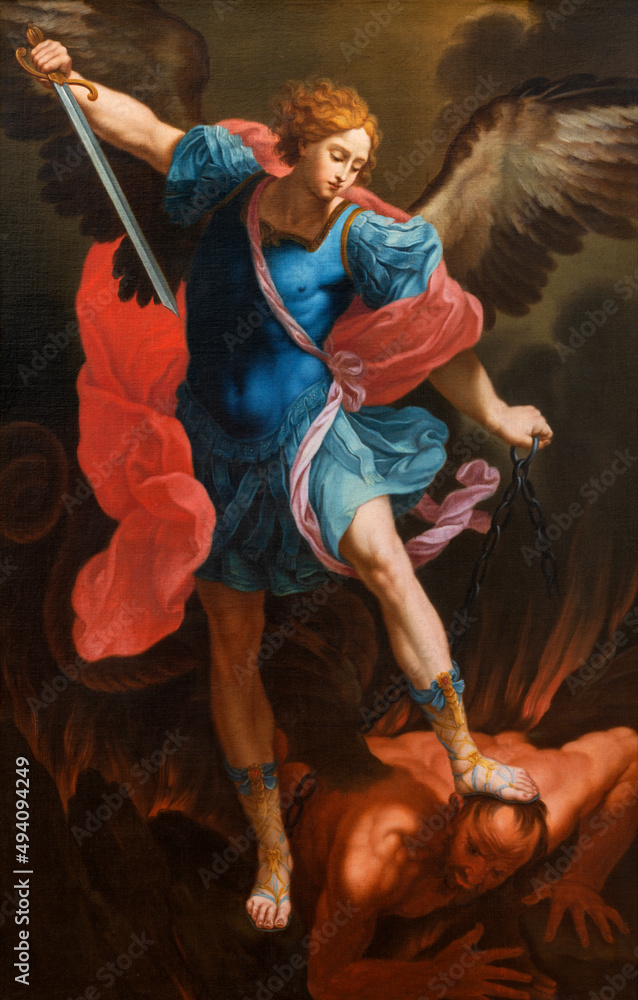
St. Michael the Archangel, pray for us and defend us in battle!
1 Quoted from St. Bernard of Clairvaux, Third Sermon for Advent, entitled: On the Three Advents of the Lord and the Seven Pillars which we ought to erect within us.
2 Heresy is an error about the Catholic Faith. Here is how St. Thomas Aquinas explains this truth:
We are speaking of heresy now as denoting a corruption of the Christian Faith. Now it does not imply a corruption of the Christian faith if a man has a false opinion in matters that are not of faith, for instance, in questions of geometry and so forth, which cannot belong to the faith by any means; but only when a person has a false opinion about things belonging to the faith.
Summa,
IIa IIae, Q.11, a.2, respondeo
(emphasis and bracketed words added).
3 The Natural Law is what we know we must do by the light of the natural reason God gave us. One example of the Natural Law is that we must never tell a lie. We naturally know this because we know that the purpose of speech is to convey the truth and so we naturally know that telling a lie is abusing the purpose of speech.
Another example of the Natural Law is that a husband and father knows that he must protect his family when it is being attacked, even if his defending them might result in his own death. Similarly, a man knows that he must defend his country from unjust attack, even at the cost of his own life.
Here is how St. Thomas explains what the Natural Law is:
[L]aw, being a rule and measure, can be in a person in two ways: in one way, as in him that rules and measures; in another way, as in that which is ruled and measured, since a thing is ruled and measured, in so far as it partakes of the rule or measure. Wherefore, since all things subject to Divine Providence are ruled and measured by the eternal law, as was stated above [in Summa, Ia IIae, Q.91, a.1]; it is evident that all things partake somewhat of the eternal law, in so far as, namely, from its being imprinted on them, they derive their respective inclinations to their proper acts and ends. Now among all others, the rational creature is subject to Divine Providence in the most excellent way, in so far as it partakes of a share of providence, by being provident both for itself and for others. Wherefore it has a share of the Eternal Reason, whereby it has a natural inclination to its proper act and end: and this participation of the eternal law in the rational creature is called the natural law. Hence the Psalmist after saying (Psalm 4:6): "Offer up the sacrifice of justice," as though someone asked what the works of justice are, adds: "Many say, Who showeth us good things?" in answer to which question he says: "The light of Thy countenance, O Lord, is signed upon us": thus implying that the light of natural reason, whereby we discern what is good and what is evil, which is the function of the natural law, is nothing else than an imprint on us of the Divine light. It is therefore evident that the natural law is nothing else than the rational creature’s participation in the eternal law.
Summa, Ia IIae, Q.91, a.2, respondeo.
4 Catholic Candle note: This quotation and citation from Isaiah have nothing to do with war as such. This passage instead refers to unrepented and unjust murder such as is committed by common criminals. This blood on the hands of the wicked is similar to the reference to the wicked in Psalm 25 and recited in the Lavabo at Mass:
Take not away my soul, O God, with the wicked: nor my life with men of blood; in whose hands are iniquities: their right hand is filled with bribes.
By using this quote the pope is heretically and unreasonably attempting to equate the killing of enemy combatants in a just war with the unrepented and unjust murder of the innocent victims killed by wicked men while committing their crimes.
Pope Leo XIV’s sermon is available here: https://www.vatican.va/content/leo-xiv/en/homilies/2026/documents/20260329-palme.html
6
Read the “New” SSPX’s words here:
https://catholiccandle.neocities.org/faith/nuclear-weapons-are-not-evil-but-their-misuse-is
7
Read an analysis of Pope Francis’s words and the true Catholic
position here:
https://catholiccandle.neocities.org/faith/nuclear-weapons-are-not-evil-but-their-misuse-is
8
Summa,
IIa
IIae, Q.40, a.2, ad.4.
9 Summa, IIa IIae, Q.40, a.1, respondeo (emphasis added).
10
For an article analyzing the Duties and Role of Men, read this
article:
https://catholiccandle.org/2024/11/15/the-duties-and-role-that-god-has-given-men-2/
11 St. Thomas Aquinas, Lectures on St. Matthew’s Gospel, ch.5, #542.
12 Although the word “violence” has many shades of meaning, the meaning that St. Augustine and St. Thomas are using appears to be this one: “an unjust or unwarranted exertion of force or power, as against rights or laws.” https://www.dictionary.com/browse/violence
13 Summa, IIa IIae, Q.40, a.1, sed contra.
14 St. Bernard of Clairvaux, In Praise of the New Knighthood, Chapter 3, found here:
https://history.hanover.edu/courses/excerpts/344bern2.html (emphasis added).
15 Quoted from a broadcast to the world December 23, 1956, The Pope Speaks, The Teachings of Pope Pius XII, Michael Chinigo (editor) Pantheon Books, New York, © 1957, p. 327.
16 Pope Pius XII, Address to Military Doctors (Address to the World Medical Association), October 19, 1953, quoted in The Pope Speaks, The Teachings of Pope Pius XII, compiled and edited by Michael Chinigo, with the assistance of the Vatican Archives, Pantheon Books, New York, © 1957, pp.332-333.
17 Lectures on the History of the Turks In Its Relation To Christianity, by John Henry Cardinal Newman, James Duffy, Dublin, 1854, p.189.
18 Lectures on the History of the Turks In Its Relation To Christianity, by John Henry Cardinal Newman, James Duffy, Dublin, 1854, p.190.
19 This is three days of special prayer and fasting for victory against the Turks. Let us see whether God hears the prayers of the just who are entering into a just war …
20 Lectures on the History of the Turks In Its Relation To Christianity, by John Henry Cardinal Newman, James Duffy, Dublin, 1854, p.190.
21
This legend, i.e.,
inscription, is the same one that the Roman Emperor Constantine saw
miraculously written in the sky, along with a Cross, when he was in
a desperate battle against the barbarians. These Latin words mean
“in this sign (viz.,
the Cross) you shall conquer”.
22
The
Sword of St. Michael: Saint Pius V
(1504 – 1572), by Lillian Browne-Olf, ©1943, The Bruce Publishing
Company, Milwaukee, p.260.
23
The
Sword of St. Michael: Saint Pius V
(1504 – 1572), by Lillian Browne-Olf, ©1943, The Bruce Publishing
Company, Milwaukee, p.264.
24
The
Sword of St. Michael: Saint Pius V
(1504 – 1572), by Lillian Browne-Olf, ©1943, The Bruce Publishing
Company, Milwaukee, p.264-265.
25
The
Sword of St. Michael: Sa i n t Pius V
(1504 – 1572), by Lillian Browne-Olf, ©1943, The Bruce Publishing
Company, Milwaukee, pp.264-265.
26 Lectures on the History of the Turks In Its Relation To Christianity, by John Henry Cardinal Newman, James Duffy, Dublin, 1854, p.191.
27 The Sword of St. Michael: Sa i n t Pius V (1504 – 1572), by Lillian Browne-Olf, ©1943, The Bruce Publishing Company, Milwaukee, p.265.
28 Lectures on the History of the Turks In Its Relation To Christianity, by John Henry Cardinal Newman, James Duffy, Dublin, 1854, p.191.
29
This is the banner given to Don Juan by Pope St. Pius V.
30 While reading this, remember Pope Leo XIV’s sermon quoted above, in which he falsely asserted that God “does not listen to the prayers of those who wage war, but rejects them”.
https://www.vatican.va/content/leo-xiv/en/homilies/2026/documents/20260329-palme.html
31 The Sword of St. Michael: Saint Pius V (1 5 0 4 – 1 5 7 2), by Lillian Browne-Olf, ©1943, The Bruce Publishing Company, Milwaukee, p.269-270.
32
Our
Lady of Guadalupe
was a title of the Blessed Virgin Mary, referring to a shrine in
Spain which was the location of many miracles and abundant graces.
In the course of time, when Our Lady appeared in Mexico, she
identified herself under that title. The Spanish bishop there knew
the significance of that title and he also knew that Juan Diego,
(the Indian to whom Our Lady appeared), could not have known that
title.
33 Pope Leo says the prayers could never help. We will see…
34 The Sword of St. Michael: Saint Pius V (1 5 0 4 – 1 5 7 2), by Lillian Browne-Olf, ©1943, The Bruce Publishing Company, Milwaukee, p.272.
35 Truly, God does hear the prayers of the just who are in a just war!
36 The Sword of St. Michael: Saint Pius V (1504 – 1572), by Lillian Browne-Olf, The Bruce Publishing Company, Milwaukee, ©1943, p.273.
37 Lectures on the History of the Turks In Its Relation To Christianity, by John Henry Cardinal Newman, James Duffy, Dublin, 1854, p.177.
38 Lectures on the History of the Turks In Its Relation To Christianity, by John Henry Cardinal Newman, James Duffy, Dublin, 1854, p.180.
See also the Catholic Encyclopedia, article: Pope Callistus III https://www.newadvent.org/cathen/03187a.htm
39 Catholic Encyclopedia, article: St. Fernando III, found here: https://www.newadvent.org/cathen/06042a.htm
40 1917 Catholic Encyclopedia, article: Pope Blessed Urban II.
41 Judges, 8:10.
42 Judges, 6:11-16.
43 Judges, 7:1-2 (emphasis added).
44 Judges, 7:3.
45 Judges, 7:4-6.