Lesson #1 Introduction to our teacher– the Blessed Virgin Mary

X Mary’s School of Sanctity X

Catholic Candle note:  This is the beginning of a reflections series which will be placed in the setting of a school where we, along side of our readers, study what Mary Our Mother would like us to learn—namely how to sanctify our souls.

This little schoolhouse, so to speak, will have for the staff of teachers Our Lady herself, St. Joseph, and Our Lord Himself. How can this be done? By following what the Church and saints have written about the topics covered, all of which are geared to instruct us in the sanctification of our souls.

Thus this series is intended to enrich our understanding of many subjects relevant to our spiritual lives, some examples of which are: meditation, the temperaments, and the Spiritual Exercises that Our Lady gave to St. Ignatius of Loyola. 

There are so many topics that Catholics have always needed to study for perfection.  In these times of Apostasy in which we live, we especially need the means that the Catholic Church has taught throughout the centuries, in order to defeat the evil one. Since the best teachers are Our Lord Himself, Our Lady, and good St. Joseph and we learn about them through the writings of the saints of Holy Mother Church, we delight to study and ponder these works along with our readers.


Lesson #1 Introduction to our teacher– the Blessed Virgin Mary

Let us enroll in Mary’s School by taking a look at our Mother Mary, after whom this School in named, for she is God’s special gift to us to be our model in sanctity.  Our Lord gave us Mary while He hung on the cross. She is precious to Him but He wanted to give her to us because He knew we need her to gain our salvation.

Mary is a treasure for us. God has blessed Mary with many prerogatives. They are so numerous that we cannot address them all in one article.  Indeed, many books have been written about her prerogatives.  However, in order to appreciate Mary more and more we will look at a few of her prerogatives below:

·         Mary is Immaculate.

·         Mary is the Mediatrix of all graces.

·         Mary IS LOVED BY God more than all the angels and other saints put together.

·         Mary LOVES God more than all the angels and other saints put together.

·         Mary is omnipotent by grace.


Mary is Immaculate.

Mary is God’s masterpiece whom He wants us to follow.  He created her Immaculate. Mary’s Immaculate Conception was solemnly defined in 1854. Because He intended for her to be the Mother of the Incarnate Word, she was conceived immaculately in the womb of St. Anne.  This means that she never had original sin.  She not only was conceived immaculate, she was also preserved from ever committing any actual sin, mortal or venial.  It was fitting that she be always pure.


Mary is the Mediatrix of All Graces.

Mary is not only immaculate; she is also the Mediatrix of All Graces. St. Alphonsus de Liguori, in his book, The Glories of Mary, explains this Catholic dogma by citing several authorities.  He relates what St. Sophronius, Patriarch of Jerusalem says, “Truly was she full; for grace is given to other saints partially, but the whole plenitude of grace poured itself into Mary.”

St. Alphonsus cites St. Basil of Seleucia, saying, “Hail full of grace, mediatress between God and men, by whom heaven and earth are brought together and united.”

St. Alphonsus further cites St. Laurence Justinian, saying, “Otherwise, had not the Blessed Virgin been full of divine grace, how could she have become the ladder to heaven, the advocate of the world, and the most true mediatress between men and God.”

As Mediatrix, Mary is so precious in God’s sight.  St. Alphonsus beautifully explains the connection between God’s plan that Mary was to be the Mother of Our Lord and the Mediatrix for the spiritual children given to her.

If Mary, as the already destined Mother of our common Redeemer, received from the very beginning the office of mediatress of all men, and consequently even of the saints, it was also requisite from the very beginning  [that] she should have a grace exceeding that of all the saints for whom she was to intercede. I will explain myself more clearly. If, by the means of Mary, all men were to render themselves dear to God, necessarily Mary was more holy and more dear to Him than all men together.  Otherwise, how could she have interceded for all others?   That an intercessor may obtain the favor of a prince for all his vassals, it is absolutely necessary that he should be more dear to his prince than all the other vassals.  And therefore St. Anselm concludes that Mary deserved to be made the worthy repairer of the lost world, because she was the most pure of all creatures. ‘The pure sanctity of her heart, surpassing the purity and sanctity of all other creatures, merited for her that she should be made the repairer of the lost world.’[1]

St. Thomas Aquinas says in his commentary on the Angelic Salutation:

So full of grace was the Blessed Virgin, that it overflows onto all mankind.  It is, indeed, a great thing that any one saint has so much grace that it is conducive to the salvation of many; but it is most wondrous to have so much grace as to suffice for the salvation of all mankind. Thus, it is in Christ and in the Blessed Virgin.[2]

Hence, we can see plainly that Mary is necessary for our salvation.


Mary IS LOVED BY God more than all the angels and other saints put together.

In addition St. Alphonsus in the above quote hints at the next prerogative that we want to look at, namely, that God loves Mary more than all the angels and saints put together. In fact, St. Alphonsus states:

Let us conclude that our heavenly child [Mary], because she was appointed mediatress of the world, as also because she was destined to be the Mother of the Redeemer, received, at the very beginning of her existence, grace exceeding in greatness that of all the saints together.  Hence, how delightful a sight must the beautiful soul of this happy child have been to heaven and earth, although still enclosed in her mother’s womb!  She was the most amiable creature in the eyes of God, because she was already loaded with grace and merit. …  And she was at the same time the creature above all others that had ever appeared in the world up to that moment, who loved God the most; so much so, that had Mary been born immediately after her most pure conception, she would have come into the world richer in merits, and more holy, than all the saints united.[3]

Also, St. Alphonsus cites St. Vincent Ferrer, saying, “that the Blessed Virgin was sanctified, in her mother’s womb above all saints and angels.”  Thus, God loves her the most.

St. Thomas Aquinas says in his commentary on the Angelic Salutation:

She is, therefore, full of grace, surpassing the angels in that plenitude.  For this reason she is rightly called Mary, which signifies that in herself she is enlightened and that she enlightens others throughout the world.  Thus, she is compared to the sun and to the moon.


Mary LOVES God more than all the angels and saints put together.

As St. Alphonsus stated just above, “… And she was at the same time the creature above all others that had ever appeared in the world up to that moment, who loved God the most;[4]

Likewise, St. Alphonsus quotes Richard of St. Victor, saying, “Ah! Well might even the Seraphim have descended from heaven to learn, in the heart of Mary, how to love God.”[5]

St. Bernard, commenting on St. John’s Apocalypse, referring to a woman clothed with the sun, says that this woman must be Mary because, “She was so closely united to God by love, and penetrated so deeply the abyss of divine wisdom, that, without a personal union with God, it would seem impossible for a creature to have a closer union with Him.”[6]

Mary certainly gave herself entirely to God and did all that He wanted her to do in her life.  She never denied anything He asked of her.  Just as she said, “Behold the handmaid of the Lord.  Be it done to me according Thy Word,” so was her whole life was one loving “Fiat.”  St. Bernardine explains this when he says, “The mind of the Blessed Virgin was always wrapped in the ardor of love,” and “That she never did anything that the divine Wisdom did not show her to be pleasing to Him; and that she loved God as much as she thought He was to be loved by her.”[7]


Mary is omnipotent by grace.

St. Alphonsus explains about this in his The Glories of Mary:

As the mother, then, must have the same power as the Son, justly was Mary made omnipotent by Jesus, who is omnipotent; it being, however, always true, that whereas the Son is omnipotent by nature, the mother is so by grace.

He quotes St. Bonaventure, who says, “Mary has this great privilege that with her Son she above all the saints is most powerful to obtain whatever she wills.”

Further, St. Alphonsus cites St. Peter Damian addressing Mary as follows, “All power is given to thee in heaven and on earth, and nothing is impossible to thee who canst raise those who are in despair to the hope of salvation.” And then adding that, “When the Mother goes to seek a favor for us from Jesus Christ, her Son esteems her prayers so greatly, and is so desirous to satisfy her, that when she prays its seems as if she rather commanded than prayed, and was rather a queen than a handmaid.”

St. Alphonsus gives additional quotes to prove this wonderful truth about Mary.  He tells how St. Germanus addresses Our Lady, “Thou art the Mother of God, and all-powerful to save sinners, and with God thou needest no other recommendation; for thou art the Mother of true life.”

“At the command of Mary, all obey, even God,” says St. Bernardine, as St. Alphonsus also records in The Glories of Mary.  As if these quotes weren’t enough, he supplies these also:

St. Anselm addresses Our Lady: “Our Lord, O most holy Virgin, has exalted thee to such a degree that by His favor all things that are possible to Him should be possible to thee.” And further, “Whatever thou, O Virgin, willest can never be otherwise than accomplished.”

St. Antoninus proclaims, “And thus, God has placed the whole Church, not only under the patronage, but even under the dominion of Mary.”

St. Alphonsus reports that St. Bridget heard Our Lord talking with Mary and telling her, “Ask of Me what thou wilt, for no petition of thine can be void.” And the reason Our Lord gave for this statement was, “Because thou never didst deny Me anything on earth, I will deny thee nothing in heaven.”

St. Alphonsus explains then, “Mary then, is called omnipotent in the sense in which it can be understood of a creature who is incapable of a divine attribute.  She is omnipotent, because by her prayer she obtains whatever she wills.”[8]

These quotes about Mary being omnipotent in grace are very impressive.  Yet, it should not surprise us that the Lord, being so loving as to give us Mary while He was hanging on the cross, would make her such a powerful advocate and intercessor for us while we are exiles in this vale of tears.


Conclusion:

Because Mary is our precious Mother in Heaven and God’s masterpiece whom He gave to us on the Cross, she is the perfect teacher of sanctity.  We delight in studying in her school of sanctity and cover the many topics she has to teach us through the great teachers of the Church.  As a little gift of our appreciation for Mary our teacher, Mediatrix of all graces, let us give Mary a mystical apple— a little poem of gratitude.

Mary, Our Mediatrix

Mary, what thanks do we not owe?

To Our Lord Who hath loved us so,

To give us such a dear sweet Queen,

Whose watch over us is e’er keen.


A mother so sweet and so pure,

Helping her children to endure,

  All God’s graces come through her hands,

‘Tis how God obeys her commands.


God has bestowed on her great things,

Far beyond one’s imaginings,

 Her love of God is better than,

All the angels and all of man.


God loves her most of creatures made,

  We can always count on her aid.

In her power we can e’er trust,

She conquers evil with one thrust.


 Thank you, Mary, our teacher dear,

You show us how to truly fear,

To displease God in any way,

Bring us closer to Him each day.


To thy school of holiness we,

Gladly come to learn from thee,

Many topics, without an end,

Mary, you are our tender friend.


[1]           The Glories of Mary —discourse #2 the birth of Mary


[2]               Of course, St. Thomas is not saying here that all men actually receive grace but he is only expressing Christ’s and Mary’s plenitude of grace.


[3]           The Glories of Mary — discourse #2 the birth of Mary (emphasis added).


[4]           Quoted from St. Alphonsus’s The Glories of Mary discourse #2, The Birth of Mary.

[5]           Quoted from St. Alphonsus’s The Glories of Mary, part IV, The Virtues of Mary, section 2, The Charity of Mary towards God.

[6]           Quoted from St. Alphonsus’s The Glories of Mary, part IV, The Virtues of Mary, section 2, The Charity of Mary towards God.

[7]           Quoted from St. Alphonsus’s The Glories of Mary, part IV, The Virtues of Mary, section 2, The Charity of Mary towards God.

[8]           All of the quotes regarding Mary’s omnipotence in grace are from St. Alphonsus’s The Glories of Mary, chapter 6, section about Mary our Advocate.

Is Your Goal to Be an Ordinary or Extraordinary Saint?

Catholic Candle note:  The article below refers to Rome’s betrayal of the Catholic Faith.  However, a reader would be mistaken if he assumed that Pope Francis’ betrayal somehow means that he is not the pope.


Sedevacantism is wrong and is (material or formal) schism.  Catholic Candle is not sedevacantist.  On the contrary, we published a series of articles showing that sedevacantism is false (and also showing that former Pope Benedict is not still the pope). 


We recommend a small book explaining the errors of sedevacantism.  It is available:


  Here, for free: https://catholiccandle.neocities.org/faith/against-sedevacantism.html  or


  Here, at cost ($4): https://www.amazon.com/Sedevacantism-Material-Quanta-Cura-Press/dp/B08FP5NQR6/ref=sr_1_1


Here is what St. Bernard of Clairvaux, Doctor of the Church, teaches concerning the need to recognize and respect the authority of a superior – such as the pope – even when he is bad:


Even should the life of any superior be so notoriously wicked as to admit of no excuse or dissimulation, nevertheless, for God’s sake, Who is the source of all power, we are bound to honor such a one, not on account of his personal merits, which are non-existent, but because of the divine ordination and the dignity of his office.[1]


However, even while recognizing the pope’s authority and our duty to obey him when we are able, we know we must resist the evil he says and does.  Read more about this principle here: https://catholiccandle.neocities.org/faith/against-sedevacantism.html#section-7


Lastly, in the article below, the reference to becoming an “ordinary saint” is not a reference to becoming a saint through attending the evil novus ordo mass, a/k/a the “ordinary rite”.  The new mass is inherently evil and a sacrilege.  This evil rite does not give grace[2] or help us toward heaven.


Is Your Goal to Be an

Ordinary or Extraordinary Saint?


You will have to be one or the other to get to Heaven.  Only saints get to Heaven.  Most people believe a lie of the devil, that “It’s too hard to be a saint; I’m not even going to try.”

We must want to be saints!  In order to do this, we must love God.  Yet, to love God we must have knowledge of Him.

Okay, let’s list things to do to increase your understanding and knowledge of a loving God, Who makes it so easy to love Him:

  Understand what He has done and continues to do for you.  Here are a few especially important blessings to remember:

  He created you specially;

  He suffered and died for you so you could be happy here on earth and forever happy with Him in Heaven.  He would have done the same if you were the only person on earth; and

  He keeps you in existence with His knowledge of you.

  Make a real effort to return His love for you by your love for Him.

  Make many and frequent Spiritual Holy Communions; and

  Discuss with Him (like you would with your best friend) all aspects of your life and how you want to be a saint and be forever with Him in Heaven.

  To increase your love, make an effort to study His life on earth and the aspects of that life.  You must have knowledge of the Person you love, as well as of the things you could study and even touch, if permitted, e.g., the Holy Cross He died on, the Crown of Thorns, etc.

At the top of the list is the Shroud, the “clean linen cloth” (as the Gospel calls it) in which Christ was laid when He was taken down from the Cross.  Here is what the Catholic Encyclopedia says about the Shroud:

This relic, though damaged by a fire, bears the faint but distinct impress of a human form both back and front.  The cloth is about 13 ½ feet long and 4 ½ feet wide.  If the marks we perceive were caused by a human body, it is clear that the body (supine) was laid lengthwise along one half of the shroud while the other half was doubled over the head to cover the whole front of the body from the face to the feet.  …

In 1898 when the shroud was solemnly exposed, permission was given to photograph it, and a sensation was caused by the discovery that the image upon the linen was apparently a negative – in other words, that the photographic negative taken from this offered a more recognizable picture of a human face than the cloth itself or any positive print.  In the photographic negative the lights and shadows were natural; in the linen or the print they were inverted.  Three years afterwards, Dr. Paul Vignon read a remarkable paper before the Academie des Sciences in which he maintained that the impression upon the shroud was a ‘vaporigraph’ caused by the ammoniacal emanations radiating from the surface of Christ’s body after so violent a death.[3]

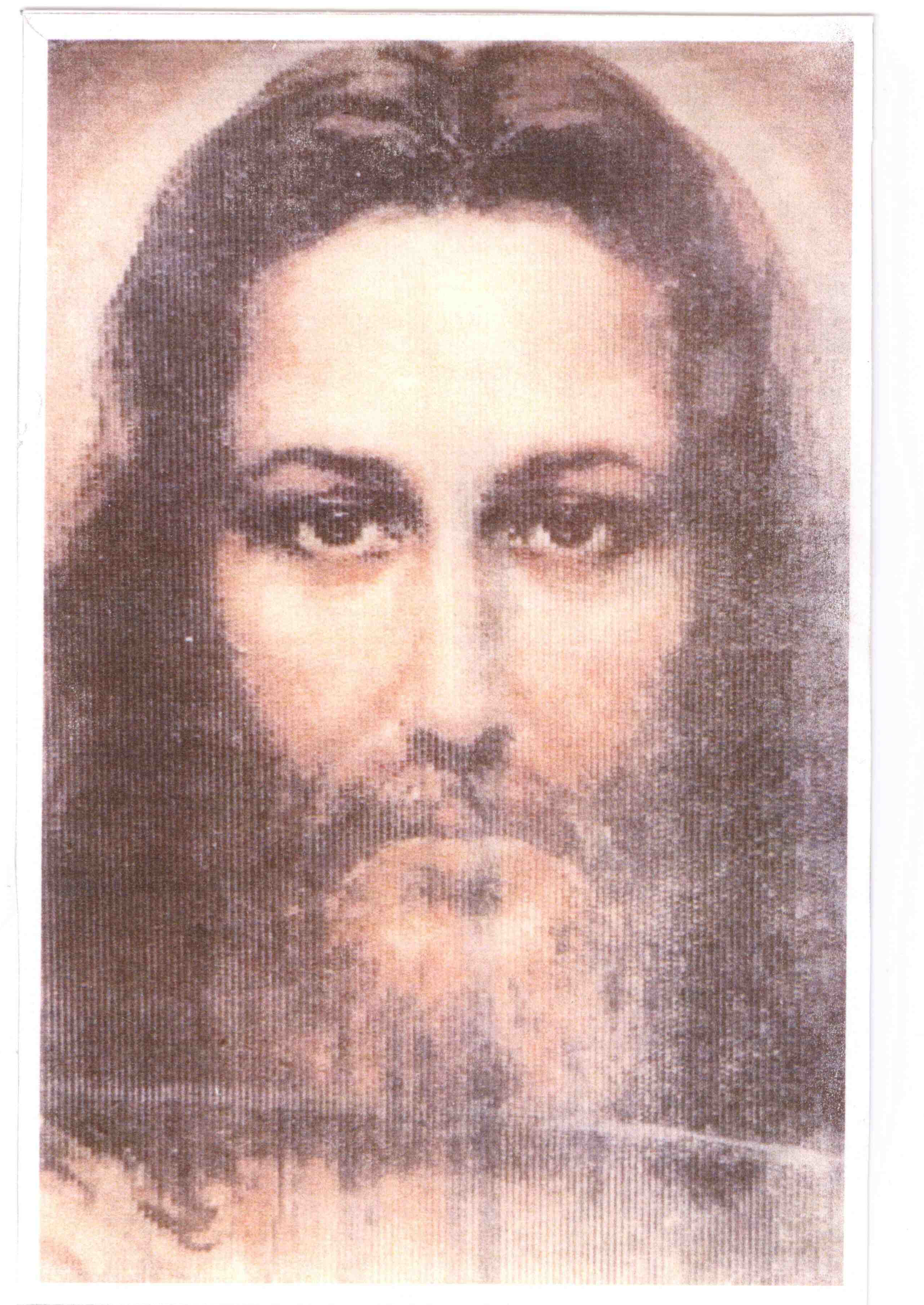
Shown below is a picture I believe was providentially developed using the shroud as a model.  It is a big help to greatly improve your Spiritual Communions, increase your love, help in discussions with Him, and better understand how it demonstrates His love for you.


Consider suffering and dying for Him (as He did for you) if it ever becomes necessary in the anti-God world we live in.  It appears a possibility, just as in 16th century England, and in other periods of persecution throughout history.

Then, the persecutions sought to eliminate the Catholic religion; now it will be to eradicate completely all reference to, or thought about God, while promoting Mother Earth, the pagan Pachamama, etc.  Don’t expect any help from Rome.  Our leaders there have already betrayed the Catholic Faith.

Our Lord knows the extent of your love and your willingness to suffer and die for Him because He can read your heart.  Oh, what a blessing!

Be sure to fulfill all the duties and requirements of your state of life, which includes unfailingly standing up for Christ.

If, by chance, you still consider it impossible to become a saint, then the devil is still trying hard to discourage you.  Ask for God’s help and discuss it with Him.  He knows how to solve your problem.

It’s possible to be an exceptional saint — like St. Thomas Aquinas, St. Francis, St. Paul, etc. – but that requires not only your special dedication but also God leading a person to that greater state.  However, even so, the road to that exceptional sanctity passes through “ordinary sanctity” as a preparation for even higher things.  So, keep it up!  You don’t know what God has planned for you.  Whatever God plans for you is not impossible; don’t listen to the devil.  You must first pursue becoming an “ordinary saint”.

On this road to “ordinary sanctity”, God will direct you to what is best for you to reach your goal of Heaven in today’s world in which you live.  It will be somewhat different than in the past.  Most likely He does not plan for you to live as a hermit in the desert, or on a platform atop a pole like St. Simon Stylite.  It could be He wants you to join an uncompromising monastery (when one becomes available); or He may ask you to start one, or to finance one.

His plan for you certainly won’t be impossible for you.  No, He will give you all necessary help.  So, it is up to you to use His help to succeed and to be happy with Him for all eternity. 

It goes without saying that all of the above requires much prayer (i.e., conversations with God).


[1]           Quoted from St. Bernard of Clairvaux, Third Sermon for Advent, entitled: On the Three Advents of the Lord and the Seven Pillars which we ought to Erect within us.


[3]           1912 Catholic Encyclopedia, Vol. XIII, Article: The Holy Shroud.

What we stand against – August

Catholic Candle note: Below is a new, occasional feature of Catholic Candle, called What We Stand Against.  It calls to mind the maxims and principles of a faithful and informed Traditional Catholic.


What We Stand Against

Resist the beginnings of liberalism.  Remedies come too late,

when delay has caused this evil to become established and to gain strength.

Wikipedia – a tool of the Leftists

Catholic Candle note:  The article below is a warning about the harm caused by the free, online encyclopedia called Wikipedia.  There are many ways in which Wikipedia does harm, e.g., it has a huge amount of the vilest impurities, ready to send a person straight to hell.

However, the article below focuses only on a single type of Wikipedia’s evil: its leftist bias.


One modern habit which is harming intellects and spreading error, is people’s wide-spread excessive use of, and overreliance on, cell phones.  Connected with that bad habit is many people’s gullibility and intellectual laziness in using unreliable online sources as their “go-to” sources for practically all information. 

By gullible and intellectually lazy, we mean a blind trust in information sources which are convenient, popular, and approved by the world, without making the effort to be more careful, dig deeper, do more thinking, reading, and searching for the truth in better, (but often less convenient), sources.

One of the common sources of falsehood frequently relied upon by the gullible and intellectually lazy, is Wikipedia.

Wikipedia was started about 20 years ago.  It is a free, online encyclopedia available to anyone with an internet connection.  The name “Wikipedia” is a combination of:

·         a Hawaiian word “wiki”, which means “quick”, but in this context seems to connote collaboration; and

·         the end of the word “encyclopedia”.

Wikipedia is free and convenient and so, is very popular.  Wikipedia claims to be:

the world’s largest reference website, attracting 1.7 billion unique visitors monthly as of November 2020.  It currently has more than fifty-six million articles in more than 300 languages, including 6,347,334 articles in English.[1]

However, Larry Sanger, one of Wikipedia’s two co-founders[2] (who has since left the organization) warns that Wikipedia “completely ignores any conservative, libertarian, or critical treatment of the subject.”[3]

According to Sanger, Wikipedia did not start with its current heavy leftist bias.  However, a decade ago, “as liberals, or leftists made their march through the institutions, Wikipedia became one of those influential institutions.  They started their march and basically took it over.”[4]

One way Wikipedia prevents the (conservative) truth being presented in its articles, is that the encyclopedia has blacklisted most conservative media sources because these media sources do not hide the truth that the leftists want to hide.[5]  These blacklisted sources are the only news sources doing any reporting on many important stories.  Wikipedia bans even mainstream media sources that are less liberal, e.g., like Fox News, the New York Post, and Daily Mail (UK).[6]  Other examples of Wikipedia’s blacklisting include Lifesitenews.com and TheEpochTimes.com.[7]

Wikipedia allows anyone to author new articles.  However, as a consequence of the above-mentioned bias, even if a Wikipedia article’s author hypothetically wanted to cite one of those less-liberal sources to support a statement in his article, he is not allowed to do so.  If the author gives no citation to a source, he risks deletion of his statement by Wikipedia because it is unsupported.

Let us examine a few examples of Wikipedia’s leftist bias.


Wikipedia changes “facts” in its “historical” and “scientific” articles, serving leftist goals.

Have you ever heard of Dr. Robert Malone?  According to Wikipedia in mid-June 2021, he is the principal inventor of the mRNA technology used in the Pfizer and Moderna COVID-19 vaccines.  Here is a screenshot of the beginning of Wikipedia’s entry for the invention of mRNA technology, as it read on June 14, 2021:

Image

This entry is now changed (as we will explain below); and so, we had to extract the above screenshot from a past version of Wikipedia which is stored at archive.org.[8]

On June 10, 2021, Dr. Malone joined biologist Dr. Bret Weinstein, Ph.D., on the Dark Horse Podcast, to discuss the use of mRNA technology in the COVID “vaccines”.[9]  Dr. Malone raised numerous safety concerns about the Pfizer-BioNTech and Moderna COVID-19 vaccines, both of which use the mRNA technology invented under his leadership.  Among other hazards, he warned about future autoimmune risks caused by the spike proteins within the mRNA injections.

This podcast was uploaded onto YouTube but it didn’t last there very long before YouTube deleted his warnings off of its site.[10]

Dr. Malone repeated his warning about the danger of mRNA “vaccines” when he appeared a few days later on Fox News.[11]  So here was one of the principal inventors of the mRNA technology used in these COVID “vaccines”, who was warning about their danger.  These warnings contradicted the mainstream media’s constant promotion of those “vaccines” and Dr. Malone’s status as chief inventor of this technology gave great weight to his warnings.

On June 16, 2021, Wikipedia changed its mRNA article to remove all credit and mention of Dr. Malone from the entry.  Here is a screenshot, (again from archive.org[12], because Wikipedia changed the mRNA article again, as will be explained below):

Image

Wikipedia then tweaked the article again to give chief credit to Jon Wolff (a collaborator of Malone’s in 1990), for the mRNA research experiments.  Here is a screenshot from earlier July 2021[13]:  

Image

As you see, Wikipedia’s article now also praises and promotes Katalin Karikó.  Karikó strongly promotes these mRNA “vaccines”.[14]

This is an example of Wikipedia’s bias in countless articles.  This reminds us of the warnings in George Orwell’s novel, 1984, in which the main character, Winston, worked in the Ministry of Truth to re-write articles in order to change the “truth” as it had been previously written, in order to fit the current desires of the totalitarian government.

There are countless other examples, besides the above, extended example of Wikipedia falsifying history and science by re-writing[15] what it claims as true.  Wikipedia expediently changes its narrative of the science/history involved, thereby destroying Dr. Malone’s important authority to speak on the subject, serving to promote the vaccines using the technology that Dr. Malone knew well and about which he began giving public warnings.  Wikipedia was his “cheerleader” until political expedience caused Wikipedia to “cancel” him.

Let’s look into more examples that show Wikipedia promoting leftist ideology rather than truth and facts.


Gender dysphoria on Wikipedia

Wikipedia writes a solemn “academic” treatment of people’s gender delusions as if those poor confused souls were not out of touch with reality.[16]

Wikipedia writes how some people have no gender (“agender”).[17]

Wikipedia solemnly explains the teachings of “scholar” Finn Enke, a poor deluded woman professor at the University of Wisconsin at Madison (a university known for its craziness and its doctrinaire leftism, similar, in this way, to the University of California at Berkeley).  On Enke’s website, you can also see that woman’s ugly, disorderly, talentless, and gimmicky “art” that she is promoting.[18]

With great seriousness, Wikipedia explains how “agender” is a gender, how a person can have multiple genders at once, or even all genders at once (whatever that means, and which absurdity is called “omnigender”).[19]

Wikipedia solemnly explains how some people (whom common sense recognizes as indecisive and confused) are “gender fluid” because they don’t want to commit to being either one of the two real genders or even firmly commit to any other specific (pretend) gender they might concoct.[20]

This Wikipedia article (as so many others) pretends that Nature does not exist, as if God does not exist, and as if reality were only whatever a person chooses, similar to a person deliriously deciding he is Napoleon. 

Wikipedia gives no hint that this transgender delusion is irrational.  Of course, we also know that this position (which Wikipedia sets forth) not only attacks sound reason and the magnificent Catholic culture which the Catholic Church built (viz., Christendom), but also God’s Law and the Holy Catholic Faith itself.

Further, Wikipedia gives no hint that there is another side on this issue, besides the satanic lie that Wikipedia gives.  Perhaps Wikipedia would object that it does present both sides of an issue when there are two sides worthy of mention.  Wikipedia might then claim that its transgender position – which is the leftist position – is the only reasonable one and so that is why the article does not give the conservative (and true) position.  However, even under that hypothesis, Wikipedia would still be no less biased and this would still result in Wikipedia being a purveyor of leftist propaganda.

Wikipedia’s article does not mention that this transgenderism was listed as a mental illness by the World Health Organization until 2019 and by the American Psychiatric Association until 2012.[21]

This is one of countless examples of Wikipedia pushing the leftist evils as if they were the only “orthodoxy”.

Truly, our times fit St. Paul’s warning:

For there shall be a time, when they will not endure sound doctrine; but, according to their own desires, they will heap to themselves teachers, having itching ears: and will indeed turn away their hearing from the truth, but will be turned unto fables.

2 Timothy, 4:3-4.


Wikipedia’s treatment of “conversion therapy”

We know from our Holy Catholic Faith (as well as from the science of Ethics) that a man can follow reason and eschew sin and vice.  In this he is not like the brute beasts, who follow instinct and have no free will.  Unlike the brute beasts, man is both capable of sin and capable of overcoming sin.  Unnatural vice is sinful[22] because a man has a free will and can stop sinning.

Thus, we know that a man who has fallen into unnatural vice was not “made that way” as some of those men claim, nor is he incapable of ceasing to commit those sins (as is also true of other sins).

So, we know that a person can stop committing these unnatural sins and that people can help him do so, by prayer, moral support, good habits, good advice, etc.  This is Catholic, reasonable, and common sense.

Now let’s look at Wikipedia’s false and leftist treatment of the issue.

Wikipedia correctly says that “conversion therapy” involves trying to change someone who is involved in such unnatural impurity, and describes the methods as:

counseling, visualization, social skills training, psychoanalytic therapy, and spiritual interventions such as “prayer and group support and pressure”.[23]

In a rough sort of way, this description corresponds to the many Catholic moral helps which can aid a person to conquer this habit of sin.

Wikipedia adds that all such efforts to help a person free himself from this unnatural vice are “pseudoscientific”.[24]  Wikipedia defines “pseudoscience” in a way that shows Wikipedia is saying that conversion therapy does not and cannot work:

Pseudoscience consists of statements, beliefs, or practices that claim to be both scientific and factual but are incompatible with the scientific method.  Pseudoscience is often characterized by contradictory, exaggerated or unfalsifiable claims; reliance on confirmation bias rather than rigorous attempts at refutation; lack of openness to evaluation by other experts; absence of systematic practices when developing hypotheses; and continued adherence long after the pseudoscientific hypotheses have been experimentally discredited.[25]

Wikipedia not only falsely declares that efforts to help a person to stop committing sins of unnatural vice are unscientific, discredited, and futile, but also connects these efforts (in the article) with “icepick lobotomies”, electric shock therapy, and other weird things[26] which have nothing to do with helping a person eschew sin by increasing virtue in the soul, as God wants us all to do.

As with the transgender article discussed above, this Wikipedia article (as so many others) pretends that Nature does not exist, that God does not exist, and that acts of unnatural vice are good, if that is what a person chooses.

Again, Wikipedia’s position is not only attacking reason and the magnificent Catholic culture which the Catholic Church built, but also the Holy Catholic Faith itself.

Also, Wikipedia gives no hint that there is another side on this issue, beside the satanic lie that Wikipedia gives.  If Wikipedia does not even recognize there is a conservative (and true) position worthy of discussion, that would merely cement Wikipedia’s status as a leftist mouthpiece. 

Wikipedia gives no hint that, only a few decades ago, before society became as degraded as it is, this unnatural vice was listed as a mental illness and also was a felony.  This crime traces its way back to the law of God, making it a capital offense.   Leviticus, 20:13

This is one of countless examples of Wikipedia pushing the leftist evils as if they were the only “orthodoxy”.

Historically, Catholic morality has been reflected in the civilized world’s common law.  That is a subject for a different article, but many of the basic principles of our law, like the right to confront witnesses, were first established in the Church’s own courts.

Of course, the Catholic Church and the Natural Law are the source of much of the civilized world’s substantive laws too, such as the recognition of the criminality of unnatural vice.  See, e.g., the U.S. Supreme Court upholding the criminality of unnatural vice, in Bowers v. Hardwick, 478 U.S. 186 (1986).


Wikipedia casts doubt on the truth of the Gospels

With a thin veneer of pseudo “scholarship”, Wikipedia rolls out the usual claims made by Our Lord’s enemies that the Gospels are uncertain, unreliable, disputed, contradictory, and not historically accurate.[27]  Wikipedia simply echoes the assertions of centuries of heretics, Jews, and other non-believers in telling the reader that the Gospels tell us little or nothing about the “historical Jesus”.[28]  Rather, they are merely pious assertions and falsehoods which are disputed by “truth-telling” scholars.[29]  Wikipedia asserts that its pronouncements on the Gospels are the conclusions of “the majority of scholars”, although Wikipedia makes no effort to prove this false assertion. 

Wikipedia’s promotion of abortion

Wikipedia’s article on abortion is full of falsehoods and leftist bias.  For example, it claims that “When properly done, abortion is one of the safest procedures in medicine.”[30]  This is a statement straight from Planned Parenthood’s own propaganda. 

Wikipedia’s claim omits the obvious fact that abortion murders a baby, so it is a deadly procedure.  Further, this claim ignores the vast body of evidence proving the grave harm to the mother, morally, emotionally[31], intellectually, and, often, physically[32], when she consents to be an accomplice to this murder of her baby.


Wikipedia’s promotion of legalizing mind-altering drugs

Wikipedia minimally acknowledges some of the obvious problems with legalizing hallucinogenic drugs, e.g., legalization leads to increased consumption of drugs.[33]  But Wikipedia’s treatment is like the typical leftist talking points which promote the legalization of “recreational” narcotics.  Although Wikipedia mentions that legalization foreseeably will cause drug use to increase, the encyclopedia then quickly transitions to the pro-legalization talking points, such as decreased gang violence, saving the costs of enforcing these laws, ability to tax “recreational” narcotic use to increase government tax revenue, and the police’s ability to concentrate on enforcing other laws.[34]


Wikipedia’s promotion of allowing the adoption of children by persons who live lives of unnatural impurity

Wikipedia’s leftist bias is on display on this adoption issue too.  Wikipedia presents (supposed) “science”, “fairness”, and “civil rights” in favor of this evil, and says that those people opposed to such adoptions are against it because of their own personal assumptions and personal faith-beliefs.[35]  The implication is that these assumptions are unscientific and unfair and that the particulars of such people’s personal beliefs are not a basis for society to prohibit such adoptions.


Wikipedia promotes the leftists’ “climate change” narrative

Wikipedia promotes the leftists’ climate alarmism.[36]  The encyclopedia falsely claims that there is an “overwhelming scientific consensus” for global warming caused by humans.  Wikipedia falsely says all research scientists agree on this “fact” and that “no scientific body of national or international standing disagrees with this view”.[37]

Wikipedia says that the only persons who disagree are the deniers spreading misinformation, who are funded by conservatives and the self-interested fossil fuel industry.  Wikipedia says that the uncertainty and controversy are not real but only manufactured.[38]  The article does not give any of the great abundance of evidence disproving the leftists’ climate alarmism.

Wikipedia promotes the leftists’ narrative on the 2020 U.S. presidential elections

Wikipedia gives a false, one-sided account of the 2020 election fraud controversy, saying that the Republican side was merely “promoting the conspiracy theory that falsely posits” election fraud.  Here is one place Wikipedia states this leftist propaganda:

Stop the Steal is a far-right and conservative campaign and protest movement in the United States promoting the conspiracy theory that falsely posits that widespread electoral fraud occurred during the 2020 presidential election to deny incumbent President Donald Trump victory over former vice president Joe Biden.[39]

This article is false and completely one-sided, failing to provide any of the extensive evidence of the actual voting fraud.[40]  However, leaving to a different time an examination of the truth of the fraud evidence (which exists in large amounts), for the present we note that this is another example of Wikipedia giving a one-sided narrative setting forth only the leftists’ talking points. 

So, if anyone seeks only to know what the leftists say about the election fraud, he can find it in Wikipedia.  But for anyone seeking to understand what evidence has moved 41% of U.S. voters to believe that Biden did not win the election fairly,[41] Wikipedia withholds this information.[42]


Conclusion

Wikipedia is largely not a source of truth but of leftist ideology.  Wikipedia can (and often does) change its articles almost instantaneously to take today’s news into account.  So, what was “true” yesterday, might be denied or deleted today, with no indication that yesterday’s “truth” was the opposite.

Beware of Wikipedia’s leftist bias on a large number of topics:

  from philosophy to foreign policy;

  from science to civil unrest;

  from technology to elections;


  from biography to religion;

  from history to immigration;

  from morals to medicine;


  from forensics to the Constitution;


  from medicine to music;


  from law to culture; and


  from politics to the rule of law.

With few exceptions, only globalist, progressive mainstream sources – and sources friendly to globalist progressivism – are permitted.  What is against Wikipedia’s leftist agenda is either ignored or is summarily dismissed as “misinformation” or a “conspiracy theory”.  In saying so, Wikipedia (and other, similarly-biased institutions) are plainly claiming exclusive control over what is thinkable.  They want any debate to occur only on the leftist playing field and want to set the boundaries of that debate, in order to tell you how to think about countless important issues.

Wikipedia articles are the perfect bait for intellectually lazy and gullible people, who are looking for a “go-to” source which is convenient, popular, and approved by the world, which does not require the effort to be more careful, dig deeper, do more thinking, reading, and searching for the truth in better, (but often less convenient), sources. 

A further “advantage” for lazy Catholics, that get their information from Wikipedia, is that they do not risk the possibility that they might learn something which would require them to withstand opposition from the world in order to defend truth and Christ the King.

We are not saying that Wikipedia never ever says anything true – even Satan tells some truths/half-truths, for his own ends.  But we urge everyone to remember whenever he is on Wikipedia (if ever) that he is in enemy-occupied territory, which exists to move the reader toward the left.


[9]           These mRNA treatments are called “vaccines” but don’t really fit the definition of what a vaccine is.  Instead, they are really gene therapy.  They are falsely called “vaccines” because that label makes them more acceptable to the public than if the experimental COVID mRNA treatments were called “gene therapy”.  That is an issue we will return to in a future article.

[13]         This screenshot is found here: https://en.wikipedia.org/wiki/RNA_vaccine


[15]         Wikipedia is not the only leftist media company which changes its information on the fly, to serve the leftist agenda.  Another prominent example is Merriam-Webster, owned by Encyclopedia Britannica. 


In October 2020, when Mrs. Amy Coney Barrett (who is relatively conservative) was testifying at her Supreme Court confirmation hearings, she was asked, in substance, if she supported a person’s “right” to live a life of unnatural impurity. 


Mrs. Barrett replied obliquely that she never discriminated against people with that “preference”.  The leftists, including Sen. Mazie Hirono, D-Hawaii, quickly pounced on her for implying that people living like that were not “born that way”.  Senator Hirono and various leftist pressure groups said that Mrs. Barrett’s comment was insulting to persons living that “lifestyle”.


One problem for the leftists, though, was that the principal dictionaries, including Merriam-Webster, showed that Mrs. Barrett’s word usage was correct and not insulting.  So, the same day Merriam-Webster changed its definition to state that using the word “preference” the way she did was an insult.


Read the account of this incident here: https://www.msn.com/en-us/news/us/merriam-webster-dictionary-updates-sexual-preference-entry-after-amy-coney-barrett-hearing/ar-BB1a3Glr and https://www.dailywire.com/news/merriam-webster-suddenly-alters-definition-of-preference-after-dems-attack-coney-barrett


[16]         For an examination of how this transgender delusion is a consequence of society’s apostasy from the Catholic Church, read this article: https://catholiccandle.org/2019/12/01/the-direct-road-from-apostasy-to-gender-confusion/


[18]         https://finnenke.com/


[22]         Romans, 1:27.

[25]         https://en.wikipedia.org/wiki/Pseudoscience (emphasis added).


[32]         Although the mainstream media ignores the frequent medical emergencies, the serious physical injuries to the mothers of the murdered babies is so common it is hardly “news”.  Here is one of countless reports: https://www.lifenews.com/2021/08/05/woman-hemorrhages-after-abortion-clinic-lacerates-her-uterus-during-botched-22-week-abortion/

[36]         Climate alarmism is really a power grab to control people.  Read this analysis here: https://catholiccandle.org/?s=climate


[40]         See, among many other analyses of election fraud, White House trade representative Peter Navarro’s three-part analysis available here: https://peternavarro.com/the-navarro-report/


[42]                     https://en.wikipedia.org/wiki/Attempts_to_overturn_the_2020_United_States_presidential_election (Emphasis in the original).


Spiritual Nuptials

Objective truth series – Reflection #24

We, baptized Catholics, are each called to be a Bride of Christ.  Our souls are meant to have a Mystical Union with the Bridegroom.

In this reflection series we have been considering the journey of the individual soul and how God, being the Divine Sculptor, leads the soul to Him through humility and charity.  Below we give a bullet point list of the purpose for each of the reflections and how there has been a step-by-step progression which has led up to this point of considering what it means to be truly a bride of Christ.  Spiritual Nuptials is the spiritual gift of God which He uses to ultimately prepare a soul for life eternal. This intimate union between Christ and the soul is a state of soul that God intends for every soul that is in sanctifying grace. It is something we should aspire to. We need to beg God to help us understand it so we can aspire to cooperate with God in striving for it!

Here is a brief recap of the Objective Truth Series:

·         Reflection 1 discusses how God sculptures our souls.

·         Reflection 2 describes how God inspires us to find examples of humility.

·         Reflection 3 ponders our nothingness.

·         Reflection 4 shows how submitting to God’s Will helps us unite with and trust God.

·         Reflection 5 shows how we must have a healthy mistrust of ourselves.

·         Reflection 6 shows how to be on guard against proud self-complacency and how to sincerely compassionate our neighbor.

·         Reflection 7 shows the importance of taking corrections well.

·         Reflection 8 shows how we need to guard against pride.

·         Reflection 9 speaks of how to avoid frustration and discouragement which are forms of pride.

·         Reflection 10 shows the importance of making frequent acts of humility.

·         Reflection 11 shows how God draws the soul to new levels of understanding.

·         Reflection 12 shows how gratitude brings humility.

·         Reflection 13 shows how God fosters humility in us by having us seek His guidance.

·         Reflection 14 shows how we must shun false human respect and lovingly pursue truth.

·         Reflection 15 shows how wonderful it is to possess the truth.

·         Reflection 16 shows how God simplifies the truth to give us a delight in it.

·         Reflection 17 ponders the amazing fact that God uses us as His instruments.

·         Reflection 18 shows how we need to live life keeping eternity always in mind.

·         Reflection 19 shows how tears of compunction are a good thing to ask for.

·         Reflection 20 shows how by thinking on death helps us die to ourselves.

·         Reflection 21 shows how we should have a great desire for heaven.

·         Reflection 22 shows how, when we forget ourselves, we become consumed in the love of God.

·         Reflection 23 shows how God wants us to focus on Him abiding in us.

Thus, in our last reflection we pondered upon the Holy Trinity and what it means to have the Trinity dwelling in a soul which is in the state of grace.  When one understands how this dwelling of the Trinity in the soul is the reality, this helps the soul to understand the Church’s mystical teaching about the spiritual marriage that occurs between Jesus Christ and the soul.

Catholics are taught their Catechism from their youth, but unfortunately, they are rarely taught mystical terminology or concepts. Yet, we are all called to a mystical union with the Lord.  This union is a mystical marriage between the Bridegroom, Our Lord Jesus Christ, and the soul.

When considering marriage in the natural order, it is easy to see why husband and wife are supposed to be best friends. They would be content to be alone on an abandoned island.  Their happiness would be complete because of their bond of friendship.[1] And so it is in the spiritual realm.  Our Lord Jesus Christ wants each Catholic in the state of grace to be His bride.

Mary is our model of such a mystical Bride because she was immaculately conceived and was never marred by any sin or imperfection.  She is God’s masterpiece, the Virgin of virgins, the humble Handmaid of the Lord, His Mother and the Spouse of the Holy Ghost.

The Canticle of Canticles, written by King Solomon, refers to the mystical marriage between Christ and the soul.  The soul loves Christ by obeying His commandments, becoming selfless, and being consumed with the love and service of God.  In this way, God so sculptures the soul to become more God-like and to become the bride of the Divine Son.

So, this amazing marriage with Christ is not just something we read about in the lives of the saints, for example, St. Catherine of Sienna or St. Theresa of Avila, but something that our souls should truly desire for ourselves.

In these times of apostasy, when Christ wants us to trust in Him completely, He surely wants to console us by such a remarkable union with Him.  Likewise, we should want to console Him Who is so blasphemed and hated in these evil times. These are special times we live in, where to stand up for being normal and moral is considered a heroically virtuous act.  So let us fly to Christ and cling to Him, begging Him to make us worthy to be His spouse.  Let us throw ourselves at His Feet and adore Him Who does not change, – and Who is Truth Itself.  Oh, that we could fall eternally in love with Truth – Objective Truth – and be willing to seek the truth always, abide in truth, defend truth, and suffer and die for truth! 

The Apocalypse refers to more, and more glorious, martyrs in the end times—may we, God Willing, want to suffer something for Christ—really suffer all things for Christ, our Spouse!  With overwhelmed hearts and burning zeal for Christ perhaps we would pledge our love in the following betrothals:

Dear Spouse of souls, in Thee we trust,

We want so much Thy spouse to be,

Yet unworthy, we are but dust,

We wholly give our hearts to Thee.


This union is a mystic one,

Understood by the saints of old,

 United to the Begotten Son,

‘Tis more precious than pearls and gold.


Mary, our Queen and our Mother,

The model bride we should admire,

Her virtues are like no other,

What love of God she doth inspire!


Of the Lord, she was a Handmaid,

And Spouse too of the Holy Ghost,

Mother of God, a virgin stayed,

Of all creatures she loves God most.


She merited being Christ’s bride,

Like Our Queen, we would like to soar,

To be forever at Christ’s Side,

And have the Groom forever more.


Of such a Groom, who is worthy?

Yet He’s meant for each soul in grace,

 Mary, please help us prepared be,

 So that this marriage may take place.


With burning hearts we yearn for this,

 Nuptial bond with Our Divine King,

So, in time we enjoy such bliss,

And have a divine wedding ring.


Catholic Candle note: For a further treatment of this spiritual marriage to which Christ calls our souls, read this article: https://catholiccandle.org/2019/06/20/our-souls-should-be-docile-brides-of-christ/


[1]           Of course, this is not taking into account the role of a family unit in society at large.

Words to Live by – from Catholic Tradition


Let us rejoice in the sufferings of our present time,

in order that Christ will reign in us!


St. Augustine, the Great Doctor of Grace, gives us these words of comfort, that our tribulations are worthwhile:


Jesus reigns in us through the adversities we suffer.


Catena Aurea on St. Luke’s Gospel, St. Thomas Aquinas, quoting St. Augustine, Ch.23, §4.


The reckless claim that there are no good priests left


Recklessness is the vice of making a decision without sufficient care about the correctness or consequences of the decision.


The sedevacantists are reckless.


Virtually all sedevacantists have these three reckless positions in common:


1.    Sedevacantists rashly judge the interior, subjective culpability of the pope and of conciliar Catholics, which leads the sedevacantists to declare that the pope and conciliar Catholics are not “real” Catholics and that we “know” that they are not part of the Catholic Church.[1]


2.    After having rashly judged that the pope is not a “real” Catholic, sedevacantists then recklessly conclude that he is not really the pope – based on their rash judgment of his interior, subjective culpability.[2] 


3.    Having recklessly concluded that we have no pope, they take upon themselves the pope’s authority to declare that the doubtful new conciliar rites of ordination and consecration are definitely invalid. 

By contrast, faithful and informed Catholics do not declare that they are certain that those rites are invalid. Instead, faithful and informed Catholics see enough doubt about those new rites that they exercise Catholic prudence and caution and simply stay away from them. They treat those rites as invalid because they are doubtful.[3]


A further recklessness of some sedevacantists:  They claim there are no good priests, Masses, or sacraments left.


After having recklessly concluded that we have no pope, and that the conciliar rites are definitely invalid, some sedevacantists then add a fourth reckless position: they declare that there are no good priests and no good Masses offered anywhere in the world.


It seems rash to say that there are no true Masses offered anywhere.  How could we be sure of that?  It seems better and more prudent to say that we know of no faithful priests who are willing and able to help us (although, of course, we know of many compromising priests).


We know of some priests who have not responded to our attempts to contact them.  These priests might well know why we are contacting them and they do not answer.  Plainly they are either unwilling or unable to help us. 


But does that mean we know with certitude they are unfaithful?  No.  We don’t know their circumstances.  Perhaps they are too sick to come to the aid of uncompromising Catholics.  God will judge that.  We should withhold judgment on their subjective, interior culpability for what they are doing and not doing.


Does that mean we know that they are not offering a true, uncompromising Mass?  No.  Are we sure we know all possibly-faithful priests in the world?  No.


Again, it seems rash to conclude we know every priest in the world (and his particular situation) so that we could conclude there are certainly no true, uncompromising Masses offered anywhere.


How should we act given that we know of no good, uncompromising priests?


We (at Catholic Candle) have no knowledge of (or access to) uncompromising Masses, priests and sacraments (except Baptism and Holy Matrimony).  For how long?  For as long as God Wills.  We are content with that.[4]  We place our trust in God, because He desires our salvation more than we do.[5]


But our lack of a faithful priest could change this month … or perhaps not for years – whatever God prefers.  We don’t know God’s plan for this.  Nor are we desperate to find out anything.  We trust in our dear Lord and with that, we are content.  Of course, however, we do our best to find an uncompromising priest whenever we hear of the “rumor” of one.  We try to follow St. Augustine’s sound advice: work as if everything depended on you and pray as if everything depended on God.


Meanwhile, we must pray the Mass prayers, unite ourselves to whatever uncompromising Masses there might be offered anywhere in the world, and pray for priests.  Let’s persevere!


It is our supposition that there will be priests and Masses until the Second Coming of our Lord.  But that will not necessarily mean that we know who those priests are and where they are offering the Mass – much less, that we can attend their Mass.  For all we know, they are in a gulag somewhere.


Instead, let us focus on God’s Plan for us and the means of salvation He is currently giving us.  Let us pray the rosary.  We are in the time of the greater efficacy of the Holy Rosary.  Our Lady of Fatima told us that time is now:


God is giving two last remedies to the world: the Holy Rosary and devotion to the Immaculate Heart of Mary.  …  Prayer and sacrifice are the two means to save the world.  As for the Holy Rosary, Father [Fuentes], in these last times in which we are living, the Blessed Virgin has given a new efficacy to the praying of the Holy Rosary.  This in such a way that there is no problem that cannot be resolved by praying the Rosary, no matter how difficult it is – be it temporal or above all spiritual ….[6]


Dear Readers, we are “in this” together!  Be assured that we (at Catholic Candle) are not only “looking out” for ourselves.  If/when we learn about an uncompromising priest, we will do our best to spread this information worldwide.  We will also do our best to help him make himself available worldwide, to all who need him.  Of course, we ask the same of you – should you know of any priests that do not suffer from the very problems we document on this website, please let us know.


Meanwhile, keep standing strong, Oh Soldiers of Christ!  May God shower you with His choicest blessings!


[1]               The unproven, negative judgment about a person’s culpability is the sin of rash judgment.  Summa, IIa IIae, Q.60, a.2, Respondeo


Sedevacantists claim that the conciliar Catholics’ actions are so self-incriminating that we have no need to know their interior state.  They wrongly say that the words of liberal Catholics make it “all too clear” that these people know that they are going against the Catholic Faith, and yet they obstinately continue.  This is the very rash judgment we are forbidden to make.


For a further explanation of the sedevacantists’ (objective) sin of rash judgment, read this article: http://catholiccandle.neocities.org/faith/against-sedevacantism.html#section-5


[2]           Read a fuller analysis of the errors of sedevacantism here: https://catholiccandle.neocities.org/faith/against-sedevacantism.html


[3]           For further information about the doubtfulness of the conciliar “ordination” rite, read these analyses:


  https://catholiccandle.neocities.org/faith/new-ordination-doubtful.html


  https://drive.google.com/file/d/0B49oPuI54eEGd2RRcTFSY29EYzg/view


[4]           This is a glorious time to be Catholic, adhering to Catholic tradition!  https://catholiccandle.neocities.org/faith/it-is-a-blessing-to-live-during-this-great-apostasy.html

We should be completely content living without the Mass and sacraments as long as God Wills this for us.  https://catholiccandle.neocities.org/faith/complete-contentment-without-the-mass-when-it-is-not-available-without-compromise.html


[5]           Here is how St. Anthony of Padua, Doctor of the Church, teaches this truth:


Cast all your care on Him, because He cares more about your salvation than

you do.


St. Anthony of Padua, Sermon for the Third Sunday after Pentecost (emphasis added).

[6]           Words of Sister Lucy, seer at Fatima, from her December 26, 1957 interview by Fr. Augustin Fuentes, vice-postulator of the cause of beatification for Francisco and Jacinta.  (Emphasis and bracketed word added.)  This interview can be found at: http://radtradthomist.chojnowski.me/2019/03/is-this-interview-that-caused-her.html


Having Children is Participating in the Diffusion of God’s Goodness

God is infinite Goodness.  He created creatures, not because He needed them or gains anything from them[1] but because He is goodness Itself and goodness is self-diffusive.[2]

Creatures are good because God put into them all the good that they have.  We see them diffuse this goodness to other creatures.  When creatures imitate God by diffusing good in the world, they are doing what good does and are reflecting the good that their Creator put in them and which He diffuses in the world.

For example, we see the sun – which is good – shining forth good into the world for the good of other creatures.

We see plants – which are good – spreading the good of their lives through production of seeds and promotion of further plant life.

We see animals (including Man) – being good in their nature and spreading this good by fostering offspring. 

Although none of the world’s creatures – except Man – can think and reflect, nonetheless they all diffuse the goodness God put in them, by following their natures. 

Among the world’s creatures, Man is special because God gave Man the dignity of being conscious and being a voluntary tool for God’s diffusion of goodness throughout the world. 

Man’s ability to voluntarily cooperate with God’s Plan, makes this cooperation an act of much greater worth, just as the voluntary declaration “I love you” from a dear friend (who really means those words) is of much more value than the same words from a parrot which has been taught this phrase.

But the necessary consequence of Man’s ability to serve God freely, is his ability to choose to say “no” to God and to refuse to be His instrument in the diffusion of God’s goodness to other creatures.  That saying “no” to God can come in many forms, e.g., cooperating in the murder of innocent babies, or frustrating the primary end of marriage.

Even if we were to leave aside the mortal sins of refusing to follow God’s laws on these matters of procreation, what a terrible, shriveled-up stinginess it is for spouses to refuse to be generously diffusive of the good of human life, as God wants them to be, and instead to choose to be “un-God-like” and refuse to do what goodness does, viz., to generously diffuse itself so that “good multiplies goodness” (as St. Thomas says above).

A Catholic Candle “corollary” to this article: After considering the above article about good being self-diffusive, we can see that there is similarly a terrible, shriveled-up stinginess in Catholics who have received the supernatural life from God (which is a much greater good than natural life) and yet they fail to do everything they can to diffuse this even-greater good, through seeking to bring other souls to this same spiritual life.  

Catholics can diffuse this great spiritual good through prayer, sacrifices, the apostolate, and the good example of their own holy life. 

Our life is short!  Let us make great efforts to diffuse good – especially spiritual good – wherever we can!


[1]           “I have said to the Lord, thou art my God, for thou hast no need of my goods.”  Psalm 15, v.2.

[2]           Here is how St. Thomas Aquinas, Greatest Doctor of the Catholic Church, teaches this truth:

It is a property of goodness to diffuse itself; thus, good multiplies goodness.

Lectures on St. Matthew’s Gospel, St. Thomas Aquinas, ch. 25, section 2052.  (“Proprie bonum est diffusivum sui; unde bonus multiplicavit bonitatem.”)

And also:

It belongs to the essence of goodness to communicate itself to others, as is plain from Dionysius (Div. Nom. iv). Hence it belongs to the essence of the highest good to communicate itself in the highest manner to the creature.

Summa, III, Q.1, a.1, respondeo.

CC in brief — July 2021

Catholic Candle note: Catholic Candle normally examines particular issues thoroughly, at length, using the teachings of St. Thomas Aquinas and the other Doctors of the Church.  By contrast, our feature CC in brief, gives a short answer to a reader’s question.  We invite readers to submit their own questions.


Why No One should play Dungeons and Dragons


Q.  My son has gotten into the game Dungeons and Dragons at his school and from the stories he’s told me about the game, it sounds pretty bad.  I want to give him some definitive reasons he shouldn’t play it, but I don’t know enough about it to tell him not to.  Any help is appreciated.


A.  The virtuous life is the happy life on earth and, more importantly, is the road to heaven.  We should not engage in entertainments which work against virtue and our progress toward heaven.


One such entertainment is the role-playing game, Dungeons and Dragons, which especially attracts high school boys and less-mature young men.


Here are our five biggest reasons this game is bad and everyone should avoid it.


1.    Dungeons and Dragons presents a false moral framework for life.  This is done explicitly and implicitly.  Players are allowed to explicitly choose to make their characters evil or morally “neutral” (i.e., “amoral”, “chaotic”) and players are free to live according to whatever moral standards they choose.  Thus, they are allowed to choose, imagine, and cause their characters to sin without limitation or contrition.  This is licentiousness, not true liberty, and it is not the conduct of a friend of God! The evil of that licentiousness is evident if someone puts himself in God’s “shoes”: Suppose a person learned that his family members and best friends spent considerable time enjoying the daydream of torturing and murdering him.  Their pleasurable fantasy would prove that they do not love him and are not his friends.  Similarly, a person would obviously offend God and not be God’s friend, if he spent his recreation time enjoying the daydream of offending God by committing sins.

2.    Besides the sin of willfully taking pleasure in imagining committing sins, such daydreams can also be sins for a second reason: they can lead to committing those sins we are imagining, and could make it easier for us to commit those sins through breaking down any reluctance we might have to committing such sins.  So, e.g., if a young man were to spend a lot of time taking pleasure by imagining shoplifting and how he could do it without getting caught, it would tend to break down his inhibitions and could make him more likely to actually commit that sin.  Thus, such imaginings can be deliberate (and unnecessary) occasions of sin.


3.    Besides this false moral framework (discussed above), Dungeons and Dragons promotes and glorifies killing for personal gain and advantage.  Catholics (and all men seeking virtue) should be peaceable and should be builders, not destroyers, as much as possible.  Dungeons and Dragons encourages the opposite: “let’s go kill and be violent”.


4.    Dungeons and Dragons presents to the players the false, central goal of living to amass material goods and power, whereas the truth is that those goods play only a small part in the good and happy life.  The truly important parts of life are missing and are “written out” of the game.


5.    Dungeons and Dragons promotes interest in (and entrance into) the occult, to learn about, use, and seek spells and magic.


The above reasons leave aside many other reasons not to play Dungeons and Dragons, such as:


§  Dangers to purity built into the game;


§  The wasting of time involved in the game;


§  The inherent, additional unwholesomeness of this game as played as a computer game, i.e., when the game is played on that medium.  (Board games are generally better than electronic games.)


§  The superiority of “real” activities, such as sports, hiking, rafting, writing and reading activities, art and kraft projects, fishing, long bike rides, swimming, gardening, raising animals, model rockets, taking on extra side jobs to save money for college, etc.

To Govern Without God is To Live Without Peace

Our Lady at Fatima, speaking to the three children in 1917, said, “He (i.e., God) is going to punish the world for its crimes by means of war, hunger, persecution of the Church.  …  To forestall this, I shall ask the consecration of Russia to my Immaculate Heart.  …  If they heed my request, Russia will be converted and there will be peace.  If not, she (i.e., Russia) shall spread her errors throughout the world, promoting wars and persecution of the Church."

I’m sure most of you have heard this many times before.  However, my point here is not just to remind you again, but to point out that we have not done what she asked.  Thus, we are living through the fact that Russia is spreading her errors throughout the world.  There are wars, and the Church is being persecuted.

The world has rejected God and He is allowing us to suffer for our rejection of Him, just like a person who is in poor health because he drinks too much: God doesn’t send an angel to tell him to stop; no, He lets him drink too much and suffer the consequences.

Russia has not been consecrated to the Immaculate Heart of Mary, so that country has spread her errors (i.e., goals) throughout the world.  These goals are listed below and were published in the Congressional Record of Jan. 10, 1963.  As you read these goals, recall how they have already been accomplished and disastrously impact our daily life.

CURRENT COMMUNIST GOALS:

  Provide American aid to all nations regardless of Communist domination.

  Permit free trade between all nations regardless of Communist affiliation and regardless of whether or not items could be used for war.

  Promote the United Nations as the only hope for mankind.

  Resist any attempt to outlaw the Communist Party.

  Capture one or both of the political parties in the United States.

  Use technical decisions of the courts to weaken basic American institutions by claiming their activities violate civil rights.

  Get control of the schools.  Use them for transmission belts for Socialism and current Communist propaganda.  Soften the curriculum.  Get control of teachers’ associations.  Put the party-line in textbooks.

  Use student riots to foment public protests against programs or organizations which the Communists oppose.

  Infiltrate the press.  Get control of book-review assignments, editorial writing, and policy-making positions.

  Gain control of key positions in radio, TV, and motion pictures.

  Continue discrediting American culture by degrading all forms of artistic expression.  An American Communist cell was told to “eliminate all good sculpture from parks and buildings; substitute shapeless, awkward, and meaningless forms.”

  Control art critics and directors of art museums.  “Our plan is to promote ugliness, repulsive and meaningless art.”

  Eliminate all laws governing obscenity by calling them “censorship” and a violation of free speech and free press.

  Break down cultural standards of morality by promoting pornography and obscenity in books, magazines, movies, radio, and TV.


  Present homosexuality, degeneracy, and promiscuity as “normal, natural, and healthy.”

  Infiltrate the churches.  Discredit the Bible.

  Eliminate prayer or any phrase of religious expression in the schools on the ground that it violates the principle of “separation of church and state.”

  Discredit the American Constitution by calling it inadequate, old-fashioned, out of step with modern needs, etc.

  Discredit the American Founding Fathers.  Present them as selfish aristocrats who had no concern for the “common man.”

  Support any Socialist movement to give centralized control over any part of the culture–education, social agencies, welfare programs, mental health clinics, etc.

  Discredit and eventually dismantle the FBI.

  Infiltrate and gain control of more unions.

  Infiltrate and gain control of big business.

  Transfer some of the powers of arrest from the police to social agencies. 

  Dominate the psychiatric profession and use mental health laws as a means of gaining coercive control over those who oppose Communist goals.

  Discredit the family as an institution.  Encourage promiscuity and easy divorce.

  Emphasize the need to raise children away from the “negative influence” of parents.

  Create the impression that violence and insurrection are legitimate aspects of the American tradition [e.g., Black Lives Matter & Antifa], that students and special-interest groups should rise up and use “united force” to solve economic, political, or social problems.

It is certainly not difficult to see that the above Communist goals are actually being increasingly achieved, as per Our Lady’s prediction.  It is a direct consequence of the failure to conduct the consecration of Russia to the Blessed Mother.

But what now?  What can we expect in the future? 

Unfortunately, I expect that our day-to-day life will become almost unbearable, with our culture and morals destroyed by anti-God Communist errors spread everywhere.  The other side of this bleak picture is Our Lady’s promise: “…..in the end my Immaculate Heart shall triumph.  The Holy Father will consecrate Russia to me, which will be converted, and a time of peace will be given to the world.”

So do not despair.  God will not leave uncompromising traditional Catholics in the catacombs indefinitely.  No, I believe He will give us many more graces to strengthen us to fight the good fight with inner peace and hope for our heavenly reward.

Of course, it goes without saying that we must pray unceasingly, sacrifice, and live with complete confidence in God.


Reasons to pray even in mortal sin

The horror of sin, especially mortal sin

Sin is always a great evil.[1]  All sin is an infinite evil in three ways and all mortal sin is an infinite evil in a fourth way also.[2]  Everything else which we might call a “misfortune” (and which is out of our control), is God’s Will for us and is for our good.  St. Paul assures us that, except for our sins, “all things work together unto the good for those who love God.”  Romans, 8:28 (emphasis added).  Thus, our own sins are the only true evil for us.

The most tragic of all sin, is mortal sin.[3]  No number of venial sins could ever be as horrific as a single mortal sin.[4]


A person in mortal sin must strive immediately to get back into God’s grace

When a person has the tragedy of being in mortal sin, he cannot merit through anything he says or does.[5]

Obviously, the most important thing he can do is immediately seek to get back in the state of Sanctifying Grace, by making Acts of Contrition as perfectly as possible[6] and by sacramental Confession (if it is available without compromise).[7]  Beware of Bishop Richard Williamson’s evil advice that you should go to confession to any priest who believes in sin.[8]

A person cannot be sure that his act of contrition is perfect enough.  If the person did succeed in making a perfect act of contrition, he is then back in the state of Sanctifying Grace[9] and can immediately begin meriting again, while he seeks to go to confession (to an uncompromising priest, as soon as one is available).

Thus, one reason for a person to continue his prayers, good works, and penances even before going to confession, is because they are meritorious if he is back in the state of grace.

But a person in mortal sin should still strive to do good, even though there is no merit

Even if the person were not back in the state of grace, he should continue praying, doing good works and doing penance, although he would not merit supernaturally for that conduct.  There are five reasons to continue this conduct even while in mortal sin:

1.    This conduct does good on a natural level;

2.    This conduct avoids harm on a natural level;

3.    This conduct enforces habits which are good on the natural level, to help us even when we cannot merit;

4.    This conduct avoids harm to ourselves by avoiding the strengthening of our bad habits or making us more prone to evil which would harm us on a natural and a supernatural level; and

5.    We should always act according to reason and, even when in mortal sin, our reason tells us to pray, perform good works, and do penance.

Below, we discuss each of these five reasons.

1.   This conduct accomplishes good on a natural level.

Such prayers, good works, and penance set a good example, especially for those to whom he is nearest and loves the most.  Does he love his friends and family?  If yes, doesn’t he want to do them good even if he does not benefit from that good?  Of course, he does!  Love is “willing the good for another”.[10]  So, a man who loves even naturally, wills the good for those whom he loves.  So, continuing his prayer, good works, and penance is a good example which does good to his loved ones.  This is especially true for parents and spouses, whose very vocation involves the care of and love of others.

Nor does it suffice to merely pretend to do good so as to give good example.  That pretense is a sin of dissimulation – not leading an honest life – which is a sin against the Divine Law and the Natural Law.

Further, most fakery is discovered and it does even more harm to a person if he is a fraud, especially in the good he does.

2.   This conduct avoids harm on a natural level.

By contrast, the failure to pray, do good works, and do penance can scandalize others, especially those who are nearest and dearest to him.  A period of such bad example from him can ruin his friends and relatives for life, even if the person himself were to return to the state of grace.  Again, a parent in mortal sin might, for example, feel like a hypocrite or unworthy to pray the Rosary with his family, and thus be tempted to not do so.  But it is part of his duty and part of love to show good example to his spouse and children.

3. Prayer, good works, and penance enforce habits which are good on the natural level, to help us even when we cannot merit from them.

Men are creatures of habit.  Even on a natural level, it is easier for a person to later pray, do good works, and do penance meritoriously once back in the state of Sanctifying Grace, if he maintains those natural habits even while unhappily unable to merit due to mortal sin.

Even while a person is (tragically) in mortal sin, he can work on acquiring or strengthening his natural virtues, e.g., patience.  Good conduct while in mortal sin can help a person acquire or strengthen those natural virtues.

4.    This conduct avoids harm to ourselves by avoiding the strengthening of our bad habits or making us more prone to evil which would harm us on a natural and a supernatural level.

Further, failures to continue those good practices lets down our guard and makes us more likely to commit future sins we otherwise would not have committed.

5.    Even when in mortal sin, our reason tells us to pray, perform good works, and do penance.

Our reason is our highest and most God-like part of our nature.  We should always act according to this highest and best part: viz., our reason.

Our power of reason is the way God made us in His own Image.[11]  

Even on a natural level, we know God is the source of all goodness and that we owe Him worship and prayer.[12] 

Even when in the state of mortal sin, a person’s reason tells him to pray, perform good works, and do penance as a matter of justice to God.

He owes this to God even if he does not merit from this worship and prayer.  This debt to God is right and reasonable.  A person must pay his debt to God even if he were not to merit, just as a child must show respect for his parents, keep his room neat, and do his schoolwork even though he did not receive a reward for doing so.  Thus, reason tells a person that he must pray even if he is in mortal sin.

A person’s reason tells him to continue doing good works – they are a natural good and a man in mortal sin should follow his reason doing good works even when he cannot merit supernaturally from those good works.

Even on a natural level, we know that we must conform our lower passions to our reason and our will, and that this task requires that we mortify our passions and do penance.


Committing mortal sin is a “wake-up call” which should immediately cause us to increase our prayers and good works.

Not only should a person not stop praying and doing good works following commission of a mortal sin, but he should immediately increase his prayers and good works. 

His sin is a reminder of his weakness.  The best remedy for this weakness is prayer.  When a person sins, it is unreasonable (and is a further sin) to not take concrete means to avoid similar falls in the future.  So, the more “wake-up calls” (i.e., sins) a person commits, the more he should realize his need for more prayer – and take those means.


Conclusion

Sin is the only true evil.  Mortal sin is the gravest evil and destroys a person’s ability to merit.  However, even a man in mortal sin should continue his prayers, good works, and penances, to avoid further harm to himself and others and to make it easier to do good in the future. 


[1]           Here is how St. Alphonsus de Liguori, Doctor of the Church, teaches this truth:


A single venial sin is more displeasing to God than all the good works we can perform.


Uniformity with God’s Will, §6.


            Here is how St. John of the Cross, Doctor of the Catholic Church, teaches this truth:


Our Lord said in the Gospel: “He that is unfaithful in little will be unfaithful also in much.”  For he that avoids the small sin will not fall into the great sin; but great evil is inherent in the small sin, since it has already penetrated within the fence and wall of the heart; and as the proverb says: Once begun, half done.


Ascent of Mount Carmel, Book III, ch.20, section 1.


Here is how Cardinal Newman compares the smallest sin to the greatest human suffering:


The Catholic Church holds it better for the sun and moon to drop from heaven, for the earth to fail, and for all the many millions on it to die of starvation in extremest agony, as far as temporal affliction goes, than that one soul, I will not say, should be lost, but should commit one single venial sin, should tell one willful untruth, or should steal one poor farthing without excuse.


Apologia Vita Sua, by John Henry Cardinal Newman, Image Books, Doubleday, Garden City, New York, © 1956, p.324.


[2]           Read the explanation of this truth here: https://catholiccandle.neocities.org/faith/the-infinite-evil-of-sin.html


[3]           Read the explanation of this truth here: https://catholiccandle.neocities.org/faith/the-infinite-evil-of-sin.html


[4]           Read the explanation of this truth here: https://catholiccandle.neocities.org/faith/the-infinite-evil-of-sin.html

[5]           Read the explanation of this truth here: https://catholiccandle.org/2021/06/14/sanctifying-grace-companion-charity/

[6]           The Catholic Encyclopedia teaches:


Perfect contrition, with the desire of receiving the Sacrament of Penance, restores the sinner to grace at once.  This is certainly the teaching of the Scholastic doctors (Peter Lombard in P.L., CXCII, 885; St. Thomas, In Lib. Sent. IV, ibid.; St. Bonaventure, In Lib. Sent. IV, ibid.).


Catholic Encyclopedia, 1908, Volume 4, article: Contrition, page 339.


After this first attempt at a perfect act of contrition, he should continue to attempt to make further perfect acts of contrition.

Regardless of the state of his soul, everyone should strive greatly, every day, to make perfect acts of charity and perfect acts of contrition for his past sins.  A man in mortal sin should do this even more urgently.


Read this article about making perfect acts of contrition:


Ø  https://catholiccandle.org/2021/04/02/rome-has-the-churches-but-traditional-catholics-have-the-faith/


[8]           Read an explanation of the evil of his advice here: https://catholiccandle.neocities.org/priests/williamson-confess-priest-believes.html


[9]           Of course, he is still obliged to go to confession when he has the chance to do so, to an uncompromising priest.


[10]         Here is how St. Thomas Aquinas, greatest Doctor of the Church, explains this truth:


According to the Philosopher (Ethic. viii, 2,3) not every love has the character of friendship, but that love which is together with benevolence, when, to wit, we love someone so as to wish good to him.  If, however, we do not wish good to what we love, but wish its good for ourselves, (thus we are said to love wine, or a horse, or the like), it is love not of friendship, but of a kind of concupiscence. For it would be absurd to speak of having friendship for wine or for a horse.


Summa, IIa IIae, Q.23, a.1, sed contra and respondeo (emphasis added).

[11]         Summa, Ia, Q.93, a.2, found here: https://www.newadvent.org/summa/1093.htm#article2


[12]         Summa, Ia IIae, Q.109, a.3.

There is no limiting for the evil “right to choose”


If a mother’s (so-called) “right to choose” means she can choose to kill her baby before he is born, why can’t she choose to kill her baby after he’s born?  How about when her baby is 3 years old?  Or 8?  Where’s the cut-off?  …  Or is there one?


The Indwelling of the Holy Trinity

Objective truth series – Reflection #23

Our Lord taught us:

If you love Me, keep My commandments.  And I will ask the Father, and He shall give you another Paraclete, that He may abide with you forever. The spirit of truth, whom the world cannot receive, because it seeth Him not nor knoweth Him; but you shall know Him; because He shall abide with you and shall be in you.  …

In that day you shall know, that I am in My Father, and you in Me, and I in you.  …

He that hath My commandments, and keepeth them; he it is that loveth Me.   And he that loveth Me, shall be loved of My Father: and I will love him, and will manifest Myself to him.  …  If anyone love Me, he will keep My word, and My Father will love him, and We will come to him, and will make Our abode with him.[1]

How wonderful it is to think about Our dear Lord Jesus Christ, His Father, and the Holy Ghost abiding in our souls!

In our last reflection we considered how God wants us to become self-forgetful as a means to become more united to God.  We also spoke of wanting to spend ourselves in the service of God which includes helping the souls of our neighbor.


God gives Sanctifying Grace, the source of all supernatural virtues.

It is natural that we humans should want to be united to God.  He is our last end and we were created to be with Him.  In our Baptism we were given Sanctifying Grace which is the participation of the soul in the Divine goodness.  We say “participation” because we are not God and can only have this grace as a habitual gift infused by God into our souls.  This gift or quality in our souls does not change our human nature, which is still not divine.  However, Sanctifying Grace, called habitual grace by St. Thomas Aquinas, makes the soul pleasing to God.  He says further that “grace is a certain disposition which is presupposed to the infused virtues as their principle or root.”[2]

We mentioned in the Objective Truth Series’ very first Reflection (about God sculpting our souls) St. Thomas’ teaching that first God chooses a soul, then He loves that soul, and then makes the soul worthy of His Love by giving the soul Sanctifying Grace.  

St. Thomas explains that along with Sanctifying Grace, God infuses the Theological Virtues of Faith, Hope, and Charity.  Love involves an act of the will in which we value or esteem something highly.  The highest thing that we can esteem is God as the chief Object of our supernatural happiness.  This makes Charity, then, the certain perfection of love (in the sense that Charity is the highest kind of love). 

St. Thomas also explains that:

There is a communication between man and God, inasmuch as He communicates His happiness to us, some kind of friendship must needs be based on this same communication.[3]

He adds further that, “the love which is based on this communication is charity” and thence, “charity is the friendship of man for God.”  Id.

This friendship with God is so beautiful, and of course it is logical that our supernatural friendship with our neighbor is based on our friendship with God. Thus St. Paul speaks of charity as the “bond of perfection.”

The indwelling of the Blessed Trinity in the soul

Friends communicate with each other and our prayer life is our communication with God. Included in prayer life is our focus on God.   However, even though it seems too bold to think about the Holy Trinity dwelling in one’s soul, the fact remains that when one is in the state of grace, the reality is that the Trinity is dwelling in the soul.

What is this dwelling?  Since God is a spirit and the human soul is immaterial, this “dwelling” is of course, not physical.  God must dwell in the soul in some other way.  St. Thomas says that God is indeed present in multiple ways in all things in the universe[4] – even in rocks, plants, animals, and in the souls of those in mortal sin.  But in those with sanctifying grace, His power and presence are incomparably stronger.

The Persons in God

We learn in our catechism that there are three Persons in one God.  Unfortunately, most catechism books do not attempt to explain this truth to us.  The term Person when referring to God is not used in the same way we humans use it when we refer to an individual intellectual creature.  When we think about God, we must realize the Three Divine Persons are special.  The use of the term Person is a special case or application.

First of all, we must consider that God, as the Supreme Being, is above all other existing things.  God is completely simple.  He has only one action [one act], which is, to exist.  His existence is His nature.  God reveals this to us when He calls Himself, “I am Who am” [Ex. 3:14].  By contrast, in us humans, our human nature does not include the very notion of existence or the necessity that we must exist.  A man might exist, or might not.

Second of all, we must understand that God’s only action is to simply exist.  We can describe His action as one continuous action [act]; however, this act includes many aspects which our feeble human minds need to grasp one at a time. 

To understand the term of Divine Person better, we need to take two particular aspects into consideration. The first aspect to consider is the one Divine Intellect.   God thinks about Himself and knows Himself.  His thought about Himself is called His Word or Divine Son.  The fact that God thinks and knows helps us see that the Divine Intellect naturally thinks about Himself.  The Thought/Word is His only Begotten Son.  This Son is the 2nd Person of the Blessed Trinity Who shares the Divine Nature.  

The second aspect to consider is the one Divine Will.  God naturally wants Himself and loves Himself.  This makes sense because He is the Supreme and most perfect Being.  [Thus, He loves Himself infinitely because He is the Infinite Good and is infinitely worthy of love.] This love proceeds from both the Father and His only Begotten Son.  This proceeding love is called the Holy Ghost, the third Person.

Thus, we see that God’s one continual act involves His Intellect and Will in continual self-reflection and love.  God’s knowledge of all other existing things and His love of all other existing things are also included in His one continual act.

The importance of meditating on the Blessed Trinity, and Its Indwelling in us

Then it is so very important to try to foster the habit of focusing on this beautiful reality.  We ought to strive to focus on the Trinity dwelling in the soul and talk to God; adore Him; thank Him; tell Him we are sorry for having offended Him; and ask His constant aid and protection.

How can we do this? One possible way is to imagine our soul as the monastery of the Holy Trinity and our heart as the chapel of this ‘monastery’.  Or one could imagine the soul as the monastery of the Holy Family and the dwelling–place of the Most Holy Trinity.

If one seeks solitude in his soul and tries to imagine the soul as the monastery of the Holy Family and the dwelling of the Most Holy Trinity—this will foster recollection and conversation with Mary, Joseph and Jesus and speaking with and adoring the Persons of the Blessed Trinity.  One’s heart may say this to Them:

O Wondrous Trinity Divine,

Thou dwellest in this heart of mine,

Unworthy am I to have Thee,

As a Guest, abiding in me.


Oh, Mary help me ‘tis my prayer,

 Please make me daily more aware,

Of the Majesty of the Three,

Divine Persons dwelling in me.


The consoling words of Thy Son,

Remind me that His Heart is won,

By true observance of His Laws,

The Triune God in the soul draws.


“Abide in Me, and I in thee,

There My Father will likewise be,

To make in your soul Our abode,

And keep you on the narrow road.”


“The Spirit of truth comes to dwell,

Makes Divine love in you to swell,

 Divine Friendship within you too,

To assist you, in all you do.”


This is the friendship so sublime,

Which makes a soul to heaven climb,

Helping one to, vigilant, keep,

Desiring truths to ponder deep,


Oh, St. Joseph, I need your aid,

To follow well the path thus made,

To focus on the Triune Guest,

And to see how to serve Him best.


My soul can be like a monk’s home,

I ne’er desire from there to roam,

To use as a place to adore,

To study my Guest, learn of Him more.


To serve Thee well, my Triune Friend,

Please preserve me unto the end,

Please let me ne’er abandon Thee,

Keep me close dearest Trinity!


[1]           St. John’s Gospel, 14:16-17, 20 & 23.

[2]           Summa, Ia IIae, Q.110 a.3, ad 3.

[3]           Summa, IIa IIae, Q.23, a.1, Respondeo.

[4]              Summa, Ia, Q.8, aa. 2 & 3.   In article three, St. Thomas quotes Pope St. Gregory the Great, teaching: “God, by a common mode, is in all things, by His presence, power and substance.  Still, He is said to be present more familiarly in some by grace”.


CC in brief — June

Catholic Candle note: We should study the Catholic Faith our whole life.  Part of this duty is to understand more fully the truths of the Faith we already learned as children.  Thus, for example, concerning the question “Who is God?”, we know from our First Communion Catechism that “God is the Supreme Being Who made all things.”  During our life, we should learn more about God, as best we can, little-by-little, using the opportunities we have.

The article below is an aid to help us “peering a little more deeply” into a few related truths of the Faith which we already learned in our catechism as children.  The article below is merely one more step in the journey of learning our Faith better.

Sanctifying Grace – the “Companion” of Charity;

Necessary for Meriting from God


What is Charity, and How does it relate to Sanctifying Grace?

Charity is friendship with God.[1] 

Without charity, a man is an enemy of God, since every man is at enmity with God through Original Sin[2] (and mortal sin), unless (and until) he becomes His friend through the friendship of charity[3], which is only acquired with Sanctifying Grace.[4] 

Sanctifying Grace is God’s Life within us[5] and makes us holy and pleasing to God.[6]

Let us summarize what we covered so far:  God’s life is to know and love Himself, and that life is pure and perfect bliss; He is the only worthy object of His love and knowledge.[7]

Yet the astounding fact is this:  When we possess charity and Sanctifying Grace, we also participate in that very life of God – His love and knowledge for Himself!  We know and love God in a way similar to the way that He Himself knows and love Himself.  Note that we said “in a way similar to how He knows and loves Himself” – but not to the same extent. 

This qualification of “in a way similar to” is very important.  Perhaps an example might help: let us suppose a very bright philosopher who knows and can prove many truths about God, yet who lacks Sanctifying Grace.  This man might be able to explain many natural truths about God (truths knowable by the human intellect without Revelation) which many or even most Catholics cannot prove because of a lack of education.  Yet this bright man is not able to know God in the way that the simplest peasant can know Him when he has Sanctifying Grace. 

What is the way the bright man knows God?   He can prove things about God from a distant and cold perspective, in a dry, academic way.  For example, he can prove there must be a God, because of such-and-such human reasoning.  He can prove that this God must be eternal, and can prove many other truths.  This is all good, but yet it is a “far cry” from what Sanctifying Grace does for the soul. 

Let us now contrast:  What can the peasant in the state of grace do which the bright philosopher in the state of mortal sin cannot do?  The peasant is able to know God as a loving Father – a personal God Who cares about each of us deeply, Who was born and died for us, Who is always looking out for us, guiding us, showering us with gifts, and Who longs to have us with Him forever in heavenly bliss.  But love requires knowledge of the thing loved.  Thus, because the peasant is able to know God in this way, he is also able to love God in a way that bright philosopher is simply not able to.

The “Companionship” of Sanctifying Grace and Charity: Sanctifying Grace and Charity always come into a soul together[8] and increase together (and they leave together, in any soul that has the great tragedy of committing a mortal sin).[9]

Thus, we can see that Sanctifying Grace and charity are inseparable “companions” in the supernatural life.  Here is how God’s Life and His Love for Himself are reflected in our possessing Sanctifying Grace and charity:

Ø  God is His Own Divine Life; Sanctifying Grace is God’s Life in us by participation.


Ø  God has one act, which is to love Himself.[10]  By charity, we love God in a similar way.


Without Charity and Sanctifying Grace, we cannot merit.

What is merit?

To “merit” means “to be worthy of or entitled or liable to earn”.[11]

Merit is a right to a reward.   For example, let us suppose a man who is in mortal sin discovers a plot to kill and overthrow the king.  The man informs the king.  This deed deserves praise and reward, because perhaps it not only saved the king himself, but also the whole kingdom.  Thus, the king – if he is a just man – might say to the man, “Well done!  You have merited a reward and my gratitude.”  In that case, the man merited a natural reward from a mere man. 


Merit can be natural or supernatural.

But what if the man did the same thing, but this time possessed Sanctifying Grace and charity?   When in the state of grace, the motive behind our actions can be that of love of God, and thus take on a supernatural dimension.   In such case, not only would the man gain natural merit from the human king, but also supernatural merit.  God, Who is Justice itself, might well give him natural gifts (e.g., good health, success), but also supernatural gifts (e.g., a right to a higher place in heaven, an increase of virtue and grace).

But without Sanctifying Grace, we cannot merit anything from God.[12]

This is not surprising, since those without Sanctifying Grace are God’s enemies.[13]  How could God’s enemies ever merit from Him while remaining His enemies and remaining in mortal sin – with their wills turned against Him?[14]

Let us “unpack” the consequences a little further, of the truth that without Sanctifying Grace, a person can merit absolutely nothing from God.  This means that:

Ø  A man in the state of mortal sin who builds orphanages, schools, or monasteries (which are good works) does not merit even the slightest thing from God, by doing so.[15]

Ø  A man in the state of mortal sin who teaches the Catholic Faith, does not merit even the slightest thing from God, by doing so. [16]


Ø  A man in the state of mortal sin who dedicates his life to fighting communism or disease, or who dies trying to rescue a child in a burning building, does not earn anything at all from God, by doing so.[17]

This is true even if the man’s work was an instrument to save many other souls and brought about much good in other ways.  Persons without Sanctifying Grace never merit from God by the good works they do.  On the other hand, though, those persons are able to commit further evil.  By choosing to commit more sins, they offend God further and deserve further punishment.

This does not mean that a man in mortal sin never does anything good and that he cannot have any natural virtues.  When the man teaches the truth or constructs a building, those are truly natural good works and this fact is not “taken away” by the man’s inability to merit from God for those works.[18]  Again, a man might merit natural rewards, such as from the human king, as explained in the above example.

Natural virtue is not a source of supernatural merit, when a man is in mortal sin.[19]  For example, a Satanist (or other enemy of God) could possibly have the habit of being patient with his neighbor or be habitually generous to a crippled child.  These habits (patience and generosity) would be natural virtues.  What is impossible is for such a man to merit supernaturally from God, by his (natural) good acts and virtues.

We ordinary Catholics, who are unaccustomed to the ways of God, might tend to falsify the truths (above) by supposing that there is a way “through the back door” for a man in mortal sin to merit in some way.  For example, although we know that a man in mortal sin cannot merit from God, we might suppose that, when God sees the man’s (human) good works or (natural) virtues, God might decide to give that man grace on that basis, i.e., for this reason.  But our supposition (viz., that God might act this way) would contradict the truth that a man in mortal sin never merits from God by anything he does.  In other words:

Nothing done by a person without Sanctifying Grace inclines God to give him any blessing or good.

Remember the explanation above: to “merit” is to be a cause of good or to earn good in some way.  If a man in mortal sin were to influence God favorably toward him in any way, through the good works that man did, so that God gave him something which the man would not have otherwise received, then that man has merited while in mortal sin.  In other words, that man’s good works would have been a cause of the good he received from God.  This is impossible.[20]  Thus, God never gives any good to a man because of that man’s good works while he is in mortal sin, because that man cannot merit anything by his works.

However, this truth certainly does not mean that God could never (or would never) give grace to a man in mortal sin.  Rather, the Sanctifying Grace and other good things which God gives to a man in mortal sin are in no way merited by him.  They are given as a free, undeserved gift of God, not based on anything he did.

In a future article, we will look at how someone can merit supernatural good in some way (called “condignly”), when he is already in the state of Sanctifying Grace.


Conclusion

A man in mortal sin cannot merit Sanctifying Grace or any other good from God, by the (human) good works he does or by the (natural) virtues he has.  Sanctifying Grace is a free gift of God, not merited in any way by the man in mortal sin.


[1]           Here is how St. Thomas Aquinas, greatest Doctor of the Church, explains this truth:

It is written (John 15:15): “I will not now call you servants . . . but My friends.”  Now this was said to them by reason of nothing else than charity. Therefore, charity is friendship.  …

According to the Philosopher (Ethic. viii, 2,3) not every love has the character of friendship, but that love which is together with benevolence, when, to wit, we love someone so as to wish good to him.  If, however, we do not wish good to what we love, but wish its good for ourselves, (thus we are said to love wine, or a horse, or the like), it is love not of friendship, but of a kind of concupiscence. For it would be absurd to speak of having friendship for wine or for a horse.

Yet neither does well-wishing suffice for friendship, for a certain mutual love is requisite, since friendship is between friend and friend: and this well-wishing is founded on some kind of communication.

Accordingly, since there is a communication between man and God, inasmuch as He communicates His happiness to us, some kind of friendship must needs be based on this same communication, of which it is written (1 Corinthians 1:9): “God is faithful: by Whom you are called unto the fellowship of His Son."  The love which is based on this communication, is charity: wherefore it is evident that charity is the friendship of man for God.

Summa, IIa IIae, Q.23, a.1, sed contra and respondeo (emphasis added).

[2]           As the psalmist teaches, concerning everyone being born with Original Sin: “I was conceived in iniquities; and in sins did my mother conceive me.”  Psalm, 50:7.  St. Paul teaches that, because of Original Sin, we are all “by nature children of wrath”.  Ephesians, 2:3. 

[3]           Here is how St. Thomas Aquinas teaches this truth, following and quoting St. Augustine: “whosoever has not charity is wicked, because ‘this gift alone of the Holy Ghost distinguishes the children of the kingdom from the children of perdition’”.  Summa, IIa IIae, Q.178, a.2, sed contra, quoting St. Augustine’s treatise on the Blessed Trinity, De Trinitate, bk.15, ch.18.

St. Paul teaches: “the charity of God is poured forth in our hearts, by the Holy Ghost, who is given to us.”  Romans, 5:5.

[4]           Here is how St. Thomas Aquinas teaches this truth, quoting St. Augustine:

Sanctifying Grace is given chiefly in order that man’s soul may be united to God by charity.  Wherefore Augustine says (De Trin. xv, 18): “A man is not transferred from the left side to the right, unless he receives the Holy Ghost, by Whom he is made a lover of God and of his neighbor.”

Summa, IIa IIae, Q.172, a.4, respondeo.

[5]           Here is how St. Thomas Aquinas teaches this truth:

[T]he light of grace which is a participation of the Divine Nature is something besides the infused virtues which are derived from and are ordained to this light ….

Summa, Ia IIae, Q.110, a.3, respondeo

See also, St. John of the Cross, the Mystical Doctor of the Church, where he teaches the same truth: Spiritual Canticle, Stanza 38, §4.

St. Peter refers to Sanctifying Grace as making us “partakers of the Divine Nature”.  2 Peter, 1:4.

[6]           Here is how St. Thomas Aquinas teaches this truth:

Even as when a man is said to be in another’s good graces, it is understood that there is something in him pleasing to the other; so also, when anyone is said to have God’s grace – with this difference, that what is pleasing to a man in another is presupposed to his love, but whatever is pleasing to God in a man is caused by the Divine love, as was said above.

Summa, Ia IIae, Q.110, a.1, ad 1.

A little below these words of St. Thomas, he says “we speak of grace inasmuch as it makes man pleasing to God”.

Summa, Ia IIae, Q.110, a.3, respondeo (emphasis added).

Here is how the Baltimore Catechism #3 explains this truth:

Q. 461. What is sanctifying grace?

A. Sanctifying grace is that grace which makes the soul holy and pleasing to God.

[7]               The only way God knows creatures is through knowing Himself and knowing us as His works.  Summa, Ia, Q.14, a.7, respondeo; Ia, Q.16, a.7, respondeo.  The reason why God loves us creatures is because we are His works and He loves His works and the good He put into us.  Summa, Ia, Q.14, a.5; Ia, Q.20, a.2.

[8]           Here is how St. Thomas Aquinas teaches this truth:

Sanctifying Grace is given chiefly in order that man’s soul may be united to God by charity.

Summa, IIa IIae, Q.172, a.4, respondeo.

[9]           Mortal sin deprives a man of sanctifying grace.  Summa, Ia IIae, Q.109, a.7, respondeo.  Mortal sin deprives a man of charity.  Summa, Ia IIae, Q.88, a.1, respondeo.

[10]         This same one act of loving Himself is also an act of knowing Himself.  It is hard for us to understand this, but God is wholly simple and has only one act, which is to know and to love Himself.  Summa, Ia, Q.3; Ia, Q.16, a.5, ad 1.

[11]         https://www.merriam-webster.com/dictionary/merit (definition of the transitive verb, “merit”).


[12]         Here is how St. Thomas Aquinas teaches this truth, referring to Sanctifying Grace using its other name, i.e., “habitual grace”, since Sanctifying Grace remains in (inhabits) those in the state of grace:

The preparation of the human will for good is twofold: the first, whereby it is prepared to operate rightly and to enjoy God; and this preparation of the will cannot take place without the habitual gift of grace, which is the principle of meritorious works ….

Summa, Ia IIae, Q.109, a.6, respondeo (emphasis added).

Here is how the Catechism of St. Pius X teaches this truth:

5 Q. Why do not those who are in mortal sin participate in these goods [shared in the Communion of Saints]?

A. Because that which unites the faithful with God, and with Jesus Christ as His living members, rendering them capable of performing meritorious works for life eternal, is the grace of God which is the supernatural life of the soul; and hence as those who are in mortal sin are without the grace of God, they are excluded from perfect communion in spiritual goods, nor can they accomplish works meritorious towards life eternal.

Catechism of St. Pius X, section, Ninth Article of the Creed, subsection, Communion of Saints (bracketed words added to the question, to show the context).

Here is how the Baltimore Catechism #3 teaches this truth:

Q. 141. Why then do we say a soul is dead while in a state of mortal sin?

A. We say a soul is dead while in a state of mortal sin, because in that state it is as helpless as a dead body, and can merit nothing for itself.

[13]         Here is how St. Thomas Aquinas teaches this truth, following and quoting St. Augustine: “whosoever has not charity is wicked, because ‘this gift alone of the Holy Ghost distinguishes the children of the kingdom from the children of perdition’”.  Summa, IIa IIae, Q.178, a.2, Sed contra, quoting St. Augustine’s treatise, De Trinitate, bk.15, ch.18.

As the psalmist teaches: “I was conceived in iniquities; and in sins did my mother conceive me.”  Psalm, 50:7.  St. Paul teaches that, because of Original Sin, we are all “by nature children of wrath”.  Ephesians, 2:3. 

[14]         Concerning three ways that all sin is an infinite offense against Almighty God and concerning a fourth way in which mortal sin is an infinite offense against God, read this article: https://catholiccandle.neocities.org/faith/the-infinite-evil-of-sin.html

[15]         We already implicitly know this truth, since we know what St. Paul teaches regarding the importance of Charity, which is the inseparable “companion” of Sanctifying Grace:

And if I should distribute all my goods to feed the poor, … and have not charity, it profiteth me nothing.     

1 Corinthians, 13:3.

[16]         We already implicitly know this truth, since we know what St. Paul teaches regarding the importance of Charity, which is the inseparable “companion” of Sanctifying Grace:

If I speak with the tongues of men, and of angels, and have not charity, I am become as sounding brass, or a tinkling cymbal.  …  And if I should have prophecy and should know all mysteries, and all knowledge, and if I should have all faith, so that I could remove mountains, and have not charity, I am nothing.

1 Corinthians, 13:1-2.

[17]         We already implicitly know this truth, since we know what St. Paul teaches regarding the importance of Charity, which is the inseparable “companion” of Sanctifying Grace:

If I should deliver my body to be burned, and have not charity, it profiteth me nothing.

1 Corinthians, 13:3.

[18]         Here is one way St. Thomas Aquinas teaches this truth:

Yet because human nature is not altogether corrupted by sin, so as to be shorn of every natural good, even in the state of corrupted nature it can, by virtue of its natural endowments, work some particular good, as to build dwellings, plant vineyards, and the like ….

Summa, Ia IIae, Q. 109, a.2, respondeo.

[19]         Here is one way St. Thomas Aquinas teaches this truth:

[W]ithout grace man cannot merit everlasting life; yet he can perform works conducing to a good which is natural to man, as "to toil in the fields, to drink, to eat, or to have friends," and the like, as Augustine says.  …

Summa, Ia IIae, Q. 109, a.5, respondeo.

[20]         St. Thomas teaches that: “Man by himself can no wise rise from sin without the help of grace.”  Summa, Ia IIae, Q.109, a.7, respondeo.

St. Thomas teaches that a man in mortal sin is as unable to merit return to grace, as a dead man is unable to cause his soul to return to his body.  Here are St. Thomas’s words:

[M]an cannot be restored by himself; but he requires the light of grace to be poured upon him anew, as if the soul were infused into a dead body for its resurrection.

Summa, Ia IIae, Q.109, a.7, ad 2.

Here is how the Catechism of St. Pius X teaches this truth:

5 Q. Why do not those who are in mortal sin participate in these goods?

A. Because that which unites the faithful with God, and with Jesus Christ as His living members, rendering them capable of performing meritorious works for life eternal, is the grace of God which is the supernatural life of the soul; and hence as those who are in mortal sin are without the grace of God, they are excluded from perfect communion in spiritual goods, nor can they accomplish works meritorious towards life eternal.


Catechism of St. Pius X, section, Ninth Article of the Creed, subsection, Communion of Saints.